


Some of Ukraine’s youngest defenders (clockwise from upper lefthand corner): Serhiy Dodurov, Oleksandr Romanuk, Deniz, Ivanna Tsimerman, and Sofiya Yanchevska
As Russia’s full-scale war enters its fourth year, a generation raised under air-raid sirens is now old enough to fight. Despite not yet being subject to conscription, these young Ukrainians are voluntarily joining the military, trading lecture halls for dugouts, or trying to balance both worlds.
Their decision comes at a time when Ukraine is facing mounting pressure to address critical manpower shortages. In 2024, the government lowered the mobilization age from 27 to 25 and later introduced one-year “special contracts” aimed at 18 to 24 year-olds, with Hr 1 million ($24,000) pay and free higher education.
Meanwhile, many young Ukrainians are making another choice — to leave the country — heightening fears of a looming demographic crisis.
The Kyiv Independent spoke to five young Ukrainians about why they enlisted, how they balance study and service, and what they hope for after the war.
Serhiy Dodurov, 20
When Serhiy Dodurov first considered joining the army, it was early 2022. He had just turned 18 and was studying law at Kyiv-Mohyla Academy.
At first, he said he thought it seemed like the army “had enough people,” but a surge in recruitment ads after the 2023 counteroffensive changed his mind.
“That was a turning point. I couldn’t keep telling myself they didn’t need me,” Serhiy says.
He signed a contract in January 2024 and took academic leave; his class graduated without him. He says that made stepping away easier.
Now, Serhiy serves in the 412th Pilot Systems Regiment, known as Nemesis, working in intelligence and analytics.
He feared losing control of his time, but death was also in the back of his mind. He wrote a will before joining and plans to update it.
“There were moments in Donbas when I really thought I might not come back,” he says.
Now, when he hears the word “planning,” he no longer thinks about his own life but about his comrades and their missions.
“Work changes your language and the meaning of words,” he says.
It’s hard for him to imagine life after the war.
“There are so many unresolved questions. And here, everything is simple: wake up, do your job, track the targets, go to sleep. Repeat,” he says.
Oleksandr Romanuk, 20
Since childhood, Oleksandr Romanuk has been fascinated by Ukraine’s past.
“I grew up on stories about the Cossacks, about people who laid down their lives for our state and nation,” he recalls. His mother, who had volunteered since the start of the war in Donbas in 2014, often told him about what soldiers were going through.
So when Russia launched its full-scale invasion in 2022, Oleksandr, then only 17, ran to the local enlistment office — but was turned away because of his age.
He volunteered delivering supplies and planned to enlist when eligible.
In late 2023, after training and long talks with his mother, he joined the 3rd Assault Brigade, one of Ukraine’s most battle-tested units.
His family accepted the decision, though not without tears.
“Everyone supported me. But my nine-year-old sister cried a lot when I left, and that was the hardest part,” he says.
He became a platoon combat medic in the unit nicknamed the “Decepticons.” At first, he thought medics wouldn’t storm trenches.
“We go into assaults. And I managed to get through more than one. I’m proud I can do it.”
On the eve of one mission, he was told to sit for exams or withdraw. After the parents of his classmates intervened, the university granted him academic leave until 2027.
He now expects to stay in the army after the war.
“At first, I thought I’d go back to civilian life. But the longer I serve, the less possible that seems,” he says.
Deniz, 18
Deniz had been waiting for this since he was 15. Back then, at the start of the full-scale invasion, he and his friends made Molotov cocktails and talked about defending Ukraine.
When he finally turned 18, he went straight to a recruiting center near his hometown in Sumy. Although he was a trained singer and could have been assigned to the military orchestra, Deniz requested a position in air defense.
Several units called him back, but some turned him down because of his age. He also had to convince his family.
“Everyone was against it. So I told them I’d just work as an instructor. Not a soldier. Like a regular job. I knew I’d end up signing the contract anyway,” he says.
He is the youngest in his unit, surrounded by men twice his age. And yet, he says, the connection he feels with them is unlike anything else. He still hopes to pursue music someday, but feels he’s where he belongs now.
“The experience they have, how much they care — it changes how you see everything. Right now, I don’t know how to live without all of this,” he says.
Sofiya Yanchevska, 19
For Sofiya Yanchevska, the decision to enlist seemed almost inevitable. “I always knew sooner or later our generation would have to fight,” she says.
Her parents volunteered during the war in Donbas in 2014 and later became veterans.
When the full-scale invasion began, her parents were at the enlistment office on Feb. 25. Sofiya, then 16, wanted to join them. Too young to fight, she spent her time on a volunteer base with her parents’ army comrades, studying between trainings.
“One sister-in-arms taught me Ukrainian, another drilled me in history. We prepared on the base,” she says.
In 2022, she enrolled at Kyiv-Mohyla Academy. Even after signing a contract with the 3rd Separate Assault Brigade at 19, she continued her studies in law.
She took exams from dugouts or basements, sometimes pausing mid-test to evacuate the wounded.
She initially aimed to study public administration to help veterans; however, her service has since drawn her toward international criminal law — to test whether it can make a difference and to aid in investigating war crimes.
While serving, she met her fiancé, Bohdan, 22. He had fought during the battle for Bakhmut in an assault unit and was wounded. He now serves in a different role within the same brigade.
“His dream is to open a bar. I don’t have such a clear vision — you first have to survive to find out,” Yanchevska says.
“But I know why I fight: for my family, and for the chance that my future children will live in Ukraine, speaking Ukrainian, reading our books, watching our films.”
Ivanna Tsimerman, 23
For Ivanna Tsimerman, the decision to enlist came the morning of Feb. 24, 2022. At 20, she walked into a recruitment office. “I had already been preparing myself mentally before, but when the explosions started at 4 a.m., there was no more doubt,” she recalls.
Initially, she was assigned to clerical duties.
“My biggest fear back then was that I wouldn’t have time to fight before the war ended,” she says.
That year, she was also finishing her fourth year at Zhytomyr State University. She considered withdrawing, but her dean pushed to continue. She studied remotely on an individual plan and graduated while serving.
Wounded in 2023 and placed in the reserves, she now serves in a command unit in Kyiv.
“It’s hard to step away once you’ve lived three years in combat. The army gives you a community, people who think like you. It’s very hard to find that anywhere else,” she says.
After her experience at the front, she struggles to believe in a quick peace. “Of course, I want it to stop, but it won’t be a happy moment. Too many have died for it to feel like a celebration,” Tsimerman says.
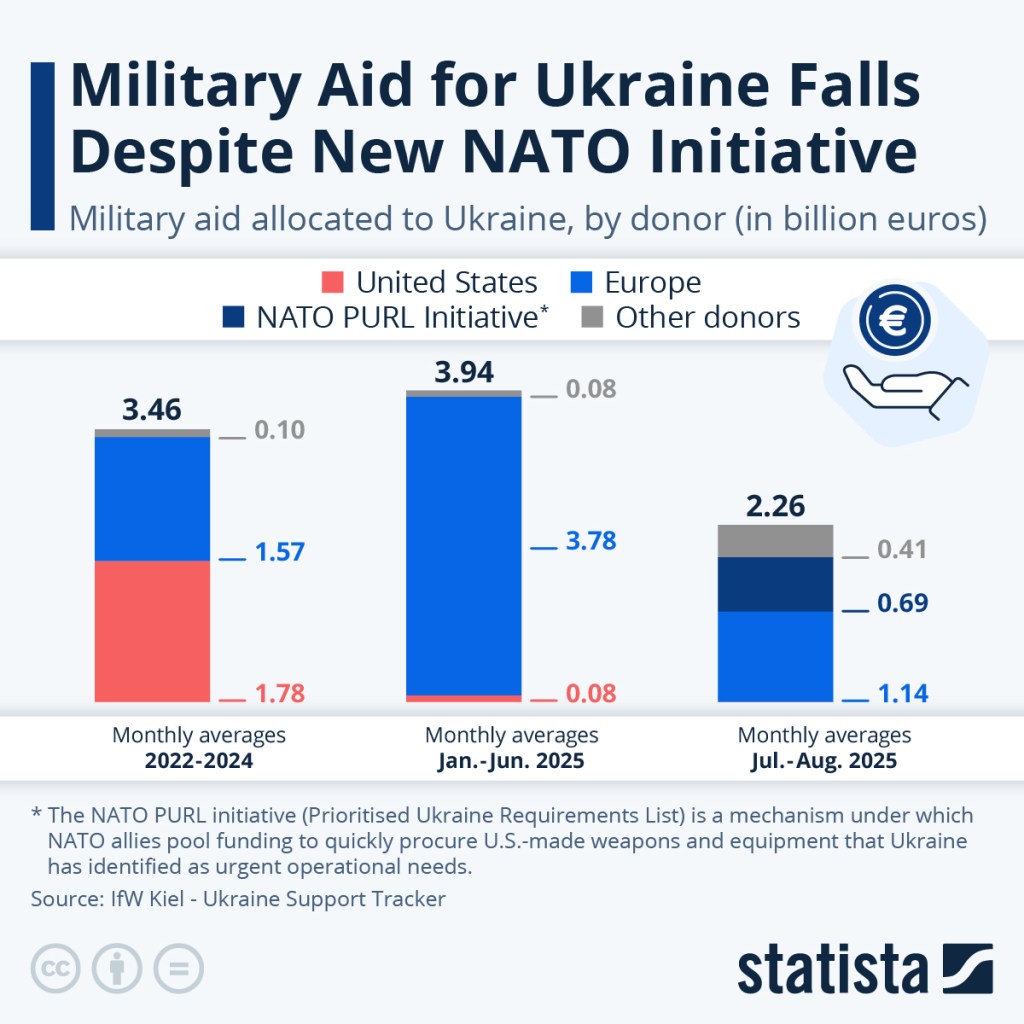
As European policy makers and defense industry leaders came together on Tuesday to discuss current and upcoming challenges at the fifth European Defence & Security Conference in Brussels, the Kiel Institute for the World Economy published the latest update of its Ukraine Support Tracker. The researchers, who have been tracking aid to Ukraine since Russia’s invasion in February 2022, found that military aid to Ukraine dropped sharply in July and August compared to previous months, despite the implementation of the NATO PURL (Prioritized Ukraine Requirements List) initiative.
The program, devised by NATO Secretary General Mark Rutte and U.S. President Donald Trump in July, enables NATO allies to fund the acquisition of “ready-to-use” weapons from U.S. stockpiles for Ukraine, potentially fast-tracking the supply of urgently needed military equipment to the country. By August, eight NATO countries, namely Belgium, Canada, Denmark, Germany, Latvia, the Netherlands and Sweden had made use of the new mechanism, providing a total of €1.9 billion in funding. And yet, total military aid to Ukraine declined significantly in July and August, falling 43 percent compared to the monthly average in the first six months of 2025.
In the first half of 2025, Europe had ramped up its contributions significantly to make up for the suspension of U.S. military aid. This momentum didn’t carry into July and August, however, when European aid fell more than 50 percent, even when accounting for Europe’s contributions to the NATO PURL program. “The decline in military aid in July and August is surprising,” Christoph Trebesch, head of the Ukraine Support Tracker and Research Director at the Kiel Institute, said in a statement. “The overall level of financial and humanitarian support has remained comparatively stable – even in the absence of U.S. contributions,” Trebesch noted. “It is now crucial that this stability extends to military support as well, as Ukraine relies on it to sustain its defense efforts on the ground.”
VOLODYMYR MYKOLAYENKO is 65, but looks ten years older. A former mayor of the Ukrainian city of Kherson, he was detained by Russian forces during their eight-month occupation in 2022. Freed at the end of August, he is now giving interviews from a hospital in Kyiv. And that is refocusing attention on what the UN’s human-rights mission in the capital calls Russia’s “systematic and widespread” torture and ill-treatment of its prisoners.
Civilian and military detainees are treated equally badly. According to a UN report last month, of 216 released civilians it interviewed 92% gave accounts of abuse. The methods included beatings, electric shocks, stress positions, ritual humiliation and rape. For soldiers the percentage is even higher. Mr Mykolayenko describes being beaten several times a day, and particularly severe “welcome beatings” each time he was transferred to a new facility. Food was so poor that he and his fellow prisoners lost drastic amounts of weight, and sanitary conditions so bad that many caught scabies. The only dental treatment he saw, once in the three years, was a tooth-pulling without anaesthetic. One guard, he says, made a practice of beating prisoners’ hands with a mallet. “Once I asked him ‘Why are you doing this?’ For a reply, I got a beating on the head.”
Singled out for particularly brutal treatment are members of one of Ukraine’s most prestigious military units, the Azov Corps. A 26-year-old junior lieutenant in the corps, Yan Danylko, was released earlier this year. Halfway through a masters degree in law when Russia launched its invasion, he signed up and took part in the battle for Mariupol, surrendering when the city fell after a three-month siege. During his three years in Russian captivity he lost a third of his weight. Standard abuses were beatings and being made to stand for 12 hours at a stretch; more elaborate positions included “the motorcycle” and “the starfish”, both unendurable for more than 20 minutes. For those who signed confessions or turned informer he has no blame: “You’ll do what they want you to do, sign what they want you to sign.”
A new development is the prosecution of Azov prisoners for membership of a terrorist organisation, Russia having so designated the unit in 2022. Nestor Barchuk, a human-rights lawyer with the corps, says at least 130 men have been given sentences of ten years or more, and that dozens more are under investigation.
Can anything be done? Russia is immune to shaming, and its own internal checks are a joke. Lieutenant Danylko describes a visit by a Russian ombudsman, when he and his fellow prisoners were given new uniforms, and better food on ceramic instead of aluminium plates. A TV crew filmed handouts of biscuits and warm clothes. “That evening they took everything away again. It was a one-day Potemkin show.” If anything, detainees’ treatment is worsening as they are dispersed to distant regions. (The UN has identified new detention sites in Siberia and Karelia.) Loudly as the outside world protests against Russia’s flouting of human-rights law, Ukraine’s only lever is prisoner exchanges. Swaps are proceeding in dribs and drabs, but Ukraine is on the defensive, so large-scale captures are unlikely soon.
Today, Lieutenant Danylko is getting used to a prosthetic leg. Still painfully thin, Mr Mykolayenko says he is trying to blot out his three years in captivity. Thinking about them is “worse than the worst horror film”. He is nonetheless giving interviews because “it’s important that people understand what they are dealing with. The biggest lesson I have learned is that you can’t negotiate with evil. And Russia is evil.” It is hard to find a Ukrainian who disagrees.
Source: “Russia is torturing its Ukrainian captives,” The Economist, 9 October 2025
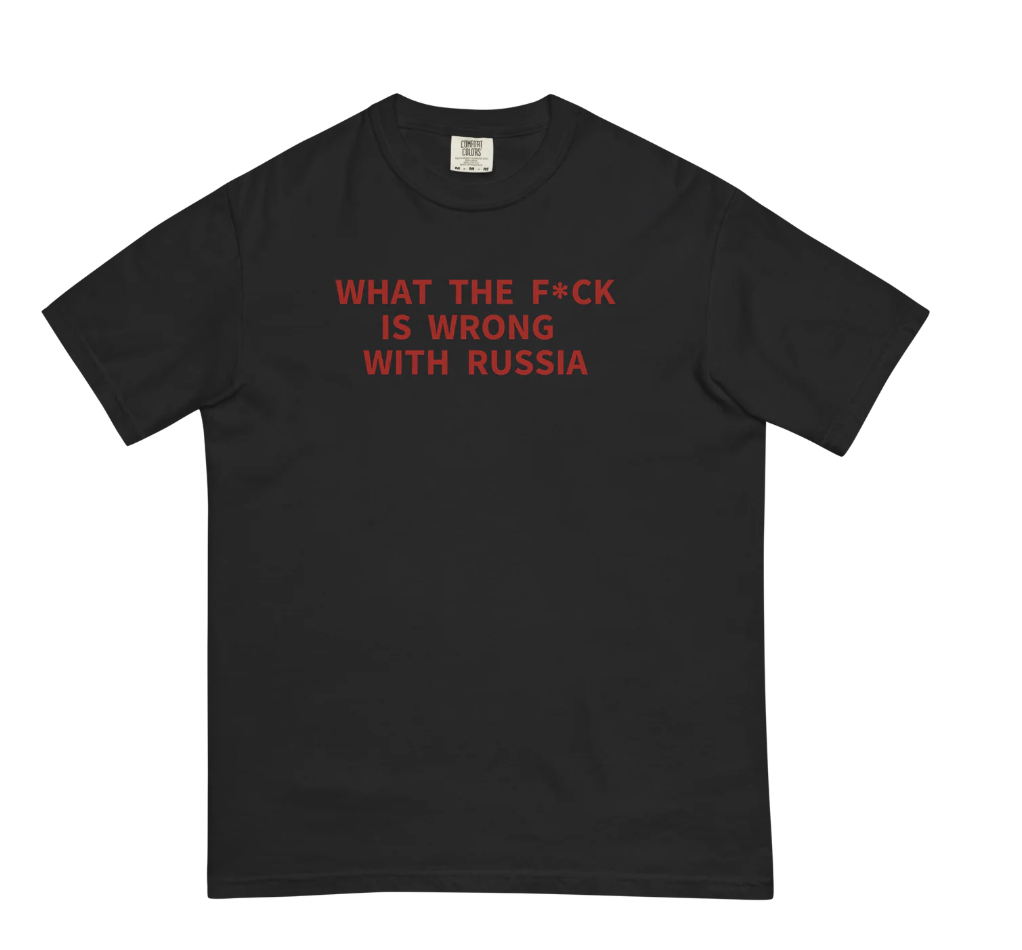
“What the f*ck is wrong with Russia?” is a question we keep asking ourselves here in Ukraine. How does a nation justify brutally invading its neighbor? How does a government convince its people that imperial conquest and war crimes are acceptable in the 21st century?
Comprehending Russia — its politics, history, and culture — is crucial to understanding why this war continues and how it might end, both for Ukraine and the world. That’s why the Kyiv Independent launched the newsletter “WTF is wrong with Russia?” — to explain Putin’s regime, the forces that drive Russian aggression, and the historical context behind today’s headlines. With our new T-shirt, you can support the “WTF is wrong with Russia?” newsletter — and show the world that you want answers.
Members of the Kyiv Independent community get 15% off. Join our community here.
By purchasing this product, you directly support our independent journalism.
Source: The Kyiv Independent Store
In this week’s bulletin: The courtroom rebels standing up to warmonger Putin/ The price of Putin’s peace: patriotism for sale – the UK far right’s Russian connection / Crimea activist Volodymyr Ananiyev’s detention extended/ nationalisation of ‘assets’ in occupied Crimea/ Update from a drone workshop/
News from the territories occupied by Russia:
Symbolic `execution of enemies of Russia’ in a school in occupied Donetsk oblast (Kharkiv Human Rights Protection Group, October 10th)
Russia uses citizenship as a new weapon against dissidents in occupied Crimea (Kharkiv Human Rights Protection Group, October 10th)
Oct 10th – the birthday of Seydamet Memetov, prominent figure in the Crimean national movement (Crimea Platform, October 10th)
The nationalisation of ‘assets’ in the occupied Crimea. (Crimea Platform, October 10th)
Defence Intelligence of Ukraine publishes data on over 140 cultural artefacts stolen by Russia (Crimea Platform, October 9th)
Crimean Mission’s team participates in OSCE’s Human Dimension Conference in Warsaw. (Crimean Platform, October 8th)
Russians imprison two Crimean Tatar brothers on lawless charges, and move into one of their homes (Kharkiv Human Rights Protection Group, October 6th)
Doctor first abducted from occupied Donbas in 2015 sentenced to 15 years `for spying for Ukraine’ (Kharkiv Human Rights Protection Group, October 6th)
Uncle Vanya, Bison, San Sanych – who tortures Ukrainian prisoners of war? (Kharkiv Human Rights Protection Group, October 6th)
Detention extended for Crimean civil rights activist Volodymyr Ananiyev. (Crimean Human Rights Group, October 6th)
News from Ukraine:
Survey shows only half of Ukrainian refugees in Europe ready to return home after the war (The Insider, October 10th)
“Drones fly right above the stores”: Residents flee the border areas of Ukraine’s Dnipropetrovsk Region amid Russian advance (The Insider, October 10th)
Loss of close to 60% of Ukraine’s gas production a major blow to Ukraine before winter (The Insider, October 10th)
`I’m afraid I’ll be kidnapped and taken to Russia’ (Kharkiv Human Rights Prot’n Group, October 6th)
Ukraine’s voiceless army: Ukrainian deserters speak out (Anarchist Communist Group, Sept 30th)
News from the front:
`The Kremlin has resources’: Putin believes Russia can outlast and overpower Ukraine. What does that mean for the war’s future? (Meduza, October 10th)
A high stakes gamble: Ukraine has successfully slowed Russia’s advance in central Donbas – but at the cost of its defenses elsewhere (Meduza, October 6th)
War-related news from Russia :
Celebrated food historian jailed in Moscow over social media war posts (Mediazona, October 10th)
Russian losses in the war with Ukraine – count updated (Mediazona, October 10th)
The courtroom rebels standing up to warmonger Putin (People & Nature, 9 October)
Ukrainian in Russia for her brother’s funeral sentenced to 12 years for 16 donations to Ukraine’s armed forces (Kharkiv Human Rights Protection Group, October 9th)
War and wine – while Russia bleeds, Putin’s wine business is booming. (The Insider, October 6th)
Putin admits Russia downed Azerbaijan Airlines flight last year (Meduza, October 9th)
Russia’s growing wanted persons data base (Mediazona, October 9th)
A US court said I faced no danger back in Russia – now I face deportation (The Insider, October 9th)
`For the Defense ministry, people are garbage’. Why thousands of Russian soldiers are deserting (Meduza, October 8th)
Budget of mass destruction: VAT hike signals Russia’s course toward prolonged war and economic decline (The Insider, October 7th)
Putin’s war economy reaches limit according to 2026 budget data (Important Stories, October 2nd)
Army Contract and Draft: Russia’s new draft laws (Posle Media, October 1st)
Analysis and comment:
Hungarian PM launches petition against Brussels’ “war plan”, developed to back Ukraine (Ukrainska Pravda, October 12th)
Counting bodies, casting doubts independent Russian analysts dispute the reliability of alleged Russian casualties (Meduza, October 11th)
Russia on the horizon – copying the Kremlin’s tactics increasingly puts Tbilisi in Moscow’s orbit (The Insider, October 10th)
A Disappearing Act – Why Navalny’s memoir is missing 100 pages in the Russian edition. (Meduza, October 10th)
Blackouts, military nukes and drones – military expert Dimitry Kuznets explains the limitations of energy warfare (Meduza, October 10th)
The next chapter in Russia’s war against Ukraine: four scenarios (Meduza, October 9th)
Reform and the price of Putin’s peace: patriotism for sale – the UK far right’s Russian connection (Ukraine Solidarity Campaign, October 8th)
Research of human rights abuses:
100 children removed from occupied territories to near Moscow, for social and psychological adaptation. (Alterpravo, October 9th)
Human rights organizations warned at OSCE Conference of expanding system of persecution and indoctrination in occupied territories (Zmina, October 8th)
ZMINA highlights systematic attacks on media under Russia’s aggression at the OSCE Conference (Zmina, October 8th)
Human rights defenders list documented economic, social and cultural rights violations in occupied Ukrainian territories to the UN (Zmina, October 6th)
International solidarity:
Report on fundraiser for cars for international legion fighters (Solidarity Collectives, October 4th)
Report on the work of the FPV drone fundraiser and workshop (Solidarity Collective, October 4th)
Andrei Khrzhanovsky, Pro-Ukrainian Russian Israeli fighting for the rights of Palestinians (The Russian Reader, September 23rd)
Solidarity Zone Russian anti-war prisoners in the gulag (Solidarity Zone)
Upcoming events
Thursday 20 November, 6.30pm: Try Me for Treason – readings of speeches from Russia’s courts / Book launch for Voices against Putin’s war. Pelican House, 144 Cambridge Heath Road, London E1 5QJ. Ukraine Information Group.
==
This bulletin is put together by labour movement activists in solidarity with Ukrainian resistance. To receive it by email each Monday, email us at 2022ukrainesolidarity@gmail.com. More information at https://ukraine-solidarity.org/. We are also on Twitter, Bluesky, Facebook and Substack, and the bulletin is stored online here.
Source: News from Ukraine Bulletin 166 (13 October 2025)
Some Mariupol residents who lost their homes during Russia’s brutal 2022 takeover have only their keys left to remind them of their lives there.
That, and the label ‘homeless.’
Three years on, Moscow’s ‘reconstruction’ of the city is just a state-organized scheme to steal property and replace the city’s Ukrainian population with Russians.
The Counteroffensive can now reveal some of the inner workings of that scheme.
The plot is a fraud aimed at legitimizing the theft of Ukrainian property, and involves such tricks as changing the address so that original owners can’t claim they once lived there. As a result, property that Ukrainians have spent years paying off can easily fall into Russian hands.
On September 23, the occupation authorities of Mariupol marked three years since its illegal referendum, in which, according to their data, more than half of the residents voted to join Russia. Russian propaganda declares that the city is ‘flourishing’, but a look into the social media groups where the city’s residents discuss their daily problems proves otherwise.
The real estate scheme is just one small part of the Kremlin’s wider plan to erase Mariupol’s Ukrainian identity and replace its population with Russian citizens.
Prime mortgage rates are available to Russians who want to move to Mariupol, but not for its original residents. Putin even issued a decree granting payments to Russian citizens who relocate to stolen Ukrainian land for purposes including the reconstruction of infrastructure, or who sustain an injury during this process.
[…]
