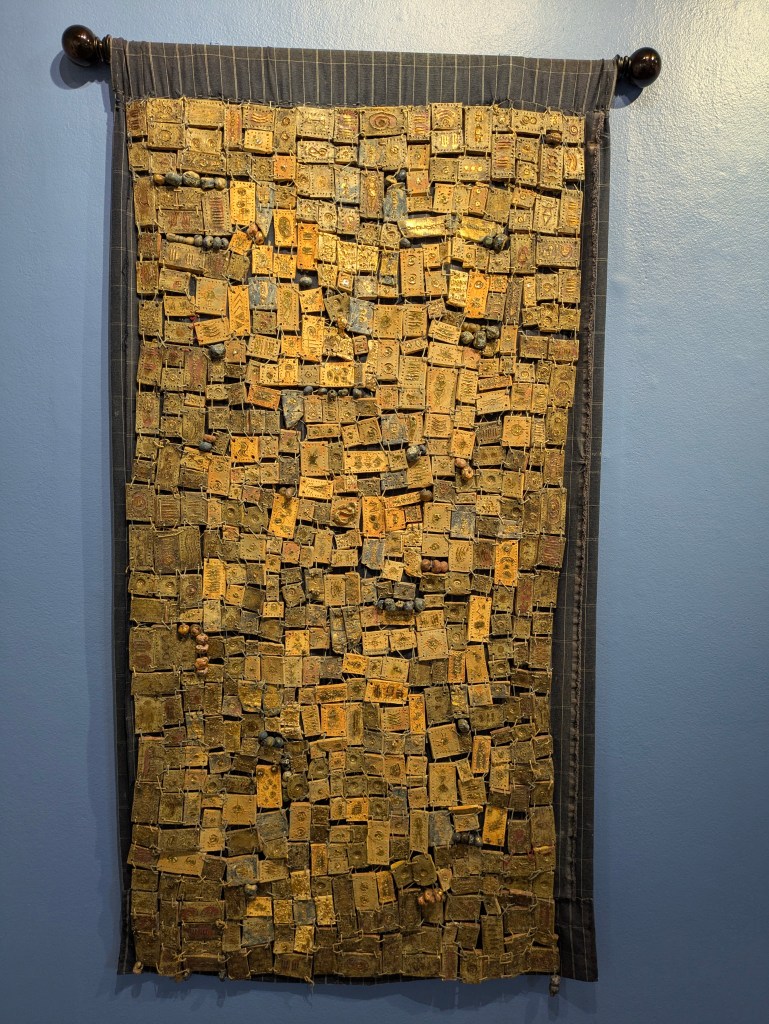
Coeleen Kiebert, Ode to the Women of Ukraine, May They Return to Quilt Their Beauty Again Soon, 2021. Ceramic, indigo linen. Pajaro Valley Arts, Watsonville, California, 26 April 2025. Photo by the Russian Reader
News from Ukraine Bulletin 144 (28 April 2025)
In this week’s bulletin: Solidarity With Ukraine conference speeches, reports and draft declaration/ Mobilise to free abducted children/ More evidence of Russian torture, targeting of civilians, abduction of children/ Putin’s foreign mercenaries
News from the territories occupied by Russia:
Donbas hostages savagely tortured for ‘confessions’ in 2019 sentenced in Russia to 24 years (Kharkiv Human Rights Protection Group, April 25th)
Huge sentences and videoed ‘repentance’ in Russia’s mounting terror in occupied Zaporizhzhia oblast (Kharkiv Human Rights Protection Group, April 24th)
“Relatives said: people like you should be killed.” The story of a woman who survived torture and fled occupied Mariupol twice (Ukrainska Pravda, April 24th)
Crimean resident jailed for “discrediting the Russian army” is freed (Crimea Human Rights Group, 23 April)
Crimean Tatar Mejlis rejects any international recognition of Crimea as Russian, chairman says (Kyiv Independent, April 22nd)
Horrific sentences demanded against five Ukrainians abducted from Russian-occupied Melitopol (Kharkiv Human Rights Protection Group, April 22nd)
The situation at the front:
The weekly war summary (The Insider, 26 April)
‘Wiping out neighborhood after neighborhood’ Russia pounds Ukraine’s Pokrovsk, forcing civilians to flee under fire. For many, it’s not the first time. (Meduza, April 21st)
News from Ukraine:
Russia returns body of abducted Ukrainian journalist Victoria Roshchyna with scars from torture (Kharkiv Human Rights Protection Group, April 25th)
Nine people killed and 42 injured in Russian drone attack on bus in Marhanets, Dnipropetrovsk Oblast – photos (Ukrainska Pravda, April 23rd)
‘Please don’t use my name’ A report by journalist Shura Burtin on the growing war weariness among Ukrainians (Meduza, March 27th)
War-related news from Russia:
Russia’s deserters: “A raging meat grinder” (Meduza, 24 April)
Despite Putin’s denials, Russia’s military has welcomed foreign mercenaries from at least 48 nations — (iStories, April 23rd)
Darya Kozyreva gets real prison term for Taras Shevchenko poem and opposition to Russia’s war against Ukraine (Kharkiv Human Rights Protection Group, April 22nd)
The Lost Army: War veterans could pose a problem for Putin’s Russia, just like they did for interwar Germany (The Insider, April 21st)
Olga Menshikh: “A Society Sick with Fear Cannot Be Happy” (Russian Reader, April 20th)
Analysis and comment:
What Trump’s plan might look like, in maps (Meduza, 24 April)
Russia’s selective ‘terrorism’ in war against Ukraine and in fraternizing with the Taliban (Kharkiv Human Rights Protection Group, April 23rd)
In memory of Cooper Andrews, Finbarr Cafferkey and Dmitry Petrov (Solidarity Collectives, 19 April)
Research of war crimes and human rights abuses:
Meeting with Representatives of Ukrainian Roma in Brussels (Kharkiv Human Rights Protection Group, April 25th)
Experts of the Committee on the Elimination of Racial Discrimination Commend Ukraine’s Presence Despite the Prevailing Circumstances, Raise Questions on the Treatment of Ukraine’s Indigenous Peoples and the Roma Population (UNHCR, April 24th)
A reliable tool in the hands of human rights defenders: how the KHPG database works (Kharkiv Human Rights Protection Group, April 23rd)
International solidarity:
Mobilise to free the Ukrainian children abducted by Russia (Labour Hub, April 27th)
“My soul is in this project of ours” (Solidarity Zone, 24 April)
Building Global Solidarity with Ukraine (Ukraine Solidarity Campaign, April 23rd)
Justice without borders: the ZMINA and TDC advocacy trip to Chile (Zmina, April 18th)
Free Denys Matsola and Vladyslav Iskra Zhuravlov (Solidarity Collectives, 16 April)
Solidarity With Ukraine conference in Brussels, 26-27 March. Contributions here, media coverage here, draft conference declaration here, with call for amendments
Upcoming events:
Wednesday 7 May, 3 – 5pm, War and Peace in Ukraine, Clerici Building G.21, Headington Campus, Oxford Brookes University, Oxford.
Sunday 1 June, 1.0pm, Marble Arch, London, March for the children of Ukraine
This bulletin is put together by labour movement activists in solidarity with Ukrainian resistance. To receive it by email each Monday, email us at 2022ukrainesolidarity@gmail.com. To stop the bulletin, reply with the word “STOP” in the subject field. More information at https://ukraine-solidarity.org/. We are also on Twitter, Bluesky, Facebook and Substack, and the bulletin is stored online here.
Source: Ukraine Information Group
KYIV, Ukraine (AP) — A peace proposal by the Trump administration that includes recognizing Russian authority over Crimea shocked Ukrainian officials, who say they will not accept any formal surrender of the peninsula, even though they expect to concede the territory to the Kremlin, at least temporarily.
Giving up the land that was illegally annexed by Russia in 2014 is also politically and legally impossible, according to experts. It would require a change to the Ukrainian constitution and a nationwide vote, and it could be considered treason. Lawmakers and the public are firmly opposed to the idea.
“It doesn’t mean anything,” said Oleksandr Merezkho, a lawmaker with Ukrainian President Volodymyr Zelenskyy’s party. “We will never recognize Crimea as part of Russia.”
Unlike a territorial concession, a formal surrender would permanently relinquish Crimea and abandon the hope that Ukraine could regain it in the future.
The Ukrainian public largely understands that land must be ceded as part of any armistice because there is no way to retake it militarily. Polls indicate a rising percentage of the population accepts such a trade-off.
But much of the public messaging about land concessions has suggested that they are not necessarily permanent, as when Kyiv Mayor Vitalii Klitschko told the BBC recently that Ukraine may need to temporarily give up land as part of a peace deal.
Saying otherwise would effectively admit defeat — a deeply unpopular move, especially for Ukrainians living under Russian occupation who hope to be liberated and reunited with their families one day. It also would call into question the sacrifices made by tens of thousands of Ukrainian service members who have been killed or wounded.
U.S. President Donald Trump underscored the Crimea proposal in an interview published Friday in Time magazine: “Crimea will stay with Russia. Zelenskyy understands that, and everybody understands that it’s been with them for a long time.”
Asked by reporters on Sunday if Zelenskyy was ready to give up Crimea, Trump said, “Oh, I think so. Crimea was 12 years ago. That was President Obama that gave it up without a shot being fired.”
His comments offered the latest example of the U.S. leader pressuring Ukraine to make concessions to end the war while it remains under siege. Trump has also accused Zelenskyy of prolonging the war by resisting negotiations with Russian President Vladimir Putin.
Crimea, a strategic peninsula along the Black Sea in southern Ukraine, was seized by Russia years before the full-scale invasion that began in 2022. The Russian takeover followed large protests that ousted former Ukrainian President Viktor Yanukovych, who had refused to sign an association agreement with the European Union.
In the lead-up to peace talks, Ukrainian officials told the Associated Press for months that they expect Crimea and other Ukrainian territory controlled by Russia to be among Kyiv’s concessions in the event of any deal. But Zelenskyy has said on multiple occasions that formally surrendering the land has always been a red line.
Elements of Trump’s peace proposal would see the U.S. formally recognizing Crimea as Russian and de facto accepting Moscow’s rule over occupied Ukrainian territories, according to a senior European official who spoke on condition of anonymity to discuss sensitive diplomatic discussions.
Whether the U.S. formally recognizes Crimea as Russian is out of Zelenskyy’s hands. But many obstacles prevent the Ukrainian president from doing so, even under immense pressure. He cannot unilaterally sign any such proposal, and he could be reprimanded by future governments for even attempting it, experts said.
Ukraine began to accept that it would not regain its lost territories after the failure of the country’s 2023 summer counteroffensive. From then on, the Ukrainian military concentrated on defending the territory it still held.
In return for territorial concessions, Ukraine wants robust security guarantees that ideally would include NATO membership or concrete plans to arm and train its forces against any future Russian invasion with the pledged support of allies. One scenario envisions European boots on the ground, which Russia rejects.
Zelenskyy has said negotiations over occupied Ukrainian territory will be drawn out and will not likely occur until a ceasefire is in place. In late March, he told reporters after a call with Trump that the U.S. president “clearly understands that legally we will not recognize any territories.”
He said giving up territory would be “the most difficult question” and “a big challenge for us.”
Formal recognition of Crimea would also amount to political suicide for Zelenskyy. It could expose him to legal action in the future, said Tymofiy Mylovanov, president of the Kyiv School of Economics and a former economics minister.
Signing a potentially unconstitutional document could be interpreted as high treason, Mylovanov said.
The Ukrainian government cannot act either. It has no constitutional means to accept a violation of its territorial integrity, and altering the territorial makeup of the country requires a nationwide referendum.
If Ukrainian lawmakers were even to entertain the idea of surrendering Crimea, it would trigger a long, drawn-out legal debate.
“That’s why Russia is pushing it, because they know it’s impossible to achieve,” Mylovanov said.
“Anything related to constitutional change gives so much policy and public communication space to Russia,” he added. “This is all they want.”
Soldiers on the front line say they will never stop fighting, no matter what the political leadership decides.
“We lost our best guys in this war,” said Oleksandr, a soldier in the Donetsk region, who spoke on the condition that only his first name be used in line with military protocols. “We won’t stop until all Ukrainian lands are free.”
Source: Samya Kullab, “Shocked by US peace proposal, Ukrainians say they will not accept any formal surrender of Crimea,” Associated Press, 27 April 2025. The emphasis is mine — TRR.

Coeleen Kiebert, Ode to the Women of Ukraine, May They Return to Quilt Their Beauty Again Soon, 2021 (detail). Pajaro Valley Arts, Watsonville, California, 26 April 2025. Photo by the Russian Reader
