
In documents released by the U.S. Department of Justice in the case of Jeffrey Epstein, who was accused of sexually trafficking minors, the Faculty of Liberal Arts and Sciences of St. Petersburg State University [aka Smolny College] is mentioned about thirty times.
Bumaga has examined some of the so-called Epstein files. Read how the American was invited to the graduation ceremony at Smolny and how the financier himself recommended the Petersburg university to fashion models.
How Epstein was invited to a graduation ceremony at St. Petersburg State University
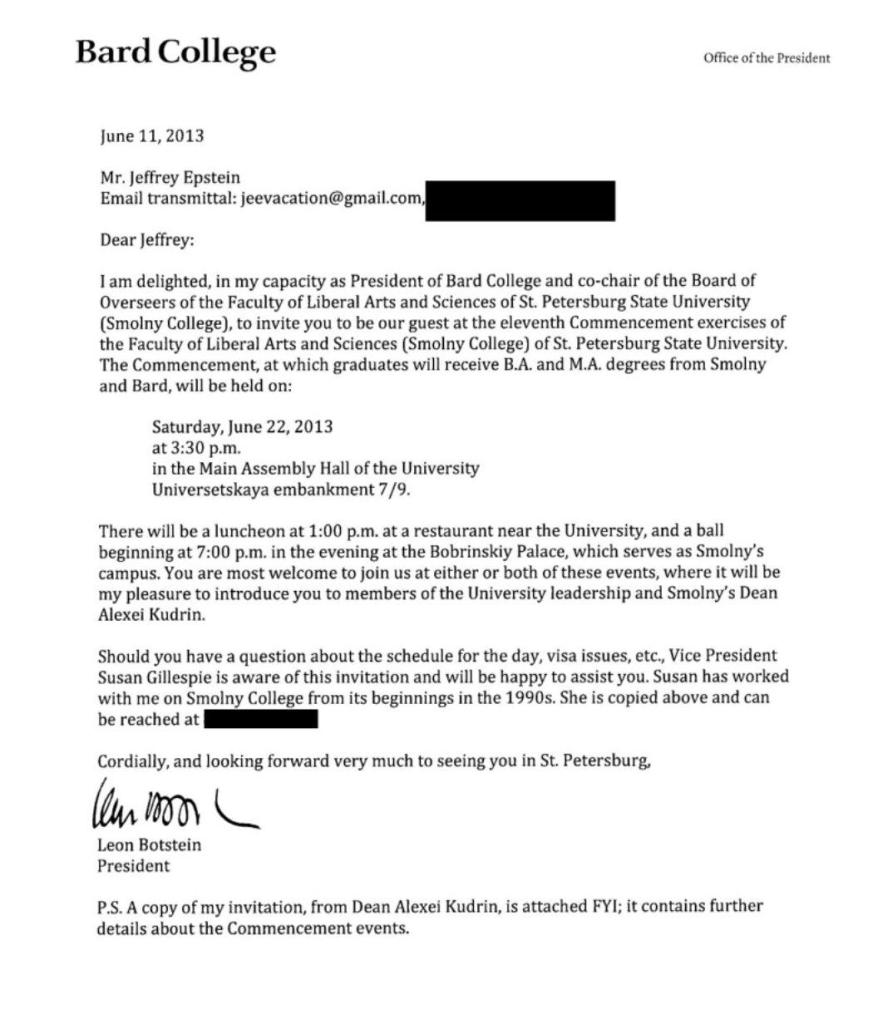
In May 2013, Alexei Kudrin, then dean of the Faculty of Liberal Arts and Sciences, sent an invitation to Leon Botstein, president of Bard College, to attend the graduation ceremony. Botstein, in turn, invited Jeffrey Epstein to accompany him to Petersburg. Faculty co-founder Valery Monakhov also emailed an invitation to the American financier to visit St. Petersburg State University.
The program included an official ceremony in St. Petersburg State University’s auditorium on University Embankment and a ball at the Bobrinsky Palace [the home of Smolny College]. During the graduation ceremony, Leon Botstein planned to introduce Epstein to Kudrin, who was not only the head of the faculty but also a former Russian finance minister. The financier himself had already been convicted of trafficking minors.
Epstein never went to St. Petersburg State University, however: his assistant, Lesley Groff, responded to the invitations by saying that her boss was busy.
How Epstein partly financed Bard College
Bard College is a private tertiary educational institution in the United States that collaborated with St. Petersburg State University for over twenty years. The Faculty of Liberal Arts and Sciences was established with its involvement. The collaboration continued until 2021, when Bard College was declared an “undesirable organization” in Russia. The Russian Prosecutor General’s Office declared that the work of the university “poses a threat to the foundations of the constitutional order and security.” Russian academics and artists decried the sanctions against the college as yet another blow to research and education in Russia.
In 2023, Wall Street Journal reporters revealed that, in 2016, Epstein had donated $150,000 to Bard College President Leon Botstein and transferred $270,000 for Professor Noam Chomsky. Epstein had previously donated funds to the college on several occasions, including $75,000 in 2011.
According to media reports, Bard College scholars met with Epstein on several occasions after the financier was charged with soliciting prostitution from minors in 2008.
Meanwhile, according to journalists, Botstein sat on the advisory board of Epstein’s foundation. The president of Bard College, however, has claimed that he did not perform any work for the foundation.
How Epstein advised young female models to apply to Smolny
The Faculty of Liberal Arts and Sciences—Smolny College—appears several times in Epstein’s correspondence with women who mention that they work in the modeling business. We do not know whether Epstein was corresponding with one young woman or several. The names of potential victims have been redacted in most of the files.
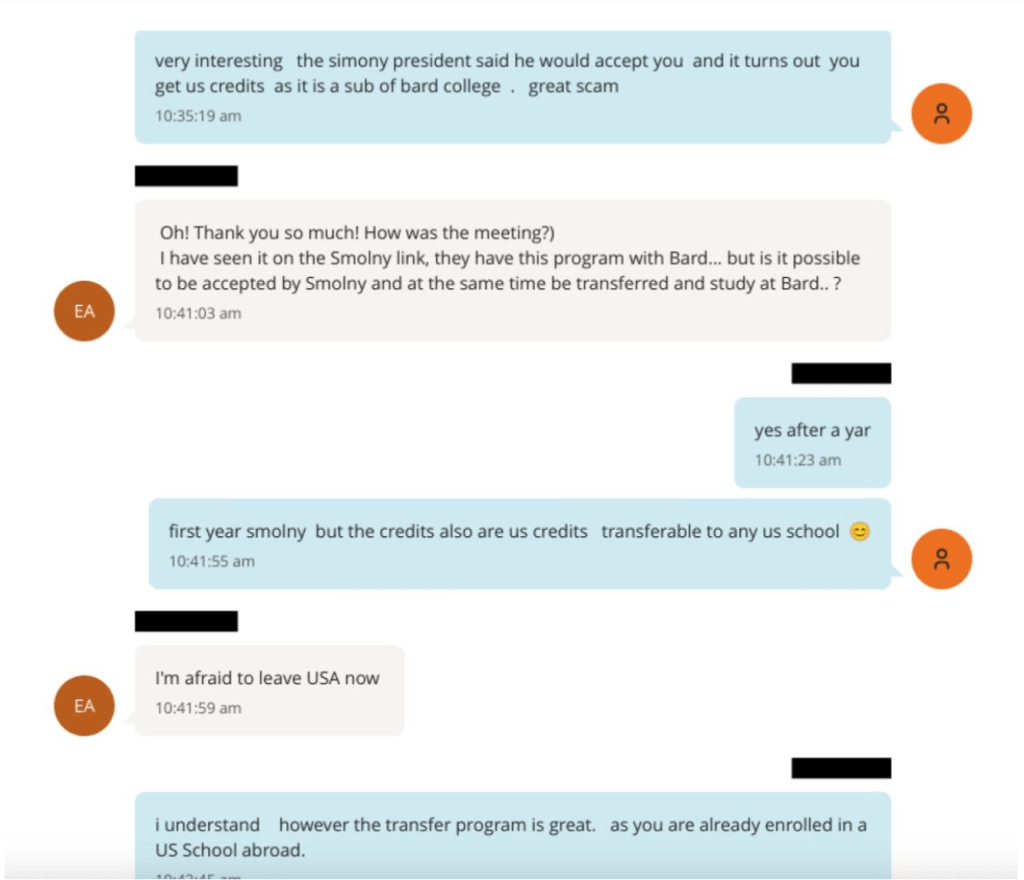
In 2018, Epstein met with the “President of Smolny” (whether this was Alexei Kudrin or officials at Bard College is not known) to discuss the process of applying to St. Petersburg State University and subsequently transferring to Bard College.
Epstein then counseled his female acquaintance as follows:
“first year smolny but the credits are us credits transferable to any us school,” he writes.
“I’m afraid to leave USA now,” she replies.
“I understand however the transfer program is great,” he writes.

Epstein also sent links to Smolny’s programs to a model in 2019. He had invited his correspondent to visit him in Paris, while the young woman suggested they sleep together that night. “you can visit for 30 minutes. I want to know more about university desire , I will let you go early to get some sleep,” Epstein replied.
In 2018, a young Russian woman named Anna is mentioned in Epstein’s online correspondence. The financier tried to connect her with his acquaintances from Bard College so that they could “help her make a decision about Smolny.” Epstein’s assistants booked tickets for the young woman to Paris, Tel Aviv, and the United States.
Bumaga noticed that the information about Anna as contained in the correspondence coincides with the biographical details of a model from Petersburg. Judging by the young woman’s age, she was not a minor at the time of her interactions with Epstein. In 2017–2019, photos taken in France and Israel appeared on her social media pages. Her name was not subsequently mentioned on the websites of the Faculty of Liberal Arts and Sciences or Bard College.
Anna had not responded to our message by the time this article was published.
Who was Epstein and how else is Petersburg mentioned in his case files?
Jeffrey Epstein was a former mathematics teacher and billionaire who had close ties to the world’s political, business, and academic elites. Epstein was the central figure in one of the most high-profile criminal cases of the twenty-first century after he was charged with sexually exploiting and trafficking minors. The American was first convicted in 2008 under a lenient plea bargain deal with prosecutors, but he was re-arrested on federal charges in 2019. Epstein died in prison shortly after his arrest. His death was ruled a suicide, but the official account is still a matter of controversy in the U.S.
The documents published by the U.S. authorities on the Epstein case contain mentions of world leader and other influential figures, including U.S. President Donald Trump and billionaire Elon Musk. However, the fact that individuals are mentioned in the files does not imply that there are grounds for charges against them.
Petersburg is mentioned over a thousand times in the released files. Earlier, Bumaga reported that, between 2014 and 2016, Epstein corresponded and met with Sergei Belyakov, former Deputy Minister of Economic Development and Chairman of the Board of the St. Petersburg International Economic Forum (SPIEF).
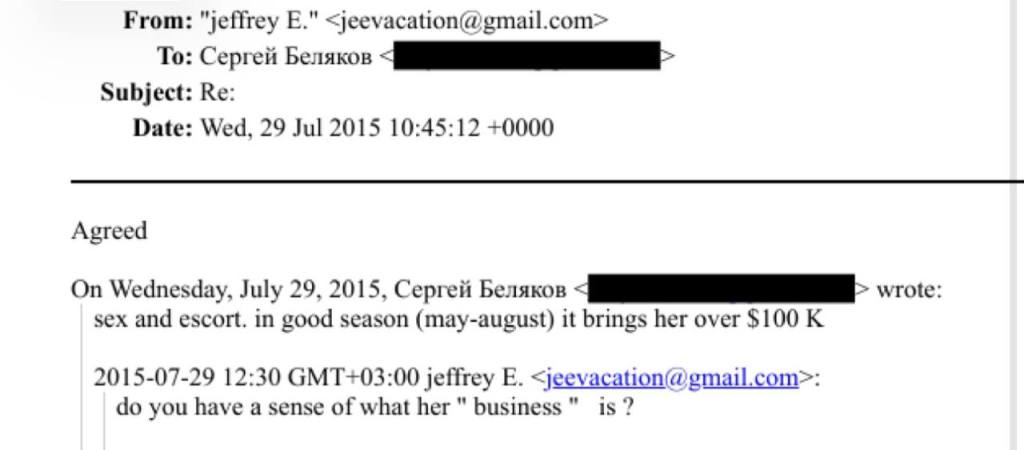
In July 2015, at Epstein’s request, Belyakov made inquiries into a certain young woman from Moscow who was allegedly attempting to blackmail businessmen in New York. Belyakov set about his search for information without asking any questions and, a couple of days later, replied that the Russian woman in question was working as an escort and, during the peak season from May to August, earned more than $100,000.
According to the Dossier Center, the woman in question was a model named Guzel [Ganieva] who in March 2021 accused American billionaire Leon Black of coercing her into performing sadistic sexual acts. Guzel claimed that Black had introduced her to Epstein and tried to force her to have sex with “his best friend,” but the Russian woman refused.
Epstein also assisted Belyakov with organizing SPIEF 2015 and the Open Innovations Forum. The American financier did not attend the economic forum himself, but he introduced [link not functioning currently] Belyakov to former Israeli Prime Minister Ehud Barak, who ended up appearing SPIEF 2015.
Epstein also suggested “dream attendes” for the forums to Belyakov and promised to provide contact information for former Microsoft chief technology officer Nathan Myhrvold, LinkedIn co-founder Reid Hoffman, and PayPal co-founder Peter Thiel. The meeting with the latter took place only in 2016.
In April 2018, Belyakov also planned to send a letter to the Russian consulate in New York requesting that Epstein be granted a three-year visa to Russia.
Belyakov is currently the president of the Association of Nongovernmental Pension Funds. He declined our request for a comment.
Source: “Epstein and the Faculty of Liberal Arts: how a financier accused of sex trafficking and sexual abuse of minors is linked to Smolny,” Bumaga, 3 February 2026. Translated by the Russian Reader
What if Jeffrey Epstein’s influence wasn’t just about sex trafficking scandals but part of a broader far‑right agenda to destabilize democratic institutions worldwide? In this explosive video, we break down the latest revelations from the Epstein Files and explore how his network may have intersected with powerful right‑wing actors, online extremists, and political operatives. Investigative journalist Ryan Broderick joins us to unpack the latest revelations from the Epstein Files, revealing how his network intersected with powerful political actors, extremists, and online operators.