Everyone Wants to Like and Be Liked

Mail.ru Group Speaks Out against Punishments for Likes and Reposts
Company Proposes Changing the Law and Law Enforcement Practice
Olga Churakova and Yekaterina Bryzgalova
Vedomosti
August 6, 2018

Mail.ru Group не раз критиковала громкие законодательные инициативы, касающиеся интернетаMail.ru Group has repeatedly criticized high-profile law bills and laws affecting the internet. Photo by Yevgeny Yegorov. Courtesy of Vedomosti

Mail.ru Group, which owns the largest social networks in Russia, VK and Odnoklassniki [“Classmates”], has harshly condemned the practice of filing criminal charges against social media users for likes and reposts on social networks.

“Often the actions of law enforcement authorities have been clearly disproportionate to the potential danger, and their reaction to comments and memes in news feeds are inordinately severe,” reads a statement on the company’s website. “We are convinced laws and law enforcement practices must be changed. We believe it necessary to grant amnesty to people who have been wrongly convicted and decriminalize such cases in the future.”

Recently, the number of convictions for posts and reposts on social networks has reached a critical mass, explained a Mail.ru Group employee. Most of the convicitions are not only unjust but also absurd. He would not explain what specific corrections the company was going to propose.

“We believe current laws need to be adjusted, and we are going to make pertinent proposals,” VK’s press service told Vedomosti.

Mail.ru Group has repeatedly criticized high-profile laws and law bills affecting the internet. In 2013, for example, the company opposed an anti-piracy law. In 2015, it teamed up with Yandex to criticize the “right to be forgotten” law. In 2016, it opposed a law bill that proposed regulating messengers and search engines.  But punishing people for likes and reposts has become a political issue. Members of the opposition and social activists have often been the victims of Criminal Code Article 282, amended in 2014 to allow prosecution of people for incitment to hatred or enmity while using the internet.

Communist Party MP Sergei Shargunov addressed the problem during the President’s Direct Line in June of this year.

“If Article 282 were taken literally, certain zealots would have to convict Pushkin, Tolstoy, Dostoevsky, and Mayakovsky, and have their works removed,” he said.

Putin agreed it was wrong to reduce such cases to absurdity. Subsequently, he tasked the Russian People’s Front (ONF) and the Prosecutor General’s Office with analyzing how the notions of “extremist community” and “extremist crime” were employed practically in law enforcement.

fullscreen-1tgt

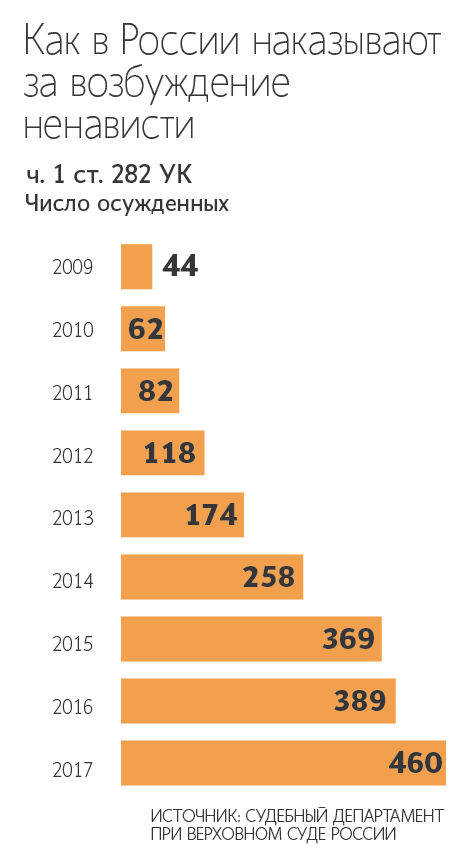
“Prosecutions for Incitement to Enmity (Criminal Code Article 282 Part 1) in Russia. Numbers of People Convicted, 2009–2017. Source: Trials Department, Russian Supreme Court.” Courtesy of Vedomosti

An Agenda for the Autumn
On June 25, Shargunov and Alexei Zhuravlyov, leader of the Rodina [“Motherland”] party, tabled draft amendments in the Duma that would decriminalize “extremist” likes and reposts. The MPs proposed transferring the violation described in Criminal Code Article 282 Part 1 to the Administrative Offenses Code, where infractions would be punishable by a fine of up to 20,000 rubles or 15 days in jail, while leaving only Part 2 of Article 282 in the Criminal Code. Part 2 stipulates a punishment of up to six years in prison for the same actions when they are committed with violence, by a public official or by an organized group. The government, the Supreme Court, and the State Duma’s legal department gave the draft amendments negative reviews, pointing out that the grounds for adopting them were insufficient. A spokesman for Pavel Krasheninnikov, chair of the Duma’s Committee on Legislation, informed us the committee would start working on the amendments when MPs returned from summer recess.

The ONF, which held a meeting of experts in July, has begun drafting a report for the president. The legal community, the General Prosecutor’s Office, the Interior Ministry, telecommunications watchdog Roskomnadzor, and the Russian Supreme Court must send their proposals to the Kremlin’s control directorate before September 15.

Leonid Levin, chair of the State Duma’s Committee on Information Policy, agreed there was a problem.

“The law is repressive, and there is no misdemeanor offense, although the Supreme Court issued an opinion that different cases should not be treated identically,” he said.

While there has been no lack of proposals, no one is in a hurry to abolish the law completely. A source in the Kremlin said dissemination of prohibited information should be punished. But a way of relaxing the law must be devised and, most important, a means of avoiding random convictions, he added.

A Demand for Liberalization
Recently, VK had been under pressure from the public due to the huge number of criminal prosecutions for posting pictures and reposts, said Pavel Chikov, head of the Agora International Human Rights Group. He argued the statement issued by Mail.ru Group was an attempt to defend the company’s reputation. According to the so-called Yarovaya package of amendments and laws, since January 1, 2018, VK has been obliged to provide law enforcement agencies with information about its users upon request, but the question of the legality of providing information having to do with people’s private lives remains open, since under Russian law a court order is required for this, Chikov noted.

Political scientist Abbas Gallyamov argued political decentralization and moderate opposition were now fashionable.

“Even the most cautious players sense the dictates of the age and have been trying to expand the space of freedom. Mail.ru Group is trying to be trendy,” he said.

Gallyamov predicted that, as the regime’s popularity ratings decline, the screws would be loosened, and the number of people advocating liberalization would grow.

Part of the political elite realizes many things have gone askew, agreed political scientist Alexander Kynev. A number of people hoped the circumstances could be exploited to push the idea of moderate liberalization. This could be a way of showing the regime was ready to talk, he argued.

“A lot will depend on what the autumn brings, on the results of regional elections. Now it would appear to be a topic that is up for discussion, but there are no guarantees. There are people in the government interested in having the topic discussed, but this doesn’t mean a decision has been taken,” Kynev said.

Translated by the Russian Reader

Orthodoxy or Death

Russian MP Vitaly Milonov. Photo courtesy of @Fake_MIDRF

Chuvashia Resident Fined for Reposting Photo of Milonov
Maria Leiva
RBC
November 16, 2016

A member of the board of Open Russia from Chuvashia has been fined 1,000 rubles for reposting a photograph of Russian MP Vitaly Milonov in which he is posed in a t-shirt brandishing a slogan deemed extremist in Russia

A court in Chuvashia has fined Dmitry Semyonov, a member of Open Russia‘s board in the region, 1,000 rubles for reposting a photo of MP Vitaly Milonov in a t-shirt emblazoned with the slogan “Orthodoxy or Death” on the social media network VKontakte. The slogan has been ruled an incitement to sectarian strife and placed on the federal list of extremist matter. Semyonov’s lawyer, Alexei Glukhov, reported the news on his Facebook page.

In another post, he added that the court had reject the defense’s motion to order a forensic examination and summon specialists to confirm the date when the Internet had been monitored.

Last week, Semyonov was summoned by the police over the repost of Milonov’s photograph. As the activist told RBC himself, he was charged in writing with violating Article 20.29 of the Administrative Offense Codes (producing and disseminating extremist matter).

“The charge sheets say that, on November 3, FSB officers suddenly felt like monitoring social media networks and chanced upon my post,” said Semyonov.

He linked the incident to his work as a social and political activist with Open Russia. Semyonov is the organization’s regional coordinator in eight Russian regioins.

In turn, Glukhov told RBC that police in Chuvashia constantly haul in activists for reposts on social media.

In conversation with RBC, Milonov said that last Wednesday he had sent a letter to the Justice Ministry asking them to remove the slogan from the register of extremist matter, but had not yet received a reply.

“As one brother to another, I’ll tell the justice minister, ‘Do you really imagine living outside the faith? So it’s a normal Orthodox slogan, and anyone who thinks otherwise is a bastard,” said the MP.

He was confident the slogan would soon be removed from the list of extremist matter, but promised to study Semyonov’s case more closely, “although membership in Khodorkovsky’s organization deserves attention itself.”

Earlier, Milonov told RBC that he did not consider displaying a photograph in which he posed with the slogan “Orthodoxy or Death” a crime. However, the MP doubted that Semyonov was being prosecuted solely over the photograph.


Translated by
A Loaf of Bread

Be Kind, Don’t Repost 2: Blessed Are the Ice Hole Bathers

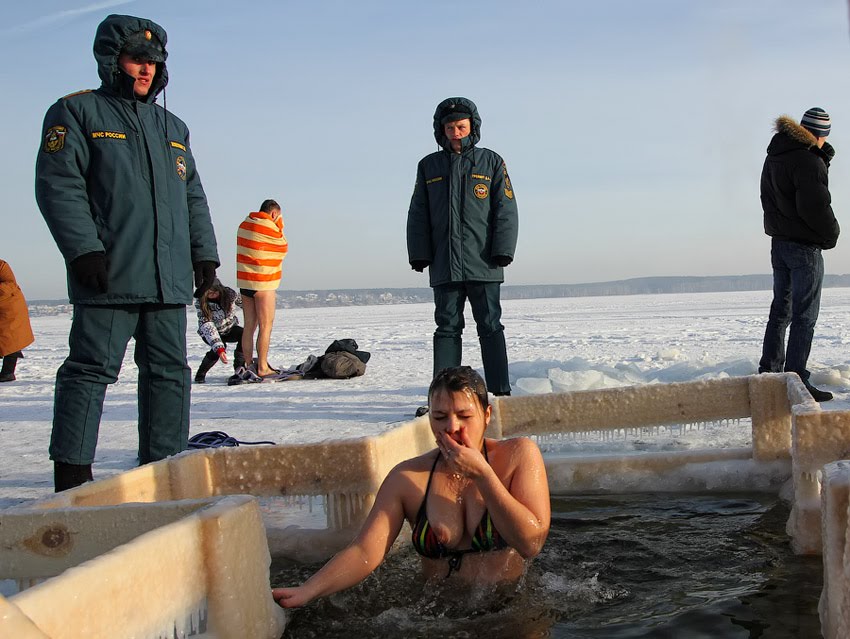
Epiphany ice hole bathing on Lake Shartash in Yekaterinburg, January 2012
Epiphany ice hole bathing on Lake Shartash in Yekaterinburg, January 2012. Officers from the Emergency Situations Ministry (EMERCOM) stand watch.

Berdsk Resident Sentenced to One Year, Three Months in Work-Release Penal Colony for Commenting on Ice Hole Bathing
Mediazona
May 31, 2016

The Berdsk City Court in Novosibirsk Region has sentenced local resident Maxim Kormelitsky, charged with extremism, to one year and three months in a work-release penal colony, reports Radio Svoboda.

Maxim Kormelitsky was accused of posting a captioned pictured on his personal page in the Vkontakte social network. According to police investigators, in January 2016, the young man published a photograph of wintertime Epiphany bathing and in the comments insulted people involved in the religious ritual. According to Kormelitsky, he “simply evaluated the mental state of people who sacrifice their health for the sake of religion.”

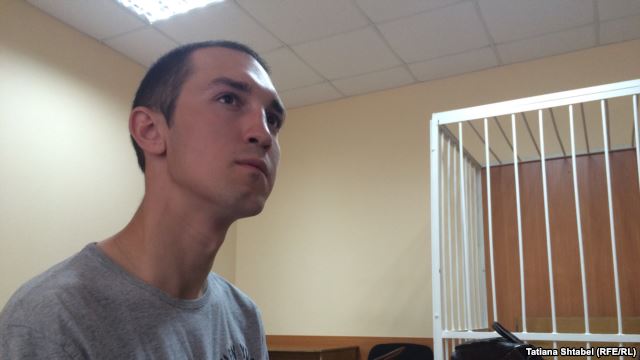
Maxim Kormelitsky in court

During the hearing, the prosecutor argued that Kormelitsky had insulted people who took part in the bathing, since he “is an atheist and feels hatred towards people who profess Christianity.”

“I copied it from another community. Besides me, something like seventy people reposted it. I think it odd that ultimately I am the only one on trial because an Orthodox activist saw my page. There were no calls for violence; there was only the insult. I have acknowledged my wrongdoing, I am sorry for what I did, and I ask the court to sentence me to a punishment not involving deprivation of liberty,” Kormelitsky said in court.

The court found Kormelitsky guilty under Criminal Code Article 282.1 (incitement to hatred on religious grounds) and sentenced him to a year in a work-release penal colony, adding three months to his sentence for a previous conviction.

Translated by the Russian Reader. Photos courtesy of Yuri Vershinin/Panoramio and Tatiana Shtabel (RFE/RL)

The Case of Ekaterina Vologzheninova: Watch What You “Like”

Click on the Button and Get a Sentence
Latest “Extremist” Reposting Case Goes to Court
Margarita Alyokhina
October 14, 2015
Novye Izvestia

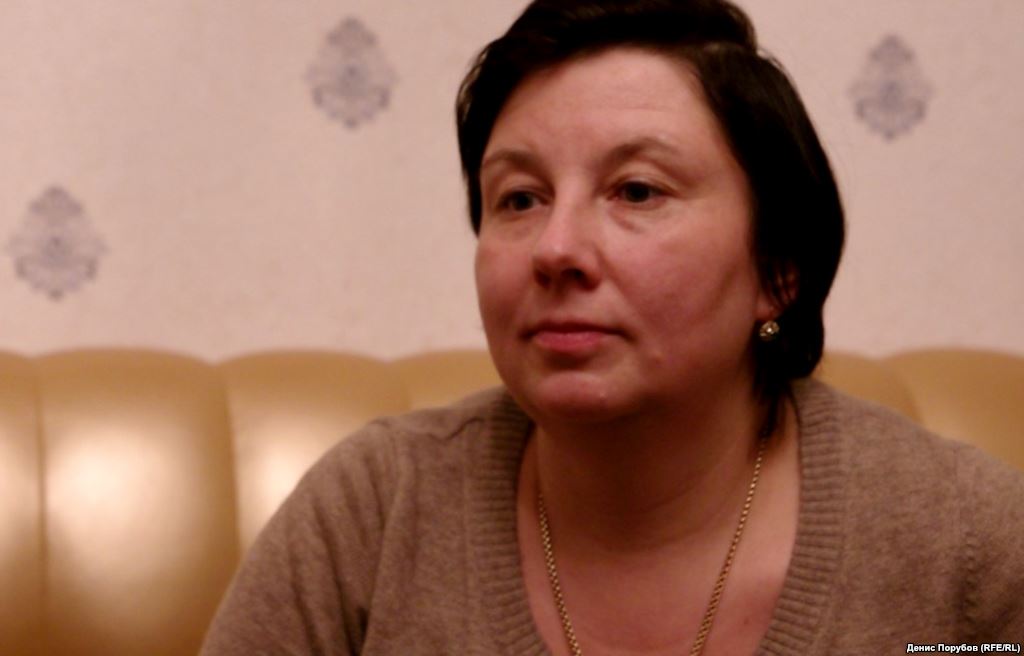
Ekaterina Vologzheninova

The first hearing on the merits of the criminal case against Ekaterina Vologzheninova, who has been accused of extremism for reposts she made on the social network VKontakte, will take place on October 27. In addition to distributing “inflammatory” matter (consisting, in fact, of pictures and poems, supporting Ukraine, that are freely available on the Web), the 46-year-old single mother [from Yekaterinburg] has been accused of associating with “undesirable persons,” which included activists from Memorial and International Amnesty.

Vologzheninova has been charged under Article 282.1 of the Russian Federal Criminal Code (“incitement of hatred or enmity, as well as humiliation of human dignity”). The authorities began pursuing Vologzheninova after she shared several items on VKontakte. These items, we should note, have not been included in the Federal List of Extremist Materials.

Experts from the SOVA Information and Analysis Center have commented on the case against Vologzheninova on their website.

“The poem ‘Katsaps,’ whose main idea is that Ukraine’s ethnic Russians will defend it from Russia, contains accusations that the Russian authorities have attacked Ukraine, but there are no aggressive appeals in it. As for the poster, it obviously calls on Ukrainian citizens to defend the country from occupation.”

As usual, the preliminary hearing in the case was held in closed chambers.

“The prosecutor read out the indictment. But she read it out in an interesting way, omitting the most absurd paragraphs,” Vologzheninova’s attorney Roman Kachanov told Novye Izvestia.

During the hearing, the defense moved to send the case back to the prosecutor’s office, since, according to Kachanov, the indictment did not meet the requirements of the law. It did not make clear what the charges were.

“The conclusion states that [Vologzheninova] committed acts aimed at inciting hatred and enmity on the basis of race, ethnicity, and origin. As for race and origin, we did not understand that at all. But as for ethnicity, the indictment turns on the social group ‘Russians,’ although in the items at issue, ethnic Russians, on the contrary, are assessed positively; it is argued that it is wrong to oppose Russians to Ukrainians. In one text, Russians fighting in the Armed Forces of Ukraine are mentioned proudly,” Kachanov told Novye Izvestia.

According to Kachanov, the indictment accuses Vologzheninova of inciting hatred toward the social group “Moscow occupier” [sic]. It also features the phrase “ethnic hatred and enmity toward the public authorities.”

Earlier, during the investigation, Vologzheninova had also been reproached for associating with “undesirable persons,” human rights activists from Memorial and Amnesty International.

“Formally, such charges were not brought against her, because there is no such crime. At the very end of the investigation, however, [Vologzheninova was interrogated] by a FSB field officer by the name of Khudenkikh. And he, apparently wanting to generate a negative psychological atmosphere, accused her of having dealings with Memorial, which is a ‘foreign agent,’ and with Open Russia, which is funded from the west,” Kachanov told Novye Izvestia.

According to him, on the eve of the court hearing, it transpired that Vologzheninova’s bankcard had been blocked.

“The situation is this. By law, if a person is suspected of extremist or terrorist activities, his or her name is put on Rosfinmonitoring’s black list. A court sentence is not needed for this. But it does not always happen this way. I know people convicted of extremist crimes who have continue to have use of their bank accounts,” the lawyer explained.

According to him, a person who goes on the Rosfinmonitoring list stays there practically in perpetuity. For example, the slain terrorists Shamil Basayev and Salman Raduyev are still on it. And since the list is openly accessible, for “extremists” like Vologzheninova it is an additional humiliation. As Novye Izvestia ascertained, Ekaterina Vologzheninova is indeed listed among terrorists and extremists on Rosfinmonitoring’s website.

Svetlana Mochalova, a linguist with the FSB’s crime lab in Sverdlovsk Region, performed the forensic examination in the case. As Novye Izvestia reported earlier, a whole string of verdicts in controversial “extremism” cases in the Urals have been based on her findings. Among them is the verdict in the case of Pervouralsk resident Elvira Sultanakhmetova, who was sentenced to 120 hours of community service for calling on Muslims not to celebrate New Year’s because it was, in her opinion, a pagan holiday. Mochalova identified “incitement of hatred and enmity towards persons who do not celebrate New Year’s, whose customs and festivals are manifestations of a lack of faith” [sic] in what Sultanakhmetova had written. In 2010, Mochalova found “statements calling for social strife and the violent overthrow of the Russian Federation’s constitutional order an integrity” in the article “Patriotism as a Diagnosis,” written by the attorney Stanislav Markelov, who had been murdered [by Russian neo-Nazis] a year earlier. The article was examined as part of the proceedings against civic activist and Tyumen State University lecturer Andrei Kutuzov. He was prosecuted for, allegedly, handing out leaflets calling for an end to political crackdowns. According to Mochalova, these leaflets incited hatred against the authorities and aroused social discord. Mochalova refused to reveal her examination procedure to the court on that occasion, claiming that it was marked “for official use only.”

In July, teacher Alexander Byvshev, who had posted a pro-Ukrainian poem on a social network (unlike Vologzheninova Byvshev had written the poem himself), was sentenced to 300 hours of community service in the Oryol Region. Sentences for “likes” and reposts have practically become the norm this year. Thus, on September 28, Chelyabinsk blogger Konstantin Zharinov, who had reposted material from the banned Right Sector, was found guilty and immediately pardoned. On September 15, Krasnodar activist Sergei Titarenko was fined 100,000 rubles [approx. 1,400 euros] for reposting a political post. On September 17, the Lenin District Court in Cheboksary sentenced Parnas opposition party activist Dmitry Semyonov [and immediately pardoned] for reposting a caricature of Dmitry Medvedev.

Translated by the Russian Reader. Photo courtesy of Radio Svoboda

__________

A Currenttime.tv report about the criminal case at Yekaterinburg resident Ekaterina Vologzheninova, accused under Article 282 of the Russian Federal Criminal Code of inciting ethnic hatred and enmity against the Russian public authorities, residents of Southeast Ukraine who do not support modern Ukraine’s political course, volunteers from Russia fighting on the side of the Donetsk People’s Republic, and other absurd things. Posted on October 17, 2015. Thanks to Sergey Chernov for the heads-up

Closed, Destroyed, Deleted Forever: Russian Authorities Crack Down on Lena Klimova and Children 404 on Eve of Olympics

colta.ru
February 3, 2014
Closed, Destroyed, Deleted Forever
Moral crusader Vitaly Milonov is trying to shut down Children 404, a group which supports LGBT teens. Dmitry Pashinsky talked to the group’s founder, Lena Klimova

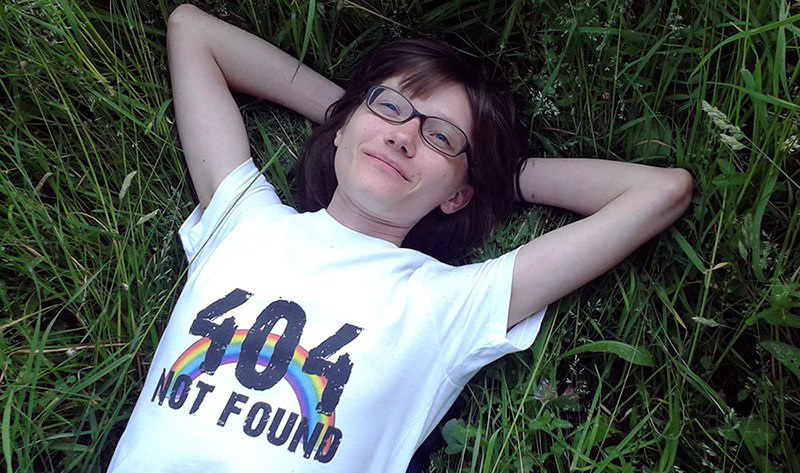
Detailed_pictureLena Klimova

In Nizhny Tagil, Lena Klimova, a 25-year-old journalist and founder of the project Children 404, which is dedicated to helping LGBT teenagers, has been charged with promoting non-traditional sexual relations among minors.

On January 31, formal misdemeanor charges were filed against Klimova following a complaint by Vitaly Milonov, a member of the St. Petersburg Legislative Assembly.

According to the charge sheet, law enforcement officers have deemed that the project’s group page on the VKontakte social network, where participants communicate with each other, publish open letters, and get help from psychologists and lawyers, promotes non-traditional sexual relations. Klimova now faces a fine of fifty thousand to one hundred thousand rubles [approx. 1,000 to 2,000 euros]. She also does not preclude the group’s being shut down. In her opinion, this would cause “irreparable harm” to thousands of LGBT teenagers, who would lose a means of sharing their problems and adapting to society.

Commenting on the situation in the media, Vitaly Milonov himself said, “This group is most likely funded by foreign grants. It should at least be declared a foreign agent. It should banned from involvement in politics, and of course this group should be closed, destroyed, and deleted forever.”

Lena Klimova talked about how absurd it was to be accused of promoting homosexuality among minors for letters written by minors themselves.

It’s not clear from what Milonov said who should be declared a foreign agent, me or the group. I hear this nonsense about foreign funding all the time. I don’t know what the basis of these claims is. I would say it’s a bad thing to lie.

Has a court date been set?

Not yet.

How do you plan to make your case? What does your lawyer say?

The lawyer says we will muddle through. I haven’t asked her yet how we’re going to make our case, but I think we have almost no chance of winning. I suspect a political put-up job is underway. When I went to the police investigator in mid-January, he told me he saw no evidence of a violation and would refuse to open a case. But then I was suddenly summoned again, and the same investigator admitted he wasn’t calling the shots and would now draw up a charge sheet. From which I concluded that the order had come from higher up. I imagine he was told, Are you a fool, or what? Don’t you know who Milonov is? File charges right now! The interrogation lasted for less than an hour. I was asked what the group was and why it had been created, for what purpose. I was also asked who LGBTs and transgenders were.

Personally, what is happening reminds me of the lead-up to a show trial. The only thing that is not clear is why the authorities want another LGBT-related scandal right before the Olympics.

The trial will probably be after the Olympics. They hope the Games will take place and the international community will stop worrying about the problems of gays in Russia. Although I’m sure it won’t be that way. Three or four people have already been convicted under this law, the latest as recently as January 30. The newspaper Molodoi Dalnevostochnik was fined for publishing an interview with the fired gay school teacher Alexander Yermoshkin. He said, “My existence is itself the most effective proof that gays are normal.”  The editors were fined fifty thousand rubles for this phrase.

Аs for us, this is totally Kafkaesque. We’re charged with promoting homosexuality among minors, and it is the letters of minors themselves that constitute this promotion. This is nonsense! But we’re told that no, minors will read the letters and be swayed.

How likely is it now that the group will be closed? And what will the consequences be?

I think it’s quite likely. But we are fully prepared for this. Around a week ago we started working on a website. In addition, we have a mirror group on Facebook, and Facebook is much more difficult to block. The site itself will have foreign hosting. It can also be blocked by putting it on the list of banned sites, but such bans are easy to get around. But closing the group on VKontakte will cause irreparable harm. It’s our greatest resource. On Facebook we have 2,500 subscribers, but on VKontakte, where young people mainly hang out, we have over 16,000 subscribers. All the psychological and moral support we provide work only on VKontakte: people write and offer advice, and we moderate the discussions. But the people subscribed to our Facebook page are usually foreigners and people from the older generation. We’ll be sorry to lose the audience on VKontakte.

Have you contacted VKontakte management in connection with this case?

With regard to this case, no. But our opponents have written complaints to VKontakte’s tech support and posted screenshots of their correspondence, from which I’ve gathered that the site’s management is wholly on our side. They say they see no evidence we are promoting homosexuality. If you think otherwise, they write, take it to court. But going to court is not the same thing as writing to VKontakte: you have get your butt off the couch. Only Milonov has been able to do that so far.

Is this the first time the authorities have put pressure on you?

Yes, it’s the first time. Before this, no pressure groups were formed to oppose us, no complaints were filed, and there were no parliamentary inquiries.

How many people are involved in the project team?

There are around ten psychologists and eight coordinators. Everyone has their duties. For example, I’m in charge of corresponding with the teenagers, while other people handle posting the letters on social networks, banning homophobes, and translating from foreign languages. There is also someone who runs our closed group on VKontakte. We have that for teenagers to communicate freely.
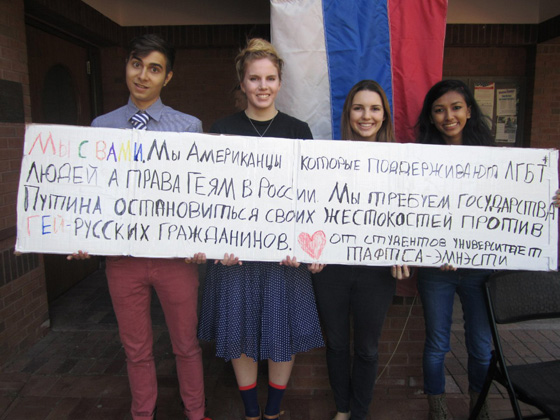
Students at the University of Massachusetts Send a Message of Support to Children 404 

Why is a group meant for free communication closed?

Only teenagers and vetted adults who come to help them are members of the closed group. It is closed because the problems discussed there are fairly personal, the sort of problems that could be put up for general discussion only anonymously, the way it happens in the open group.

You have a fairly large team. What motivates these people? What prompted them to work on this project?

Aside from wanting to help, people have very different motivations. Our first admin is a heterosexual with two children. He became an LGBT activist long ago, I don’t know why. Our next admin is a LGBT teen, whose letter launched the project. There is another straight admin, but his daughter is a lesbian. For everybody, it is a fifty-fifty mix of personal motivations and the desire to lend a helping hand.

I find it hard to talk about what motivates other people, I can only talk about what motivates me. Well, sexual orientation also motivates me, as I’m bisexual. And I’ve had to deal with discrimination. When I was suspected of being lesbian, I was fired from my job with a lot of fuss. This was at a state university where I had worked for quite a while. At one point I was called on the carpet and told to write a resignation letter. My boss later added I shouldn’t pretend I didn’t get it. I was in a desperate situation and couldn’t strike an attitude by invoking the Labor Code. It left a huge wound in my soul. I have an acquaintance who says that the basis of all human rights work is deep psychological trauma. Some people, of course, get their skulls cracked, but still that incident forced me to feel the injustice of the world, so I help others. I don’t want them to feel the same thing I did.

Are there many groups like yours on the Russian segment of the Internet?

There are quite a lot. And, in my experience, they sprang up like mushrooms after we appeared. More than once I have had to ask them to change their name, because they were all called Children 404, but there was porn posted on their walls. At least patent the name! Someone will show up and write they saw kiddie porn on Children 404, and then go and try to prove we’re innocent.

But it’s obviously provocateurs who set them up?

No, they are not provocateurs. They’re silly boys from the rainbow community. But I haven’t found any psychological support groups either for teenagers or LGBT people generally. In Russia, only one helpline for LGBT people has remained. Incidentally, it recently stopped taking calls from teenagers for fear of being charged with violating the law on promoting homosexuality.

Does your project receive financial assistance from anyone?

No. We didn’t go looking for investors, either. The reasons for this are many, but the main one is that we are not an organization, a legal entity. We’re nobody. We don’t exist. We’re just a group of concerned people in a social network.

And you don’t envision the possibility of registering Children 404 as a human rights organization?

I’m afraid that no one would register us. But even as a project we get on well. What are the advantages of registration? We’re interested not in financial resources but in human resources. We always welcome new lawyers and psychologists. We find them among those who’ve already worked with LGBT people. We don’t do interviews: we are guided by the assessments of friends. I’ve had to turn down a few students without diplomas who “just wanted to help.” We also need translators from English, because people often write to us from abroad, and because we are planning to translate current research on homosexuality for the website, and most of this in English. All the work is voluntary. It is only Milonov who tells tales about foreign grants.

I suspect he is not too sincere, but he manages the role nicely.

Yes, a journalist who knew Milonov back when he still worked for [the slain Yeltsin-era democratic politician] Galina Starovoitova wrote to me. He was then the most liberal of liberals. The journalist told me not to believe all this homophobia: when the wind blows the other way, Milonov will be the first to be gone with the wind. But nowadays homophobia is trendy. Even the media noticed us only when that red-headed parasite took a swipe at us.  News about his complaint to the police spread far and wide, including outside of Russia. He filed the complaint back in October, and it took two and a half months to get to Nizhny Tagil. I didn’t advertise the fact I live here. He thought I was from Petersburg, so he sent the complaint to the local authorities there. The final countdown to the Olympics had started by the time the complaint found me.
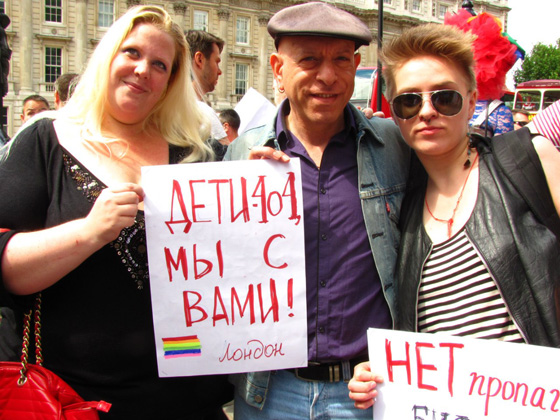
Rally in London in Support of Children 404

How many letters have you received over the course of the project?

We have been around since March 2013, and to date we have received 1,067 letters.

What places do the teenagers write from?

Aside from Russia, they write from Ukraine, Belarus, Kazakhstan, Tajikistan, Uzbekistan, Canada and Israel. Quite a lot of letters come from the US.

What about the North Caucasus?

There have been only one or two letters. A young woman who called herself Gina sent a letter, but she was already eighteen or twenty. Everything had worked out more or less fine for her, surprisingly. The other day we got a letter from a guy from a Muslim family. He is twenty-two, but he has the same problems as teenagers. He has thoughts of suicide, and his family is quite poor, they have no money. He can’t come out either to his father or his mother.

Recently, literally everyone has been turning to us for help, including teenagers suffering from ordinary romantic tragedies. I remember one amazing letter from a young woman who was dating an older woman with a ten-year-old child. She asked for help in coming out to her girlfriend’s daughter. Usually, kids want to come out to their parents, but here an adult wanted to come out to a child.

Do adolescents suffer more from an intolerant society or from self-loathing?

A psychologist recently said our main problem was that the teenagers who wrote to us had already recognized who they were. But those who are still trying to accept who they are almost never write, because they are sitting around thinking there is something strange happening to them. They type “how to stop being gay” into a search engine, but they definitely won’t find us that way.

But mostly it is people who have accepted themselves who write. Everyone has different problems.  Some are in unhappy relationships, others have problems with their parents, still others are bullied at school. There is a letter for every problem. Just recently, someone wrote to me, “I feel gay, but I don’t like it at all. I want a normal family and children, but I can’t stop looking at boys.” We also publish letters like this. Someone will always write in the comments, “Don’t worry, being gay is alright.” And someone is going to call that promotion of homosexuality? What is the guy supposed to do? Seek treatment? Where? Go pray? It’s all very complicated.

You publish the letters, and the kids get support in the comments. But you’ve said almost nothing about the work of your psychologists, about how teenagers have been helped. Why?

To be honest, I have never thought of doing that. And our psychologists are unlikely to go that route. When I had to find out the details of a situation, they told me they could not say anything specific, because professional ethics and doctor-patient confidentiality forbid it. They described the problem and how it was solved only in the most general terms. And there is not much point in my knowing. As it is, hundreds of young people know we have psychologists and that they can consult with them.

What are the most frequent questions?

The question asked most often is whether to come out to one’s parents. It gets asked so often I’ve worked out a universal answer to it: unless you are one hundred percent sure your parents are not homophobes, it is better not to do it.  It is worth coming out when a few important conditions are in place: one, you have your own place to live, and, two, you have your own source of income. Only when these are the case is it absolutely safe to come out. But if neither the first or second condition has been met, it is risky.

It happens that a letter arrives where a guy writes that his parents are horrible homophobes, but he couldn’t stand it and came out, and his parents abruptly changed their minds about gays. Or vice versa: the parents seemed gay-friendly, and the person came out to them, but then he or she was kicked out of the house practically in their underwear. It is impossible to predict what parents will do, but you also cannot forbid kids from coming out to them.

How did you personally come out to your family and friends?

It was fairly hard. My friends accepted me without question. As for my mom, alas, she still hasn’t accepted me. We had a difficult conversation. I cannot even describe it. I have a difficult relationship with my mom, although she sometimes asks me about both my activism and the project. But she does not want to hear anything about my personal life. She says, When you are around me, pretend you’re ordinary. So I have every right to sympathize wholeheartedly with children in similar situations.

What else do the teenagers who write to you have in common besides their orientation?

It is quite hard to figure that out, because the letters are not written to a template. I once did a survey. A total of 115 people were polled. What percentage had thought of suicide? How many had come out to parents and friends? I wanted to find patterns. If you judge on the basis of the letters, what do they have in common? Geography for sure: most of them come from Moscow and Petersburg. The age range is wide: the youngest was twelve, the oldest, fifty. She was a mom whose daughter was an LGBT person. All her life she had regarded LGBT people tolerantly, but then she had to deal with one personally and had had second thoughts.

Do they often write about suicide?

Not really. Since the majority had recognized who they were, they simply took it for granted. At any rate, this was true for half the people I polled, while the other half had tried to find a way out in relationships with the opposite sex, going in big for religion, reading the “right” books, and consulting with psychologists. Suicide was seen less as a way out and more as an inevitability, because they had been harassed at school and at home. They felt terribly lonely.

I know absolutely hellacious stories. There was one girl, a lesbian. Her mother did not accept her, and the girl swallowed a bunch of pills. The ambulance took her to hospital, were her stomach was pumped. She wrote, “You know what the first thing my mom said when she saw me? ‘Did you think everyone would be happy you’re still alive?'” Can you imagine such a thing?