Dankhaiaa Khovalyg: Russia’s Asian Republics Speak

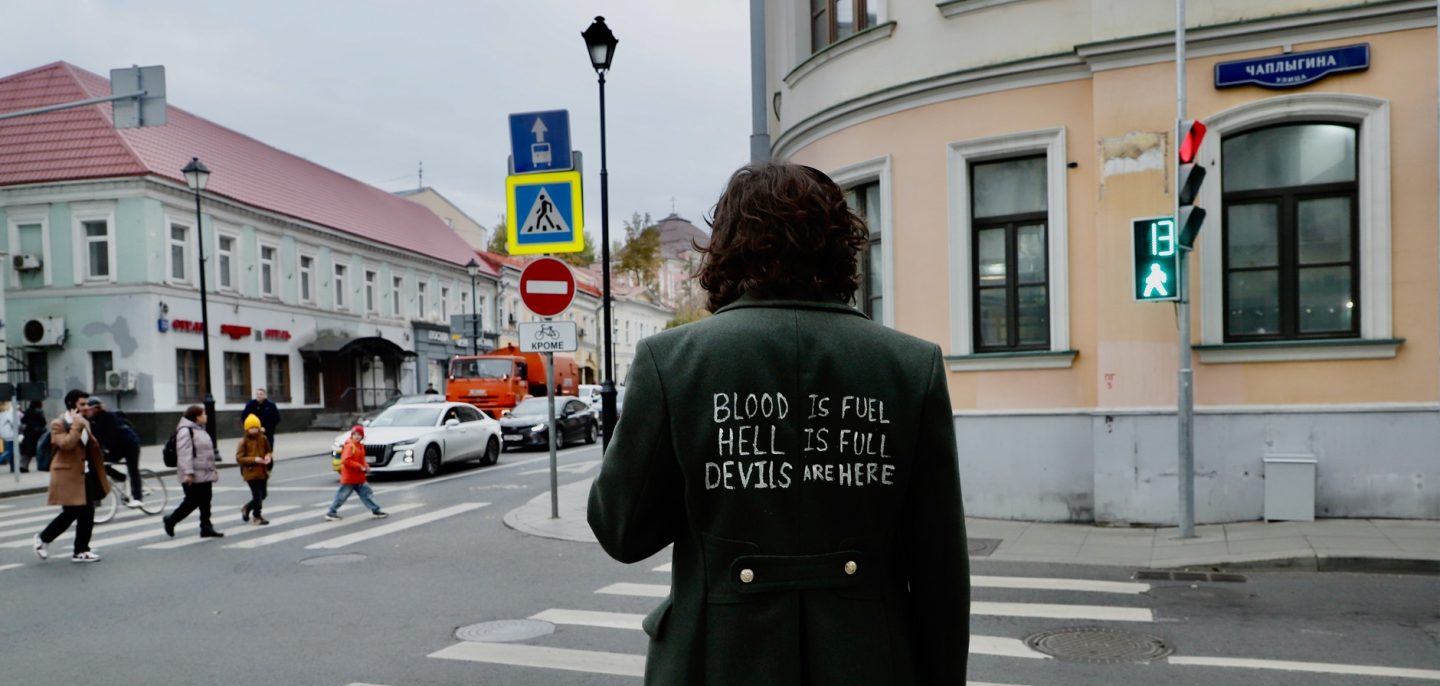
Dankhaiaa Khovalyg. Photo: Rinchinaaa/Baikal People

‘I was made from Russian anyway,’ 28-year-old Dankhaiaa Khovalyg writes in her story ‘Ayalga,’ published in early 2022. Its female protagonist tells a psychologist how she feels like a stranger in her own country. When Dankhaiaa was a teenager, she deliberately detached herself from her native culture. She was proud to speak Russian without an accent, and dreamt of leaving Kyzyl ‘to be with her own people’ in Moscow.

During her eight years in Moscow, Dankhaiaa was involved in decolonial activism, researched her own painful background, and launched a project about indigenous people from Russia’s six ethnic Asian regions —the podcast re.public_speaking.

Alina Golovina, a Baikal People correspondent based in Buryatia, spoke with Khovalyg about why it is important to talk about trauma, where decolonization begins, and whether Russia’s ethnic republics can unite for their own benefit. At Danhkaiaa’s suggestion, they spoke to each other using the informal second-person pronoun ty.

As soon as I would lеave home, the world would crash down on me with all its xenophobia

— Tell me about yourself, Dankhaiaa.

— I was born and raised in Kyzyl. After graduating from school, I went to study in Moscow and lived there for eight years. I worked as a client manager in an IT company and was involved in feminist activism. In 2021, I quit my job and realized my childhood dream: I enrolled in literature classes and took up writing. Since March 2022, I have been living in Berlin and doing podcasts and anti-war activism.

— You told me that up to ninety percent of the indigenous people in Tuva speak Tuvan and consider it their native tongue. Why have you prioritized Russian? Is it a problem?

— I’m a city girl: I grew up in Kyzyl. I was sent to a Russian-language kindergarten and, later, to a Russian-language class at school. That was how my mother showed that she cared about me: Russian-speaking classes were considered tonier. I was a bookworm and was engrossed in Russian literature. Unfortunately, I didn’t have access to a large amount of foreign literature at school, and at that moment, eighty percent of me certainly consisted of this great and beautiful Russian literature by the so-called Tolstoyevskys. I read all of that stuff and would dream of going to Moscow. I was a little proud that I spoke such beautiful Russian. Basically, I went through all that internalized colonial chauvinist crap that life was better there, that I was going to get out because I was more like them.

— Did it save you from ethnic discrimination? If not, when did you first encounter it?

— My experience of discrimination actually began long before I moved to Moscow. My mother found opportunities using travel vouchers to send me to summer camps in Krasnodar Territory, Khakassia, and other regions. I was eleven and twelve years old at the time. It didn’t matter whether I traveled five hundred kilometers from home or several thousand, because everywhere I went I encountered phenomenal bullying. I was labeled ‘China girl’ and ‘black.’ No one asked me to dance at dance parties. I was either totally ignored or talked to condescendingly and peppered with passive-aggressive insults. I had lived in my native Tuva in a groovy, comfortable bubble: most people spoke Tuvan, and we didn’t encounter any racism there. But as soon as I would leave home, the world would crash down on me with all its xenophobia. Whereas in Tuva I was considered pretty, smart, and cool, everything and everyone at those camps made it clear to me that I was second-rate.

— How did this affect you?

— These contrasts generated very unhealthy takeaways in my head: that Tuva’s overall level [of development] was much lower than the rest of Russia’s. This absolutely perverted assumption made me, as a teenager, condescend to Tuvan culture and my Tuvan side. It is quite painful for me to remember the instances when relatives addressed me in Tuvan, but I would reply in Russian, saying that I didn’t understand them, although that was a lie. Those memories now make me feel bitter. I feel sorry for that teenage girl.

— What happened later in life? How did Moscow welcome you?

— I often encountered micro-aggressions in public places. For example, I would be standing in the queue at a store, and a huge Russian guy would push me aside and go in front of me. There was no explicit verbal indication that this was because I was non-Russian, but I think this wouldn’t hae happened if I had been of Slavic appearance. I repeatedly had big problems finding a place to live because of my name and my appearance. Or, for example, I would be climbing the stairs to my floor, and neighbors descending the stairs would say, ‘The churkas have come and taken over the place’ when they would see me. They would not say it to my face, but under their breath as it were, and when they were already a flight below me, so I couldn’t even shout back at them as it happened. I would just stand there for a while, frozen on the steps. You always deal with this alone because when you are with your husband or a group of people, those very same neighbors keep their mouths shut. Every such episode of chauvinism really demoralized me, although I didn’t express it outwardly. Because no matter who I would tell, they would say, ‘Oh, don’t pay attention! Rise above it! We don’t stoop to their level.’ I swear that there has never been an instance when someone just shared my indignation for a second.

— Have you experienced physical violence? Have you been attacked?

— I didn’t encounter any actual boneheads (far-right skinheads): I moved to Moscow in 2013, by which time the most ardent supporters of that ideology had been jailed. The cases of physical violence that happened to me are difficult to categorize. The first time it happened was when I was in my first year at university. I was traveling from my part-time job in an empty train carriage to my dormitory. I had leaned my head against the window and fallen asleep with my legs stretched out. I woke up to an old man kicking me and saying, ‘Move your damn feet.’ I did and asked him what was the matter, and he said he wanted to sit down. I suggested he sit down in one of the other free seats, upon which he started kicking me again, saying that I was a churka and if I gave him any guff, he would beat the shit out of me. It was so horrible, because the old man spoke softly and looked like a harmless creature. I didn’t leave because I didn’t want to look weak. He stared at me point-blank the whole way and commented that I behaved very freely in Russia. It was forty minutes of violence.

The second incident happened on Leninsky Prospekt near the Oktyabrskaya subway station. It was summer, I was walking with headphones on in a crowd of people, listening to music. I noticed out of the corner of my eye that a man was walking in my direction and looking at me intently. Over the years, you develop something like a muscle that reacts to unwanted attention and makes you tense up and pull yourself together as if you’re getting ready to react. When the man walked by, he hit me over the head with a bottle. I fell down. He walked on. So there I was, lying propped up on my elbows, looking at the man walking away, and all the other people just passed me by. I thought at the time that it could have been a scene from a film, because only in a film can you get hit and nobody comes up and asks how you’re doing or tries to help you. And there were a lot of little situations — elbowing, pushing, kicking. Several times when I was putting away my dirty tray at a food court, I was told, ‘Hey, clean this up.’

Continue reading “Dankhaiaa Khovalyg: Russia’s Asian Republics Speak”
Asians of Russia: “Without Independence, Nations Perish”

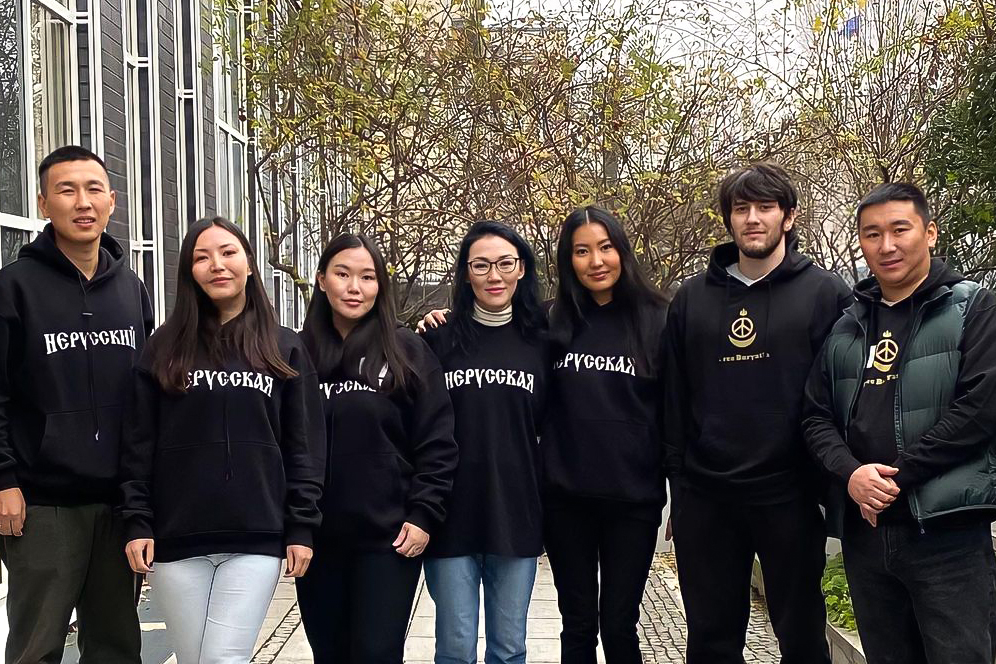
The Asians of Russia team at an anti-war congress in Berlin, most of them wearing sweatshirts identifying them as “non-Russians.”
Photo: asiansofrussia (Instagram)

Pyl spoke with Asians of Russia cofounder Vasily Matenov about how the campaign has been helping people despite hounding from the Russian Interior Ministry, and why the residents of Russia’s ethnic republics are the most vulnerable to the Russian state.


How a social media page about ethnic cultures grew into a mutual aid project

Asians of Russia came into being five years ago. I am Buryat myself, and my wife is Tuvan. We lived in Novosibirsk for a while. It’s a city where there are many migrants from Central Asia, and yet the locals often have a negative attitude to this. When you say that you come from Irkutsk, they don’t understand how that could be. Five years ago, we decided to create a social media page that would promote the culture of different nations, so that people could see which nations live in Russia and what their lives are like.

Asians of Russia cofounder Vasily Matenov: “Asians of Russia Against the War.” Photo: Vasily Matenov/Pyl

At some point, our social media followers started contacting us for help. We began raising money to treat children with serious illnesses, or to pay for tours by ethnic children’s ensembles. The posts that hit home with the public were reposted thousands of times. We recruited volunteers and raised money to fight the forest fires in Yakutia. People began to trust us more and more.

We somehow got the idea to help manufacturers of local products: furniture, clothing, and jewelry. We began traveling to the regions, filmed stories about their enterprises, talked about what products they produce, and how production is organized. This went on for several months. They paid us small amounts of money, and so we earned a little. But we didn’t have any funding or grants at all.

An anti-war rally outside the Russian embassy in the Mongolian capital, as reported on Asians of Russia’s Instagram page

How Asians of Russia helped its followers after the war’s outbreak

On February 24, I immediately started posting photos from the war, images of soldiers and prisoners, on our Instagram page. At first, users wrote that none of it was true. Then people from the regions began to recognize their relatives among the soldiers. A panic arose.

Lawmakers and officials wrote to us and threatened us. Then the law on “fake news” about the military was passed. One follower telephoned us and said that an acquaintance of his at the Interior Ministry’s Department K (which deals with information technology) had told him that they were very interested in us.

After some time, unknown people started knocking on our door. We didn’t open it: we pretended that no one was home. This went on for three days. On the third day, we exited the apartment late at night and left the country. The Zimin Foundation offered us help in getting out of Russia and a little financial support. My wife and I now live in Poland.

We do crowdfunding campaigns as needed. We raised money to pay the fines people had to pay for making anti-war statements and going to anti-war rallies. These fundraisers raised the amounts of money needed in a matter of minutes.

When the mobilization began, we raised money for buses so that people could leave for Kazakhstan or Mongolia. We were able to evacuate a lot of people in concert with other organizations: we joined forces with with both ethnic movements and the Feminist Anti-War Resistance. Together, we looked for taxi drivers or private carriers who would take people to the border.

We also hired lawyers to help contract soldiers legally refuse to do military service, and we helped conscientious objectors and those whose requests to be dismissed from military service were not approved. Over the past year, we have raised fourteen thousand dollars to pay lawyers and get people out of Russia.


From a follower:

Hello dear ones! You can publish my letter, because a lot of people look at your page and the problem I want to write about is very dire for all of us right now!

We live in a small village, and my husband and I have two underage children. My husband and I were orphans, so we live in a private house that we received from the state. I will not describe what terrible quality these houses are: I hope everyone knows and understands this.

During the mobilization, they tried to take my husband to fight. They were not stopped even by the fact that he has a group-three disability.

After consulting with friends, we decided that it would be better for him to go to Kazakhstan than to go to kill and most likely get killed. Our children love Dad very much, they just wouldn’t survive it. We’d rather he be alive far away than dead in the neighborhood cemetery.

He and a friend quickly packed and left for Kazakhstan. Our little ones call him every evening by video link. Everything has gone well for them in Kazakhstan. They found a job that provides them with a room in a hostel, for which I am very grateful to the Kazakhs!

Our small household has now fallen entirely on my shoulders. We have chickens and a cow, which is about to bear offspring. The house is heated by a stove. We burn coal, which costs about three thousand rubles per ton with delivery. There is no water in the house: we have to go to the nearest water pump for water.

I take the children to school myself, because I’m afraid of dogs. We have had several cases of dogs attacking children, it is very scary. The temperature here is now minus thirty degrees. It was minus forty the previous two weeks.

Don’t get me wrong. We are not in the habit of complaining. We were taught that one must endure no matter how hard life is. But if you think about it, do we deserve such a life?

The children and I like to watch travel shows on YouTube and see how people in other countries live. Watching such programs, you begin to realize that we too could have better lives.

I look at the children and imagine what awaits them, what the future will be like, and I cry at night. 😭 I want to give up everything and leave, but where can I go with two small children and with no money? It’s very scary.

I want to appeal to all those who have not yet lost their minds: may you have strength and patience. Take care of yourselves.


How the authorities have been trying to divide the ethnic community

We have always tried to produce high-quality content, to shoot high-quality videos. So, we initially attracted a very high-quality audience: there were almost no supporters of the war among them. The average age of our audience is between twenty-five and forty-five, and it has been growing even since Instagram was blocked in Russia.

There were bot attacks on our public page. At the same time, there was an influx of followers who would disappear after a couple of hours. They could write racist comments, about which they themselves might file complaints so that our public page would be blocked, or so that it would be subject to a shadow ban and would not show up in the feed.

I know people who are mixed up in such things. First, they organize bot attacks, and then they become aides to lawmakers.

The purpose of these bots is not just to block our profile, but to divide society so that there is no consensus on any issue. You can write any old nonsense. One of our followers admitted that he had worked in such a troll factory. They were told that they could even write that they opposed the authorities. What mattered was that they avoided coming to a unified stance in the comments.

Photos from a protest organized by Voices of the Indigenous People of Russia

Why Russia’s ethnic regions are the most vulnerable

The authorities understand that if there were a unity of opinion and a common cause in the ethnic regions, everything could flare up like a match. Therefore, propaganda is stronger here: there is not a single independent media outlet. We were in Georgia, and the Georgians said that god forbid the authorities would do something that the people did not like: everyone would immediately go to the parliament to protest. This happens because there is a national cause in Georgia.

There are very close family and friendship ties in the ethnic republics. It is customary in our part of the world to be in touch with fourth cousins and go visit them . It is vital for us to stand up for each other. The authorities have been doing everything possible to destroy this unity in the regions.

That is why all discontent and all protest in Russia is nipped in the bud. For example, when Dmitry Trapeznikov, who had been among the leaders of the “Donetsk People’s Republic,” was appointed acting mayor of Elista, the capital of Kalmykia, the whole region rose up to oppose him. The residents of Elista packed the city’s main square every day for a month. Consequently, Russian National Guardsmen from Moscow were brought to Kalmykia to break up the protest, and then all the protest leaders were put on trial. Since then, people in other regions have simply been afraid to take to the streets in protest.

The residents of the Russia’s ethnic republics are the most vulnerable part of the country’s population. They don’t know their rights well. There is no internet in the villages, and people speak Russian poorly. If the authorities go to the villages to mobilize young men for the war, how can they protect themselves? So, we must develop democracy in Russia, starting with the regions.

I’m not a politician or a political scientist. I don’t know exactly how to restructure Russia after Ukraine’s victory, or whether the ethnic republics will secede and how to do that. But I do know that, without independence, nations perish. For example, there are fewer than ten thousand Shors left in Russia, although they are an ethnic group that has existed for two thousand years, since before there were ethnic Russians.

If Russia wins the war, it will only get worse. We must not just turn out for rallies for a free Russia. We must make sure that Ukraine wins. Only then can we take up the vital task of preserving the independence of the nations living now as part of Russia.

Source: “Asians of Russia: ‘Without independence, nations perish,'” Pyl, 13 February 2023. Thanks to Maria Kol’tsova for the interview and the heads-up. Translated by the Russian Reader. I edited the sentence about Dmitry Trapeznikov so that it better reflected the facts of the conflict.