An Apology for Fascism

Editor’s Note. Confused readers might imagine that the following (excerpted) screed from the hilariously named website The Saker (for the ornithologically challenged, the saker is a falcon used in falconry) is an apology for fascism. Actually, they’d be right.

* * * * *

“There are no separate Russia or Ukraine, but one Holy Rus” – Elder Iona of Odessa

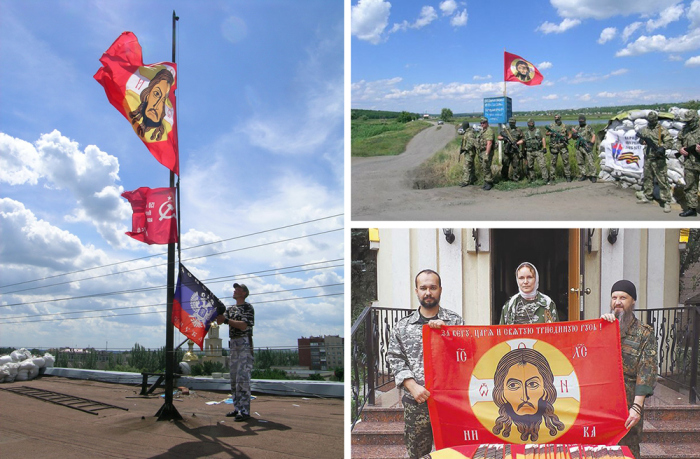
The year 2014 saw an unprecedented surge of patriotism in contemporary Russia, which resulted in popularizing the notion of the Russian World. One reason for increased patriotic sentiment was Crimea’s return to the home port after the overwhelmingly positive vote by its majority-Russian residents in a referendum one year ago. The onset of the liberation war in Donbass from the West-backed Kiev regime was the other. This war truly delineated the stakes for the existence of the Russian World. The latter is not an ethnic, but a civilizational concept that encompasses shared culture, history, and language in the Eurasian space within a traditionalist framework. To a certain extent and despite the obvious ideological differences, the Russian Empire and the USSR embodied the same geopolitical entity. A particularly noteworthy aspect of the ongoing crisis in Donbass is the symbolism—religious and historic—that surpasses the commonly used, but outdated Left-Right political spectrum. In the Russian context, this also means overcoming the Red-White divide of the Communist Revolution. That this war pushed Russians to examine their country’s raison d’être is somewhat remarkable: for two decades its citizens did not have an official ideology, prohibited by the Constitution that is based on Western models. The emergence of a new way of thinking in Russia will become clearer once we refer to the meaning of religious insignia, wars—Russian Civil and Great Patriotic, as well as the question of ideology in the Postmodern world.
mandylion-combined

[…]

In fact, post-Liberal ideology is one of the factors that blinds many Westerners to the realities of the liberation war in Donbass. The current Western model of citizenship is an abstract one: it centers around a set of principles in which individuals are interchangeable—as long as they adopt “European values” or the “American way of life”—instead of the more traditional notions of rootedness in the landscape, cultural and linguistic ties, and ancestral bonds. Thus, those who subscribe to this abstraction have difficulties understanding how belonging to the same people (narod) overrides living in two different states—contemporary Russia and Ukraine—haphazardly formed at the time of the Soviet collapse, and why they seem so attached to their language, culture, religion, history, and land that they are willing to die for them. But even for those Russians that lean toward more traditionalist thought, it took this war—the war that was meant to separate—to ideologically and spiritually unite them with others like them across the border, to begin questioning who they really are, uncertain, but hopeful, forging the idea of the Russian World. Beyond Left and Right, Beyond Red and White.

—Nina Kouprianova, “Beyond Left and Right, Beyond Red and White: Framing the Liberation War in Donbass,” The Saker, March 18, 2015

You would be right in asking, Who the heck is Nina Kouprianova? What does it matter what she thinks? But what this guy thinks does matter and he seems quite on message with Ms. Kouprianova:

Putin also addressed Ukraine’s struggles, saying “extreme nationalism is always harmful and dangerous,” and implied that Ukrainian voters would hold the parliament and the Poroshenko Administration responsible the country’s current mess. “I, for one, have always thought of Russians and Ukrainians as a single people,” he added.

His intentions could not be plainer.

Thanks to Comrade NT for the heads-up on this depressing new website.

“Return to Home Port”

KRYMFASH
Ayder Muzhdabaev
March 12, 2015

The other day, colleagues from several foreign media asked me to help them find ordinary people in Crimea willing to talk on camera about what their lives were like a year after Krymnash [Russia’s annexation of the peninsula].

Just about their lives, not about politics.

With Muscovite ease, I promised to help them out. And…

…it was not just that none of my many relatives and friends (except journalists) were willing to appear on TV, NO ONE even wanted to meet off the record with foreigners.

Their first argument was that foreigners would be followed, and at best a person who met with them would be dragged into the FSB for questioning, and at worst … You never know what.

Given that, over the past year, nine Crimean Tatars have disappeared without a trace, one was brutally murdered after being abducted, several people have been deported, several have been placed under arrest, and hundreds have been sentenced to hefty fines, I did not even bother trying to change their minds.

Such is the brownness that Russia has installed in Crimea.

Be proud if you like.

Source: Facebook

Ayder Muzhdabaev is deputy chief editor at Moskovsky Komsomolets newspaper.

__________________

natalya kokorinJournalist Natalya Kokorin

Dmytro Gnap
March 13, 2015

Two hours ago, the FSB detained our colleague Natalya Kokorin, a journalist for Slіdstvo.Іnfo and the Center for Journalistic Investigations. Intelligent and beautiful, Natasha has written many investigative reports about the redistribution of Crimean property, corruption, gangsters in power, and the Russian occupation. She and her colleagues have had to do many of their articles almost clandestinely. Today, the authorities began a search at her parents’ house when Natalya arrived there, and four FSB officers took her to their headquarters. The “Russian World” has quickly achieved victory in Crimea. A journalist who exposes the regime is a real threat to the federal and local ghouls. We are waiting for news from her lawyer and ask that you repost this.

Source: Facebook

__________________

Anti-Maidan presents the exhibition Crimea: Return to Home Port

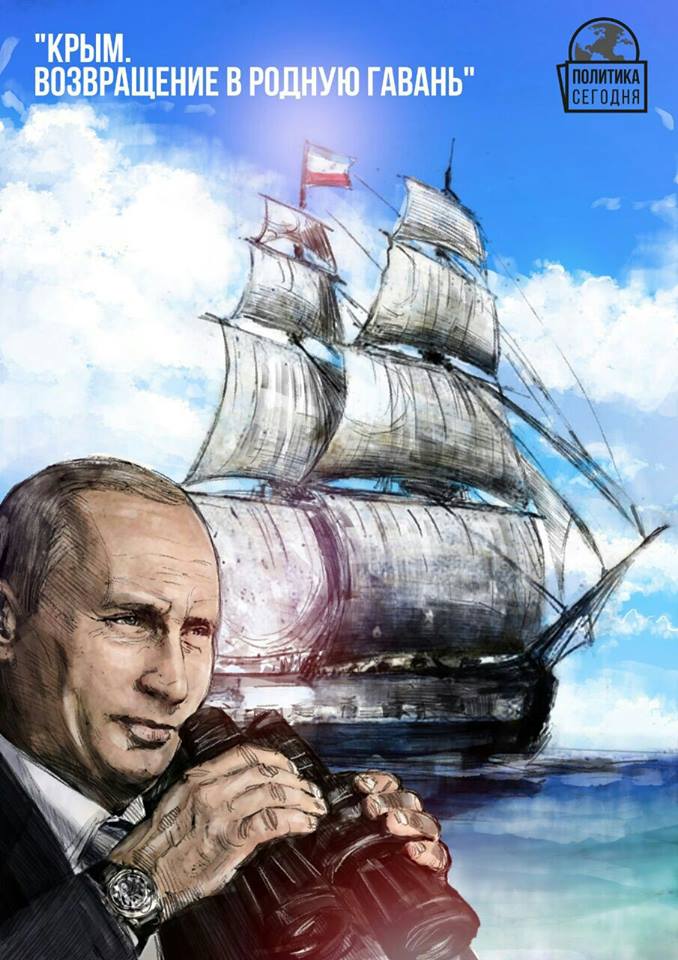
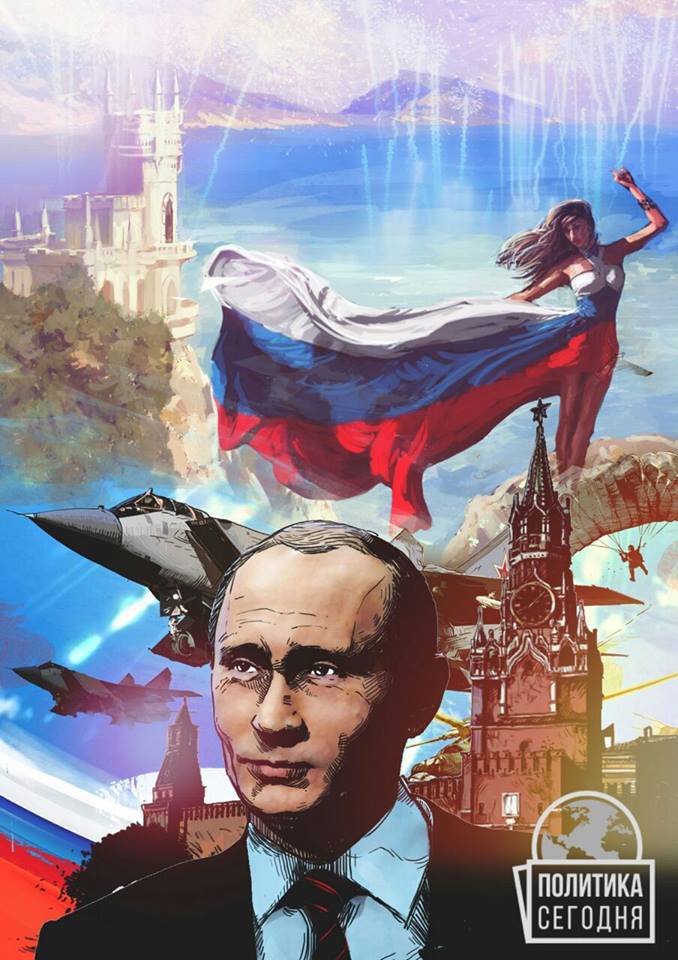
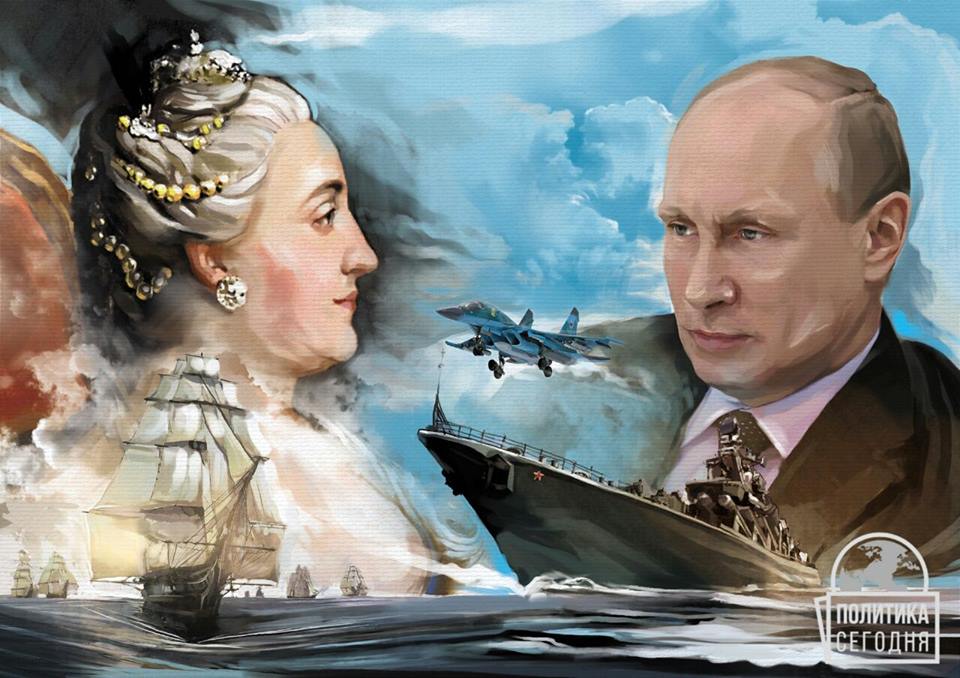
crimea-putinOn March 16 at 1:00 p.m. in Moscow, an exhibition of graphic art, Crimea: Return to Home Part, will open with support from the Anti-Maidan Movement and the Russian Bear Movement. The exhibition is dedicated to the anniversary of the referendum in which the residents of Crimea voted to join the Russian Federation.

crimea-putin-2The exposition in Novopushkinsky Square will feature about fifty works by patriotic cartoonists and graphic designers from the group Politics Today. The exhibition will send visitors back to the memorable events of the Russian Spring in Crimea. The work that will be presented at the exhibition are produced in the graphic design style [sic].

Members of the Night Wolves national motorcycle club and Julia Berezikova, co-chair of the Anti-Maidan Movement, will attend the event.

crimea-putin-3The exhibition will be held March 16 from 1 to 6 p.m. Admission is free.

Location and time: 1:00 p.m., Novopushkinsky Square, Moscow

Contacts: +7 926 430 2454 (Grigory)

Source: Emailed press release (courtesy of Comrade SC)