HIV on the Rise Again in Russia

The number of new cases of HIV infection in Russia has been growing again. In 2022, 63,150 people were diagnosed with HIV, while a year earlier this figure was 61,098 people, according to the Russian Health Ministry. During the pandemic, fewer cases of HIV infection were detected in Russia due to reduced testing coverage and lockdowns.

The HIV detection rate in Russia increased by eight percent per 100,000 people in a year. There was an even bigger jump in particular regions. Compared with 2021, this figure almost doubled in the Belgorod Region. It increased by 76% in the Kaluga Region, by 66% in Yakutia, and by 60% in Ingushetia and the Altai Republic.

HIV infection rates in Russia per 100,000 people between 2004 and 2022, according to the Russian Health Ministry.

However, the Health Ministry’s data encompasses only people who have registered as outpatients at AIDS centers. They do not reflect those who have tested positive for HIV, but were not registered. The number of such people is as high as twenty percent of all confirmed cases of infection, estimates Vadim Pokrovsky, head of the Epidemiology and AIDS Prevention Research Department at Rospotrebnadzor’s Central Epidemiology Research Institute. Nor does this figure include foreign nationals and anonymous positive tests.

In 2021, 1,138,000 people with a confirmed diagnosis of HIV diagnosis resided in Russia. In 2022, another 60,000 people were diagnosed with HIV. To these groups we need to add around 300,000 people (according to Pokrovsky’s estimates) who have HIV but don’t know it because they haven’t been tested. Thus, the number of HIV-positive people in Russia is one and a half million, which is one percent of the country’s population.

2.6% of pregnant women in the Irkutsk Region are HIV positive.

At the Congress on Infectious Diseases, Pokrovsky said that almost a third of Russia’s regions are undergoing the generalized (third) stage of the HIV epidemic. He explained that there are three stages of the epidemic. The first (initial) stage involves isolated cases. The second (concentrated) stage occurs when more than five percent of any high-risk subpopulation is infected (for example, prison inmates, drug addicts, or sex workers, while the third (generalized) stage occurs when more than one percent of pregnant women are infected with HIV.

According to Pokrovsky, nine Russian regions are in the first stage of the epidemic, while forty-eight are in the concentrated stage, and twenty-seven are in the generalized stage. In the Irkutsk Region, 2.6% of pregnant women have been diagnosed with HIV, he noted. Ten percent of Russian prison inmates are infected with HIV, and four percent of Russian men over the age of forty have HIV, adds Pokrovsky.

In 2022, regions of Siberia and the Urals — Krasnoyarsk and Perm Territories, Orenburg, Kemerovo, Irkutsk, Tomsk, Chelyabinsk, Novosibirsk, Kurgan and Sverdlovsk regions — remained the leaders in the rate of HIV spread, as in previous years.
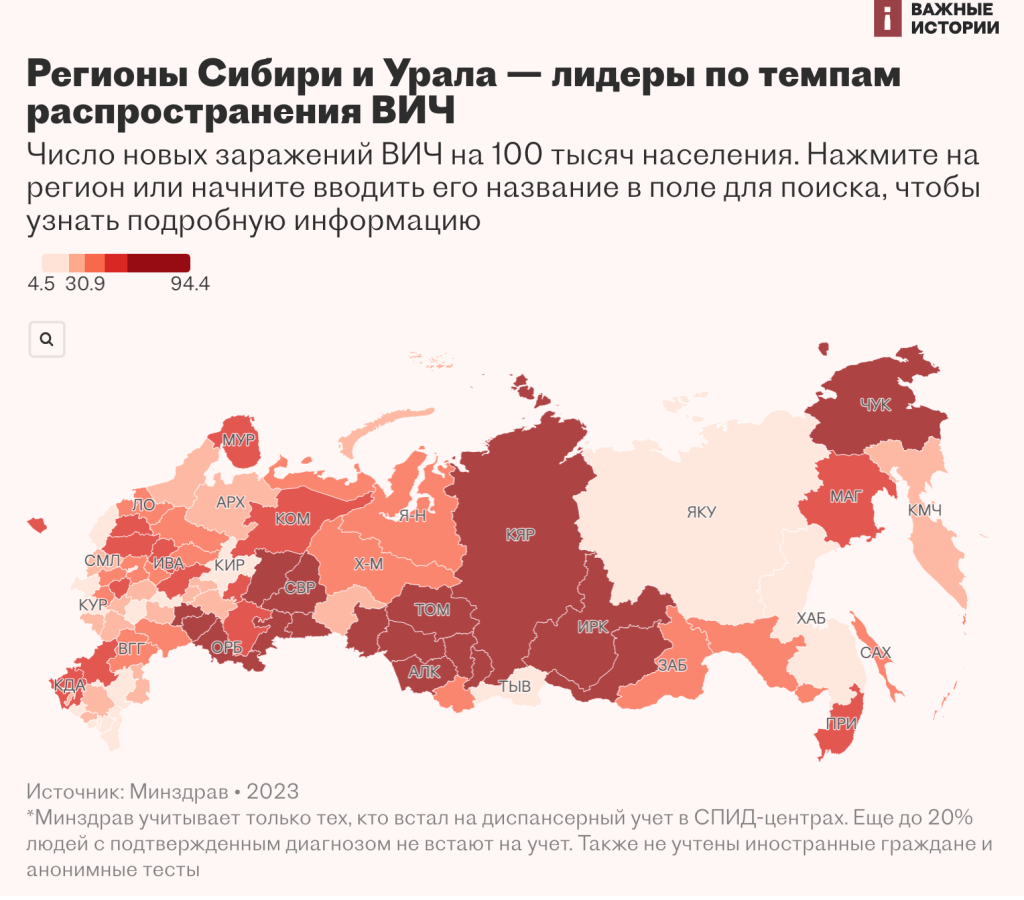
“Regions of Siberia and the Urals are leaders in the rate of HIV spread. Number of new HIV infections per 100,000 people.
Click on the region or start typing its name in the search box to see specific figures.”
This map is interactive in the original article, as published on the Important Stories website.

And yet, flying in the face of its own data, which showed an increase in cases, in March of this year the Health Ministry reported a reduction in the number of new cases of HIV infection in 2022.

According to the UN strategy for eradicating HIV, a country should seek to hit the “90–90–90” treatment target if they want to beat the epidemic. This means that ninety percent of people with HIV should know their status, ninety percent of people who know they are HIV positive should receive sustained treatment, and ninety percent of patients undergoing treatment should have an undetectable (i.e., very low) viral load. When this is the case, an HIV-positive person undergoing antiretroviral therapy cannot transmit the virus to another person.

Antiretroviral (ARV) treatment is the principal means of combating HIV. Every person living with the immunodeficiency virus should receive this therapy. But that is not the case now.

In 2021, 82% of people who had regular medical check-ups and 56% of all those living with a confirmed diagnosis of HIV infection received ARV treatment, according to Rospotrebnadzor’s AIDS Prevention and Monitoring Center. An undetectable viral load was attained by eighty percent of those receiving ARV treatment.

The rest — more than half a million people with a confirmed diagnosis — do not receive treatment. Their viral load remains detectable, so they risk spreading the infection.

By law, Russian citizens should receive ARV treatment for free. However, the Health Ministry procures less medicine than HIV-positive people need, and has not increased the treatment budget despite the fact that the number of patients has been growing every year. Every day, the project “Interruptions.ru” fields messages from patients complaining about the unavailability of treatment.

49% of Russians registered as HIV positive are covered by drugs purchased by the state.

In 2021, Russia procured only 391,000 annual doses, according to the International Treatment Preparedness Coalition. This covers approximately 49% of the number of people who receive follow-up care, and 34.4% of all people registered as HIV-positive. Therapy coverage was thus fifteen percent lower in 2021 than in 2020.

The drugs procurement budget for 2023–2025 must be increased by at least fifteen billion rubles annually in order to provide all patients with the necessary treatment. However, the Finance Ministry is willing to allocate 31.7 billion rubles for drugs procurement annually during the period 2023–2025 — that is, it does not plan to increase spending.

And yet, according to one estimate, Russia spent ten trillion rubles on the war over the past year. This same amount of money could provide all Russians in need of it with ARV treatment for 270 years in a row.

The Health Ministry procures drugs for ARV treatment on the federal level, while the regions must purchase the drugs they lack themselves, an activist who helps people with HIV explained to Important Stories on condition of anonymity.

According to her, AIDS centers in the regions submit applications to the Health Ministry for the amount of drugs they need. But the Health Ministry buys less than requested — for example, AIDS centers might apply for ten thousand doses, but the Health Ministry buys them only seven thousand. The regions have to find the money to make up for the shortfall in drugs.

“We must increase the number of patients in treatment and increase coverage,” our source told us. “At the moment, it is unclear what to do without additional allocations of money for purchasing medicines.”

If the Russian authorities spent ten trillion rubles on medicines, rather than on the war in Ukraine, they could provide HIV-infected Russians with the treatment they need for 270 years in a row.

The regions are not required to buy additional medicines, nor do all of them do it. Consequently, patients find themselves in unequal conditions: in richer regions, they receive the appropriate treatment, while in poorer regions they do not. Moreover, spending on drugs does not depend on how bad the HIV epidemic is in a particular region. This can be seen by looking at procurements of the drug Dolutegravir. According to our source, it is a well-researched and rather expensive drug that is suitable for many patients. But the Health Ministry has been reducing its purchases of the drug, while the country’s richest regions — the Tyumen Region, Moscow, St. Petersburg, and the Khanty-Mansi Autonomous District — spent the most of their own funds on it in 2022.

More than half of Russia’s regions did not purchase additional Dolutegravir for their patients at all, including, for example, the Sverdlovsk Region, where almost three thousand new patients were registered in 2022.

More than 77% of the money spent on Dolutegravir was spent by regions where only 23% of new HIV patients live.

Cutting-edge HIV treatment is available mainly to residents of rich regions

More than 77% of the public funds spent on procuring the drug Dolutegravir in 2022 were allocated by regions where only 23% of new cases live

A table showing how much Russia’s regions spent, in rubles and as a percentage of nationwide spending, on the ARV drug Dolutegravir in 2022, versus new cases of HIV infection last year, both in sheer numbers and as a percentage of the national total. The list includes Tyumen Region (at the top), Moscow, St. Petersburg, Khanty-Mansi Autonomous District, Chelyabinsk Region, Irkutsk Region, Tula Region, Novosibirsk Region, Yamalo-Nenets Autonomous District, Murmansk Region, and “all other regions.”

In 2022, Kommersant wrote about the reduction of purchases of expensive drugs for which there are no less-expensive substitutes. In 2021, such drugs accounted for 67% of the total volume of ARV treatment purchases, while in 2022, this figure was 55%. Cheaper drugs are being purchased to replace them.

Reducing the choice of drugs available makes it more difficult for patients to choose a treatment that suits them without causing side effects. It happens that only one drug out of four is suitable for a person, but the region where they live does not supply it.

Pokrovsky notes that the 63,000 new cases in 2022 is a high rate of infection. In reality, there are even more HIV-positive people in Russia, since the country’s most vulnerable groups are less likely to be tested.

“In part, the large number of new cases is due to the fact that we do test a large portion of the population: more than forty million tests were done in 2022. (But we must take into account the fact that, for example, pregnant women and donors are tested several times a year.) On the other hand, people who are particularly vulnerable to HIV infection — drug users and men who have sex with other men — are not tested enough,” Pokrovsky says.

68% of new HIV infections in Russia were the result of heterosexual sexual contact,
so sex education is needed to combat the epidemic.

Pokrovsky argues that to effectively combat the epidemic, the Russian government should promote sex education and fund social advertising campaigns.

“Nowadays, the biggest chunk of funding, over 30 billion rubles [per year], is spent on procuring drugs,” he says. “Treatment is supported by the pharmaceutical companies, so that is where the bulk of the funds are allocated. But there are no market-based solutions to prevention. In this case, you can only count on public funds. Very little is allocated for prevention, literally 500 million rubles [per year], and this amount does not grow from year to year. Most of it is spent on appeals to get tested, rather than on teaching people how not to get infected with HIV. Sex education is now practically prohibited [in Russia].”

Russia was among the top five countries in terms of new HIV case numbers in 2021. According to UNAIDS (the United Nations HIV/AIDS program), Russia accounted for 3.9% of the one and a half million new cases of infection in the world. Russia was bested, in 2021, only by South Africa (14% of all new cases), Mozambique (6.5%), Nigeria (4.9%), and India (4.2%). The Russian Foreign Ministry dubbed the news a “dirty information campaign” on the part of the West. Instead of receiving support, many Russian NGOs campaigning for HIV prevention and patient care have been labeled “foreign agents” by the Russian authorities.

Contrary to the stereotype that drug addicts are the most infected segment of the populace, heterosexual sexual contact is now the primary mode of HIV transmission in Russia, accounting for 68% of new cases.

You can take an HIV test free of charge and anonymously at AIDS centers in all regions of the country.

Source: “Every third region of Russia is experiencing a third-stage HIV epidemic. But the authorities refuse to recognize the growth of infections and purchase the medicines needed. Cutting-edge drugs are available to patients only in the wealthiest regions,” Important Stories (IStories), 13 April 2023. Translated by the Russian Reader


In Russian prisons, they said they were deprived of effective treatments for their H.I.V. On the battlefield in Ukraine, they were offered hope, with the promise of anti-viral medications if they agreed to fight.

It was a recruiting pitch that worked for many Russian prisoners.

About 20 percent of recruits in Russian prisoner units are H.I.V. positive, Ukrainian authorities estimate based on infection rates in captured soldiers. Serving on the front lines seemed less risky than staying in prison, the detainees said in interviews with The New York Times.

“Conditions were very harsh” in Russian prison, said Timur, 37, an H.I.V.-positive Russian soldier interviewed at a detention site in the city of Dnipro in central Ukraine, and identified only by a first name, worried that he would face retaliation if he returned to Russia in a prisoner swap.

After he was sentenced to 10 years for drug dealing, the doctors in the Russian prison changed the anti-viral medication he had been taking to control H.I.V. to types he feared were not effective, Timur said.

He said he did not think he could survive a decade in Russian prison with H.I.V. In December, he agreed to serve six months in the Wagner mercenary group in exchange for a pardon and supplies of anti-viral medications.

“I understood I would have a quick death or a slow death,” he said of choosing between poor H.I.V. treatment in prison and participating in assaults in Russia’s war in Ukraine. “I chose a quick death.”

[…]
Source: Andrew E. Kramer, ‘”A Quick Death or a Slow Death’: Prisoners Choose War to Get Lifesaving Drugs,” New York Times, 21 April 2023

The Wagner Group’s Suicide Squad

For several months, inmates in Russian penal colonies have been recruited by the Wagner Group — hundreds, if not thousands of convicts who had several years left in their sentences have already gone to Ukraine. It is likely that many of them have already been killed, but so far only individual deaths have been confirmed. One of them is Yevgeny Yeremenko from Petrozavodsk, who had eight more years left to serve on his sentence. In mid-June, he unexpectedly informed his mother that he was being transferred to another region. In mid-August, two strangers brought her a death notice: Yevgeny had been killed near Bakhmut on July 24.

Around noon on August 14, Tatiana Koteneva, a pensioner from Petrozavodsk, opened the door to two strangers who had buzzed her on the intercom and said they had been “sent by Zhenya.” Zhenya is her 44-year-old son Yevgeny Yeremenko, who had been sentenced to ten years in a maximum security penal colony. He was serving his sentence in Correctional Colony No. 9 in Petrozavodsk. He usually telephoned his mother every week, but she hadn’t heard from her son since early May — except for a strange call in mid-June, when Yevgeny said briefly that he was being transferred to another region.

So the pensioner willingly opened the door to the strangers, invited them into the kitchen, and poured tea. They handed her a reward and her son’s death certificate. “We have come with bad news,” they said, “Zhenya has died.”

According to Koteneva, the certificate, issued by the self-proclaimed Luhansk People’s Republic, indicated the date and place of her son’s death. He was killed on July 24 in Bakhmut, a Ukrainian-controlled city in the Donetsk Region, which has been heavily fought over all summer.

A call from the train: “Don’t worry, Mom — I’m doing what I have to do”
The pensioner does not know how her son ended up in Ukraine. Between early May and mid-June, he did not call her from the penal colony, although he used to do it regularly. Instead of Yevgeny, the pensioner was once called by a penal colony official and informed that her son was “alive and well, but undergoing punishment.” Koteneva refers to punitive confinement as “the cellar,” and she is sure that her son had been put there.

“[The official] introduced himself, but I don’t remember his name,” she says. “I tried to make an inquiry. He replied that my son had violated some article of the law there, and he had been punished. I said, ‘You tortured him and probably beat him.’ And this one who called me said, ‘There isn’t a scratch or a bruise on him.'”

Only on June 14 did Yevgeny unexpectedly telephone his mother and say that he was being temporarily transferred to another penal colony.

“He called me and said, ‘Mom, we are being convoyed at two o’clock in the morning to another colony,'” recalls Koteneva. “A tumor had formed on his cheek near his nose. He says, ‘There are no doctors here [in Petrozavodsk Colony No. 9], so maybe I’ll get treatment there.’ And that was it. I said, ‘I’ll be expecting a letter from you and the details of where I should send you a package or money.'”

According to her, her son did not say that he was going to Ukraine, probably because he knew that she would be opposed to it.

“I would probably have gone into hysterics and all that to prevent it,” the pensioner argues. “I would have run to the colony and bent over backwards. But I couldn’t get into his head… He’s a grown man. He just said, ‘Mom, don’t worry. I’m doing what I have to do.'”

A week later, according to Koteneva, her son sent an SMS to a friend, asking him to inform his mother that he was alright. He added that the prisoners were still traveling on the train, where “even their watches had been confiscated.”

Recruitment in the penal colonies: “You finish your service and you get amnestied”
Yevgeny Yeremenko was probably recruited by the Wagner Group and sent to Ukraine as a mercenary. The fact that mercenaries are being recruited in correctional colonies became public in early July, but, apparently, it began in May. Yevgeny Prigozhin, the Wagner Group’s founder, a man known for his proximity to the Russian authorities, personally went to some colonies to persuade inmates to join up. Recruiters promised convicts a large salary and release after six months of combat — to this end, those who agreed to join the mercenaries would have to write petitions asking for clemency.

It is unclear how many people have been marshaled this way, but recruiters, judging by the prisoners’ reports, have already visited between fifteen and twenty colonies, and in each of them a hundred or more inmates have agreed to go into combat. (Although relatives have managed to dissuade some of them.) The head of the Russian Behind Bars Foundation, Olga Romanova, noted that her organization has already received about two hundred appeals from relatives of convicts who have lost contact with them and assume that they have been sent to Ukraine.

Yevgeny Yeremenko. Photo courtesy of his VKontakte page and Mediazona

In June, people really did come to Petrozavodsk’s Correctional Colony No. 9, where Yevgeny Yeremenko was imprisoned, and tried to persuade the inmates to go to fight in Ukraine, convict Marat Najibov told Mediazona. He himself turned down their offer. “You finish your service and you get amnestied,” he says, adding that he does not know exactly where the recruiters were from.

Petrozavodsk lawyer Ivan Varfolomeyev, who represents ten convicts in Correctional Colony No. 9, believes that they were probably from the Wagner Group. “Ten people were persuaded to go to Ukraine, but after consulting with me, no one went,” says Varfolomeyev. I didn’t see [the recruiters]. The convicts asked me what they should do. I said, ‘You have parents, wives, and children — I would not recommend it.’ My clients, at least, are not serving such long sentences.”

The convicts did not tell Varfolomeyev that they had been coerced by recruiters or the colony’s wardens. They talked to the prisoners, as he puts it, “about pies”: they vividly described the benefits to which the inmates would be entitled after being in combat.

“[They were not threatened with] solitary confinement, AdSeg, or beatings,” says Varfolomeyev. “On the contrary, all the offers were tempting.”

Little is yet known about the deaths of the prisoners recruited by the Wagner Group to go to Ukraine. In late July, iStories reported the deaths of three prisoners from Petersburg Correctional Colony No. 7. Their papers did not contain their real names, but only their nicknames. Among the dead was Konstantin Tulinov, nicknamed “Red.” it was about him that filmmaker Nikita Mikhalkov spoke in [the 6 August 2022] episode of his program [Exorcist TV] on Rossiya 1. According to Mikhalkov, Tulinov “wanted to atone for his past life,” so he himself petitioned to be sent to the front. In Ukraine, his legs were “crushed,” after which Tulinov “blew himself up with a grenade.”

“And the state responded with gratitude to him for his courageous deed. He was posthumously pardoned and, in addition, was designated a full-fledged combat veteran with all the ensuing benefits and payments,” Mikhalkov assures his viewers.

Olga Romanova of Russian Behind Bars has written that relatives of the recruited prisoners constantly appeal to her organization for help.

“What an outrage! They promised to pay [him] 200 thousand [rubles], but they paid [only] thirty thousand,” she wrote, paraphrasing the kinds of appeals her foundation has received. “And my [relative] was wounded, but [the wounded] are being treated only in the LPR; [they] are not taken to Russia. Help us save him! And then another one was killed near Luhansk; the relatives were not informed, and the body was abandoned in the combat zone so that they wouldn’t have to pay for a coffin.”

The Karelian office of the Federal Penitentiary Service has not yet responded to Mediazona‘s request for information as to how Yevgeny Yeremenko ended up in combat in Ukraine eight years before he was to be released from prison.

Since the Russian invasion of Ukraine began, the Governor of Karelia, Arthur Parfenchikov, has been publishing posts on his VKontakte page about the residents of the republic who have perished in the war. But he did not even mention the death of prisoner Yevgeny Yeremenko.

The funeral: “young men” come to pay their last respects and reimburse expenses
Tatiana Koteneva calls the strangers who brought her the death notice “the young men.” They told her that her son’s body was “in an iron coffin in Leningrad, at Pulkovo [airport].” As for additional questions, according to the pensioner, she was told that “everything is classified.” The men did not respond when she asked them who they worked for.

“What can I do now? You can’t bring anything back,” she argued resignedly two days before the funeral. “Well, that’s how it turned out, so that’s how it’s going to be. What matters to me is burying him and having a grave to go to and cry. Things turned out the way they turned out.”

On August 18, Yevgeny Yeremenko’s body was brought to Petrozavodsk by a private driver: the pensioner paid 26 thousand rubles for transportation. Yeremenko’s funeral took place the next day, recalls Marina Gorodilova, a friend of Koteneva, whose son is also an inmate at Correctional Colony No. 9. (This was how she and Tatiana met.)

“The coffin was closed and there was a strong smell of decomposition,” she recalls. “Tatiana Ivanovna stood over the coffin lid the whole time and cried.”

According to Gorodilova, at the wake and the funeral there were none of the military officers or civilian officials who make speeches on such occasions. But in the funeral hall, she noticed “two strange guys.”

“One [was] forty years old, the other [was] younger, both of them [were] powerfully built. They laid the flowers [on the coffin] and took three or four steps back. They stood at attention and didn’t talk to anyone. I picked up my phone and poked it with my finger and out of the corner of my eye I saw that they were watching me — very attentively. Tatiana Ivanovna asked them, ‘Who are you?’ But they didn’t say anything. She then asked again, ‘Do you know Zhenya?’ One of them nodded his head quietly and kept standing there.”

The day after the funeral, Tatiana Koteneva refused to meet with her friend, citing the fact that “the young men” were coming to see her again. A few days later she reported [to Gorodilova] that she had been reimbursed 145 thousand rubles [approx. 2,400 euros] for the funeral.

“Either they hold them [in solitary] before sending them, or they hold those who don’t want to sign up”

Dmitry Gorodilov. Photo courtesy of Marina Gorodilova and Mediazona

Dmitry, Marina Gorodilova’s son, is serving his sentence at Correctional Colony No. 9, where he met the deceased Yevgeny Yeremenko. He has not been in touch with his mother for a month and a half — since July 4 — and she fears that Dmitry, like Yeremenko, was put in punitive detention before being sent to Ukraine. Human rights activists from Russia Behind Bars have spoken of this practice. For example, in Correctional Colony No. 7 in Karelia and Correctional Colony No. 19 in Komi, some convicts at first agreed to go into combat, but then changed their minds. Prison officials then began pressuring them, and some were sent to punitive detention.

“Now it’s the same story: now my Dima is missing,” says Gorodilova. “He doesn’t write and doesn’t call — this has never happened. The lawyer called the prison and asked them whether Dima was there. They said he was there. I went to the colony to visit him, and they said to me, ‘He is undergoing punishment.’ It’s one of two things. Either they are held [in solitary] before being sent [to Ukraine] so that they do not receive information and do not share it with anyone. Or those who don’t want to sign up are held [in solitary, where] they are forced [to sign up].”

Gorodilova is sure that her son would not left officials force him to go to Ukraine even under torture.

“Only if they lie to him or tell him that he would cleaning up after the war, maybe he would agree to sign up. But he’s a guy that won’t sign anything until he reads it. I know that Dima will definitely not agree to it. Even if he is promised his freedom, he will not go to kill people.”

Source: Alla Konstantinova, “Sent down for ten years, enlisted in the Wagner Group, killed in Ukraine: the example of one inmate from Karelia,” Mediazona, 26 August 2022. Thanks to Dmitry Tkachev for the heads-up. Translated by the Russian Reader