A charity concert has been held in Paris in tribute to the pianist Pavel Kushnir, who died in detention in Russia. The funds raised were donated to the Paris-based Atelier des artistes en exil (Agency of Artists in Exile), which aids artists who have fled their countries due to war, persecution, and discrimination.
The concert was held at Salle Cortot in Paris. World-renowned pianists Grigory Sokolov and Sergei Babayan performed a program of pieces by Frederic Chopin, Robert Schumann, Franz Schubert, Franz Liszt, and Sergei Rachmaninoff. Tickets for the concert were sold out almost instantly.
“As musicians, we want to voice our support for artists around the world who are persecuted and sometimes forced to leave their native country. Pavel Kushnir chose internal emigration and bravely and unreservedly spoke out against the war. He paid for this with his life. We wholeheartedly support Grigory Sokolov and Sergei Babayan’s November 18 concert in Paris and join them in paying tribute to Pavel, as well as in voicing our solidarity with all artists who are suffering from repression today,” reads a letter in support of the concert, which was signed by Martha Argerich, Daniel Barenboim, Gidon Kremer, Anne-Sophie Mutter, Semyon Bychkov, Paavo Järvi, and many other famous musicians of our time.
“Music can be used for good as well as for ill. Pavel Kushnir always used it for good. Let us honor his memory and follow his example,” says pianist Evgeny Kissin, who also signed the letter.
“I am honored to pay tribute to the memory of a young artist who gave his life for the truth. Pavel Kushnir clearly understood that there can be no happiness and, in fact, no real art when one country causes another country untold suffering, and the truth about this crime is not heard. The deeply inhuman nature of the regime responsible for his death is underscored by the fact that he, a young artist living far from the capital, posed no danger to the continuation of its criminal rule. He made a beautiful recording of Rachmaninoff’s Preludes, and for that reason I wanted to play Rachmaninoff for him. I would have loved to have met Pavel, who was undoubtedly a beautiful, exceptionally sincere young soul. My thoughts are with Pavel Kushnir, his family, and all the victims of the enemies of freedom and truth,” said Sergei Babayan, explaining his involvement in the concert and the works selected for it.
The proceeds from the concert, as well as the donations raised, will be given to the Paris-based Atelier des artistes en exil, which has aided many hundreds of artists during the seven years of its existence.
“When we left Russia, we had heard nothing about Atelier, and it was not clear where we would put down roots,” says composer Dmitry Kurlyandsky, who turned down Russia’s Golden Mask national theater prize, which he was awarded for the music he wrote for Perm-based Theater-Theater’s production of the play Katerina Izmailova. He called the award “antics on the part of a system which is destroying the theater.”
“But on the second day,” Kurlyandsky says, “I had already found out about Atelier. We called them and they invited us to a meeting. It was the very beginning of the wave of emigration from Russia, and Atelier had more capacity to accommodate refugees. We lucked out. Thanks to Atelier we stayed for eight months for free in a hotel in downtown Paris, and during this time we were able to get our papers sorted and find a place to live.”
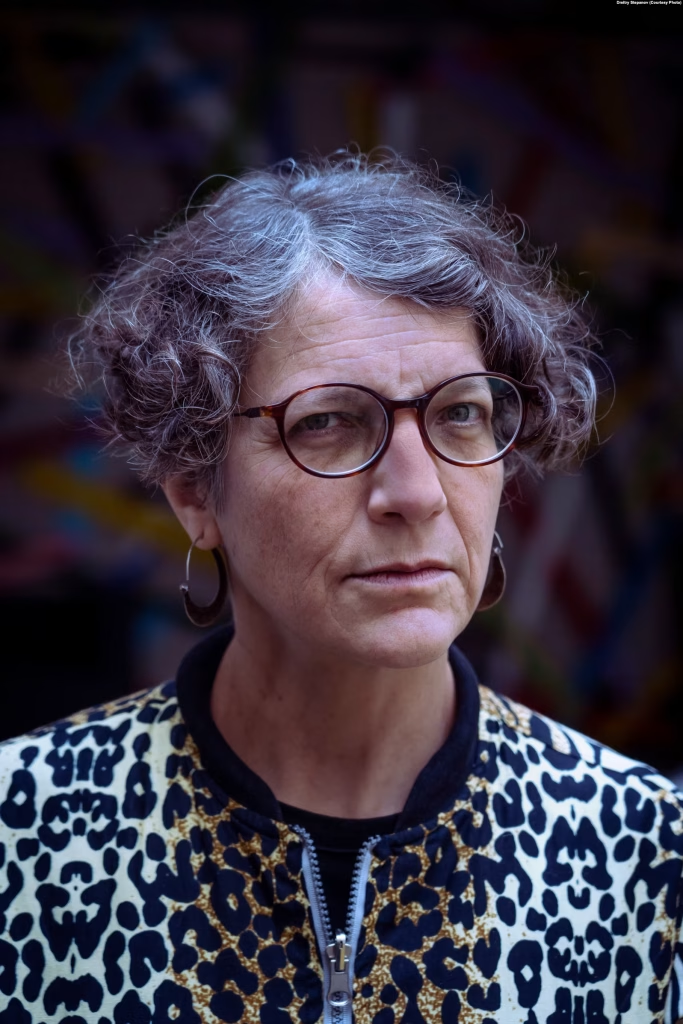
Judith Depaule, founder and head of Atelier des artistes en exil, sat down for an interview with Radio Svoboda.
— How did you find out about Pavel Kushnir’s tragic story?
— From Russian acquaintances. I also read about it in the French press. There wasn’t that much coverage of Kushnir’s plight, but there were some articles nevertheless. Many artists at Atelier talked about it.
It’s all quite frightening, of course. I have been studying the history of theater in the Gulag for a long time. I see Kushnir’s tragedy as a repetition of what already happened, of things with which we are all very familiar. I’m always amazed at how much history can repeat itself. I wonder why it repeats itself, despite everything we know about our past. How is it that people are dying again just for freely expressing themselves! I find it scary, because the right to freedom of expression is what matters most.
— You said that you said that you studied theater in the Gulag. Tell us a little more about that.
— It so happened that as part of my studies I researched the work of the Futurist theater director Igor Terentiev, who was arrested and sent to work on the White Sea Canal. We know a lot about his life on the White Sea Canal because he was photographed by the legendary Alexander Rodchenko. It was a shock to me that the theater could exist in the Gulag. I researched the topic. I went to the Memorial Society, and I was able to interview many former prisoners. I even traveled to Magadan and Vorkuta. So I am an expert on the history of the theater in the Gulag.
— Whose idea was Pavel Kushnir memorial concert? Why were Grigory Sokolov and Sergei Babayan involved in it?
— It was the artists at Atelier who took the initiative. To make the event respectable, they decided to invite famous musicians. We approached Sokolov and Babayan, and they immediately agreed.
— Yes, Sokolov and Babayan are certainly musicians of the highest order. Babayan is also a renowned teacher. Was the concert program solely Sokolov’s and Babayan’s choice? Or did they discuss it with you as well?
— No, they decided themselves what to play in memory of Kushnir. It was their own choice; we didn’t discuss it with them. It was important to us that the program included pieces which they loved and were willing to perform.
— I think any classical music lover would dream of going to such a concert. It’s just a pity that the occasion is so tragic. There was also a letter in support of the concert, signed by a plethora of classical music stars. The letter claimed that Pavel Kushnir had chosen internal emigration, internal exile. Do you agree with this? If so, how do you understand this term?
— I would imagine that Pavel did not want to be the center of attention, but simply wanted to feel freer. This did not work out for him, alas. I think that, while living under a dictatorship, Pavel was trying to find a place where he could at least breathe freely and do what he loved doing. Because Russia is so vast, you could say that it really was internal exile. This again takes us back to the past. When people tried to disappear from the Kremlin’s sight, they left the major cities to feel at least a little bit freer.
— Atelier des Artistes en Exile deals with a wide range of creative genres, not just music or theater, for example. How did you decide to take on such a serious challenge?
— I founded Atelier in 2017 as a response to the migration crisis in Europe, which peaked in September 2015. There were so many Syrian migrants in Paris. I was working in a small cultural center at the time. We just decided to shelter migrants; it wasn’t about artists at the time. Gradually we began helping immigrants and put together a festival that was dedicated to Syria. I often talked to exiled artists, and they always said the same thing: “We were professional artists before we left. We had a profession. What are we supposed to do now? We don’t understand how French society works, we don’t understand its cultural traditions.” And so on. I decided that something had to be done to help performers and artists in exile. Gradually, this idea began to develop, and I set up this agency in early 2017. At the time there was no talk at all about Russian artists and performers, back then it was mostly Sudan and Syria. Atelier has grown because it helps everyone who leaves their country, whatever the reason, whether dictatorship or discrimination. The world is now in a state in which there are wars, dictatorships, and illegal imprisonment everywhere. So performers and artists have started arriving in France much more often.
— What kind of assistance do you provide? Do you help with accommodation, visas, and jobs, or do you support cultural projects?
— For those who are still in their home countries but want to come to France, we help them get visas and explain how to get here. When people are already in France, we help them with long-term visas and residence permits, so that they are staying in France legally. We help them with social services — medical insurance and so on. We provide a place to work, because that is super important. If you don’t have a place to work, you are no longer an artist or a performer. We offer French language courses, and we have put together a program for artists to learn French through art. We help them understand how French society is organized and learn the peculiarities of French culture. We explain to them what rights they have, what benefits they can claim, how they should fill out their income tax declarations, and so on. We also organize cultural events.
— Who supports Atelier des artistes en exil itself?
— It is supported by the French Ministry of Culture, which sponsors various programs. Private foundations also help out. We are constantly looking for resources. The Pavel Kushnir memorial concert also includes a fundraising campaign to support the Atelier. This involves the money from ticket sales and donations, which we need very much, as we have a large team helping hundreds of people — 350-400 people a year.
— How can people who decide to come to you for help prove that they are artists?
— You have to show us what you have done up to this point: a portfolio, internet links, an account of your past work. It is not difficult to check whether a person is actually an actor, musician, or artist. It is immediately clear what kind of experience they have, where they studied, with whom they worked. Then we decide whether or not to work with them.
— Given that there is a full-scale war on in Ukraine, do you prioritize Ukrainian artists who have fled the hostilities when you’re choosing whom to help?
— Because there are many ongoing wars in the world, we don’t prioritize anyone. We just assist people who find themselves in a dangerous situation. If we talk about relevance, we are most often contacted by people from Gaza and Lebanon, who can be killed at any moment and who ask us how they can leave and what they need to do to leave. We are always watching what is happening in the world. It was not that everything was fine in the world when we started, but there were not so many conflicts. After the pandemic, there were immediate problems in Myanmar and Afghanistan, there was the war in Ukraine, there was the brutal crackdown against the women’s rights movement in Iran. And so on and so forth. More and more performers and visual artists have been turning to us because they don’t know how to go on living.
— Has the number of Russians who seek your assistance increased recently?
— It has been a constant flow which doesn’t stop. The current wave of émigrés from Russia is even greater than the very first one, whom we call White Russian émigrés.
— Let us return to the fate of Pavel Kushnir. I have read that famous musicians who learned about this tragedy and then listened to Pavel’s recordings and read what he wrote, voiced regret that they had not known about him or his talent earlier. Do you think there are many such unknown talents in the world? If so, how can we help the world learn about them not only after their tragic deaths, as happened with Kushnir?
— Pavel’s fate mirrors the history of art in many ways. Many great talents have been discovered after their death. There are so many musicians, actors, and artists for whom creating and making art is what matters most, not being famous. It doesn’t matter to them that they are not in the public eye. We can’t know about everyone, of course. I can’t suggest any way of remedying ths; it’s just the way the world works. There are people who will always be in the limelight, and there are people who will go on modestly pursuing what they love. Sometimes they are more talented than the artists we know well. When we discover a great talent after their death, sometimes a hundred years later, we ask ourselves how come we hadn’t heard anything about them until now, how we had missed them. But there’s hardly anything we can do about it.
Source: Andrei Sharogradsky, “‘I Wanted to Play Rachmaninoff for Him’: A Pavel Kushnir Tribute Concert in Paris,” Radio Svoboda, 19 November 2024. Translated by the Russian Reader. Thanks to Comrade Koganzon for the heads-up.