Dankhaiaa Khovalyg: Russia’s Asian Republics Speak

Dankhaiaa Khovalyg. Photo: Rinchinaaa/Baikal People

‘I was made from Russian anyway,’ 28-year-old Dankhaiaa Khovalyg writes in her story ‘Ayalga,’ published in early 2022. Its female protagonist tells a psychologist how she feels like a stranger in her own country. When Dankhaiaa was a teenager, she deliberately detached herself from her native culture. She was proud to speak Russian without an accent, and dreamt of leaving Kyzyl ‘to be with her own people’ in Moscow.

During her eight years in Moscow, Dankhaiaa was involved in decolonial activism, researched her own painful background, and launched a project about indigenous people from Russia’s six ethnic Asian regions —the podcast re.public_speaking.

Alina Golovina, a Baikal People correspondent based in Buryatia, spoke with Khovalyg about why it is important to talk about trauma, where decolonization begins, and whether Russia’s ethnic republics can unite for their own benefit. At Danhkaiaa’s suggestion, they spoke to each other using the informal second-person pronoun ty.

As soon as I would lеave home, the world would crash down on me with all its xenophobia

— Tell me about yourself, Dankhaiaa.

— I was born and raised in Kyzyl. After graduating from school, I went to study in Moscow and lived there for eight years. I worked as a client manager in an IT company and was involved in feminist activism. In 2021, I quit my job and realized my childhood dream: I enrolled in literature classes and took up writing. Since March 2022, I have been living in Berlin and doing podcasts and anti-war activism.

— You told me that up to ninety percent of the indigenous people in Tuva speak Tuvan and consider it their native tongue. Why have you prioritized Russian? Is it a problem?

— I’m a city girl: I grew up in Kyzyl. I was sent to a Russian-language kindergarten and, later, to a Russian-language class at school. That was how my mother showed that she cared about me: Russian-speaking classes were considered tonier. I was a bookworm and was engrossed in Russian literature. Unfortunately, I didn’t have access to a large amount of foreign literature at school, and at that moment, eighty percent of me certainly consisted of this great and beautiful Russian literature by the so-called Tolstoyevskys. I read all of that stuff and would dream of going to Moscow. I was a little proud that I spoke such beautiful Russian. Basically, I went through all that internalized colonial chauvinist crap that life was better there, that I was going to get out because I was more like them.

— Did it save you from ethnic discrimination? If not, when did you first encounter it?

— My experience of discrimination actually began long before I moved to Moscow. My mother found opportunities using travel vouchers to send me to summer camps in Krasnodar Territory, Khakassia, and other regions. I was eleven and twelve years old at the time. It didn’t matter whether I traveled five hundred kilometers from home or several thousand, because everywhere I went I encountered phenomenal bullying. I was labeled ‘China girl’ and ‘black.’ No one asked me to dance at dance parties. I was either totally ignored or talked to condescendingly and peppered with passive-aggressive insults. I had lived in my native Tuva in a groovy, comfortable bubble: most people spoke Tuvan, and we didn’t encounter any racism there. But as soon as I would leave home, the world would crash down on me with all its xenophobia. Whereas in Tuva I was considered pretty, smart, and cool, everything and everyone at those camps made it clear to me that I was second-rate.

— How did this affect you?

— These contrasts generated very unhealthy takeaways in my head: that Tuva’s overall level [of development] was much lower than the rest of Russia’s. This absolutely perverted assumption made me, as a teenager, condescend to Tuvan culture and my Tuvan side. It is quite painful for me to remember the instances when relatives addressed me in Tuvan, but I would reply in Russian, saying that I didn’t understand them, although that was a lie. Those memories now make me feel bitter. I feel sorry for that teenage girl.

— What happened later in life? How did Moscow welcome you?

— I often encountered micro-aggressions in public places. For example, I would be standing in the queue at a store, and a huge Russian guy would push me aside and go in front of me. There was no explicit verbal indication that this was because I was non-Russian, but I think this wouldn’t hae happened if I had been of Slavic appearance. I repeatedly had big problems finding a place to live because of my name and my appearance. Or, for example, I would be climbing the stairs to my floor, and neighbors descending the stairs would say, ‘The churkas have come and taken over the place’ when they would see me. They would not say it to my face, but under their breath as it were, and when they were already a flight below me, so I couldn’t even shout back at them as it happened. I would just stand there for a while, frozen on the steps. You always deal with this alone because when you are with your husband or a group of people, those very same neighbors keep their mouths shut. Every such episode of chauvinism really demoralized me, although I didn’t express it outwardly. Because no matter who I would tell, they would say, ‘Oh, don’t pay attention! Rise above it! We don’t stoop to their level.’ I swear that there has never been an instance when someone just shared my indignation for a second.

— Have you experienced physical violence? Have you been attacked?

— I didn’t encounter any actual boneheads (far-right skinheads): I moved to Moscow in 2013, by which time the most ardent supporters of that ideology had been jailed. The cases of physical violence that happened to me are difficult to categorize. The first time it happened was when I was in my first year at university. I was traveling from my part-time job in an empty train carriage to my dormitory. I had leaned my head against the window and fallen asleep with my legs stretched out. I woke up to an old man kicking me and saying, ‘Move your damn feet.’ I did and asked him what was the matter, and he said he wanted to sit down. I suggested he sit down in one of the other free seats, upon which he started kicking me again, saying that I was a churka and if I gave him any guff, he would beat the shit out of me. It was so horrible, because the old man spoke softly and looked like a harmless creature. I didn’t leave because I didn’t want to look weak. He stared at me point-blank the whole way and commented that I behaved very freely in Russia. It was forty minutes of violence.

The second incident happened on Leninsky Prospekt near the Oktyabrskaya subway station. It was summer, I was walking with headphones on in a crowd of people, listening to music. I noticed out of the corner of my eye that a man was walking in my direction and looking at me intently. Over the years, you develop something like a muscle that reacts to unwanted attention and makes you tense up and pull yourself together as if you’re getting ready to react. When the man walked by, he hit me over the head with a bottle. I fell down. He walked on. So there I was, lying propped up on my elbows, looking at the man walking away, and all the other people just passed me by. I thought at the time that it could have been a scene from a film, because only in a film can you get hit and nobody comes up and asks how you’re doing or tries to help you. And there were a lot of little situations — elbowing, pushing, kicking. Several times when I was putting away my dirty tray at a food court, I was told, ‘Hey, clean this up.’

Continue reading “Dankhaiaa Khovalyg: Russia’s Asian Republics Speak”
No Kidding

Russia for the Rueful: A Map of Fear | Ivan Davydov | Republic | 7 December 2021

Once upon a time, an influential, respected person and I came up with a project meant to illustrate the absurdity of the Russian Criminal Code’s infamous Article 282, the one about “inciting hatred and enmity.” Oh, what a long time ago it was. Back then, there were simply no other articles in the Criminal Code that covered thought crimes. Can you imagine?

The idea was simple: gather quotes from classic Russian literature that were obvious violations of Article 282, make a website, and send an angry letter to the authorities. How long must this go on? we would write. Enough is enough! Ban books that sow hatred!

Actually, that’s why we focused on the Russian classics. It would have been easy to find the same kind of incitement in Homer, but uniformed readers might not react to his name. But they had definitely heard the surname Pushkin.

When everything was almost ready, however, my senior colleague (a wise person) said, “You know, let’s not do this. After all, they might just up and ban these books. But we have to go on living. How will we live with ourselves then?”

Patriot Games

I recalled this story while reading the amazing news about the Investigative Committee’s war on Russian rap. First, an alarming dispatch appeared on the newswires: the head of the Investigative Committee, Alexander Bastrykin, after receiving an appeal from a “pressure group of patriots,” had ordered an inquiry into the new albums by Oxxxymiron and Noize MC. The pressure had informed the general that the rappers had whitewashed Nazism and promoted extremism.

It was a news item like any other. There is no other kind of news nowadays in Russia, nor can there be any other kind of news.

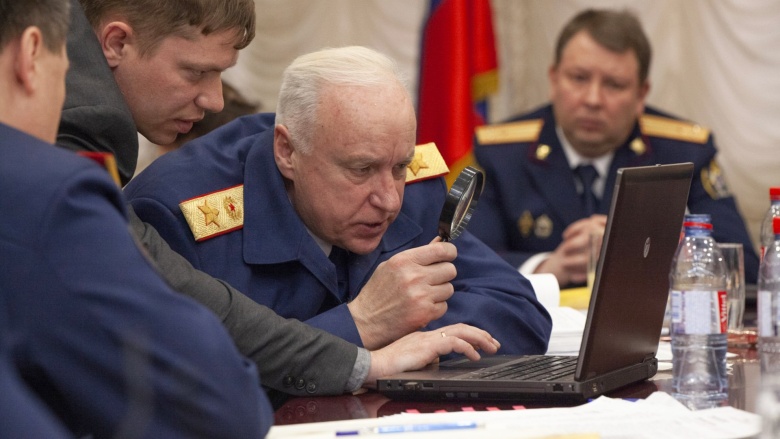
But then there was more news: the text of the letter by the “patriots” turned up on the LiveJournal blog of a moderately successful online humorist. The country’s chief investigator was not bothered, it transpired, by passages such as the following: “To tell the truth, the faces of Russian law enforcement chiefs are really not always so elegant, and when they start talking, they sometimes seem like aggressive morons, thus generating depression and suicidal moods [among the populace]. It’s also good that they’ve stopped showing the MP Irina Yarovaya on TV. Something needs to be done in this case, because our enemies exploit this weakness.” Famous for his habit of viewing publications on the internet through a magnifying glass, Bastyrkin failed to notice the ridicule.

Alexander Bastyrkin, checking whether the internet is whitewashing Nazism. Photo: Russian Investigative Committee

The author of the “letter” has now been making the rounds of the media, trying to prove that he had been joking. But it doesn’t matter: Veterans of Russia, which is a real (not fictional) pressure group, said that they would write an actual denunciation against the rappers.

Forbidden Topics

It’s basic knowledge that you don’t kid around with policemen, judges, and border guards. Lately, everyone has been recalling what they did during the “snow revolution” protests, ten years ago, so I’ll indulge in remembering what I did too. In the spring of 2012 (not the winter of 2011), I was tried and fined for being involved in an “unauthorized” protest in which I was not involved. At the trial, I decided to take issue with the arrest report, according to which it had taken the paddy wagon ten minutes to transport me from the Nikitsky Gate (in the very center of Moscow) to a police station in the suburbs.

I contacted experts, who calculated that the unfortunate PAZ bus would have had to race at a speed of 600 kilometers per hour. I presented my thoughts to the judge.

The stern lady looked up at me with tired eyes. “Are you questioning the capabilities of the domestic automotive industry?” she asked. I resigned myself to my fate. Plus the fines were humane back then, nothing like the current ones.

But the list of those who cannot be trifled with is outdated. On Monday, the supremely pro-Kremlin polling agency VTSIOM published data on what things Russians now consider it impossible to laugh at.

Many of our fellow Russians are sure that they have a sense of humor. Overall, forty percent of the respondents said they had a sense of humor, and more than half of the young people surveyed said the same thing. And yet, Russians laugh at the jokes of the Ural Dumplings and love KVN, which makes one wonder about their assessments of their own sense of humor. But let’s get to the point.

A screenshot of VTsIOM’s polling data about subjects that Russians consider off-limits for humor. It should be kept in mind that it was VTsIOM that compiled this list of “forbidden” topics, not the people who were surveyed. And Ivan Davydov says as much, below.

In first place on the list of forbidden topics are jokes about the “health characteristics of other people,” and this is probably a good thing. It gets more interesting from there. Eighty percent of those surveyed believe that it is impossible to joke about the [Russian Orthodox] Church. Sixty-nine percent do not see anything funny about “the ethnic traditions and peculiarities of different peoples.” The same number are convinced that there is also little funny about the history of Russia, the USSR and the Russian Empire. (Here, by the way, I agree: there is little that is funny about Russian history.) This includes the sixty-three percent who are against jokes about “historical figures who are not living now.” Fifty-three percent would not touch “the army and the armed forces.” And fifty-one percent consider President Putin off limits (or untouchable?). Reverence for government in general is so strong that forty-five percent are afraid to joke about “other heads of state.”

Joking Aside

The list is quite revealing. But it has nothing at all to do with a special species of hypocrisy peculiar to our population. It has to do with the state’s attempts to train the populace like animals. After all, the list perfectly correlates with the news about the campaign that the state has been waging against thought criminals. The feelings of religious believers are fragile, and the more that official spokesmen of traditional confessions talk about love and mercy, the higher are the chances that they would tear you apart for making an innocent joke. Or their particularly zealous adherents would do this: it makes no difference to the targets of their outrage. There has been a lull in the “buttocks war,” but the echoes of this war are still capable of scaring people.

Why people would steer clear of “ethnic traditions” also needs no explanation, nor is it an example of their outstanding political correctness. They understand that some traditions have their own specifics. Some peoples have a tradition of taking offense and demanding an apology on camera after having conversation with the offender that is fraught with bodily injuries of varying severity.

Nor is our reverent love of history love at all. “Whoever remembers old things, pluck out his eyes,” says the proverb. “Or maybe give him five years for whitewashing Nazism,” the Investigative Committee would add. We now have our own favorite stories on this score. The stories about the Investigative Committee and Alexander Bastrykin’s personal campaign against “Hitler’s accomplices” are well known to everyone. In the Chelyabinsk region, a homeless man who decided to dry his socks at the Eternal Flame was charged with whitewashing Nazism. What can we say about smart people who risk talking about the past? Yes, it’s better not to say anything—you’ll be safer. And if you think that all this concerns only the Second World War, then you’re thinking wrong. In Novosibirsk, investigators had a strict conversation with a scholar who dared to speak about Alexander Nevsky without sufficient respect. In St. Petersburg, the probe into the blogger who hung his own portrait in the Hermitage’s Gallery of Heroes of 1812 so that he could take selfies has not yet been completed. And so on.

The fact that the Russian President rounds out the list of topics forbidden for humor is a direct rebuke to Federation Council member Andrei Klishas. The law he wrote on mandatory respect for the authorities is not really working. (Although the police on the ground have been trying: they have been catching jokers on VKontakte and rolling out gigantic fines for them.) The Investigative Committee should probably take a closer look and figure out whether there has been any sabotage on Klishas’s part. Times are turbulent: there’s a hybrid war underway, and the enemy can entrench itself even at the Federation Council. You can’t let your guard down for a minute.

A Map of Fear

I don’t know what the pollsters at VTsIOM hoped to achieve when they did their survey. But they have produced a perfect map of fear. The state has been trying to intimidate its subjects, and, as we can see, its efforts have not been in vain. Although we should note that the Church, the “traditions of certain peoples,” and their own history frighten Russians more than the authorities, which is evidence that the state cannot finish the job even in this case. They cannot pull off everything: the police-state vertical has not yet been built. But I have to give them credit: they keep on working, they don’t give up.

What can I say. Let’s remember that laughter is the most effective cure for fear. By setting traps for pranksters, the country’s current proprietors do not demonstrate their own strength. They only point up their own weak spots. By intimidating us and nurturing our fears, they demonstrate their own fear. It’s good to see this. Although this is cold consolation for someone who has been imprisoned for making a joke.

But to avoid succumbing to excessive pessimism (and thus delighting government officials), let’s recall these lines of verse by Nikolai Karamzin, the founding father of Russian historiography:

He who, bored, summons the Muses
And the gentle Graces, their attendants,
With poems and prose amuses
Himself, strangers, and dependents,
And laughs in all sincerity
(Laughing is really not a sin!)
At everything that makes him grin
Will get along with the world in amity,
And won’t cut short his days
With sharp blades or poisons…

Translated by the Russian Reader