
Forward Together, Backward by Order
by Jim Swift
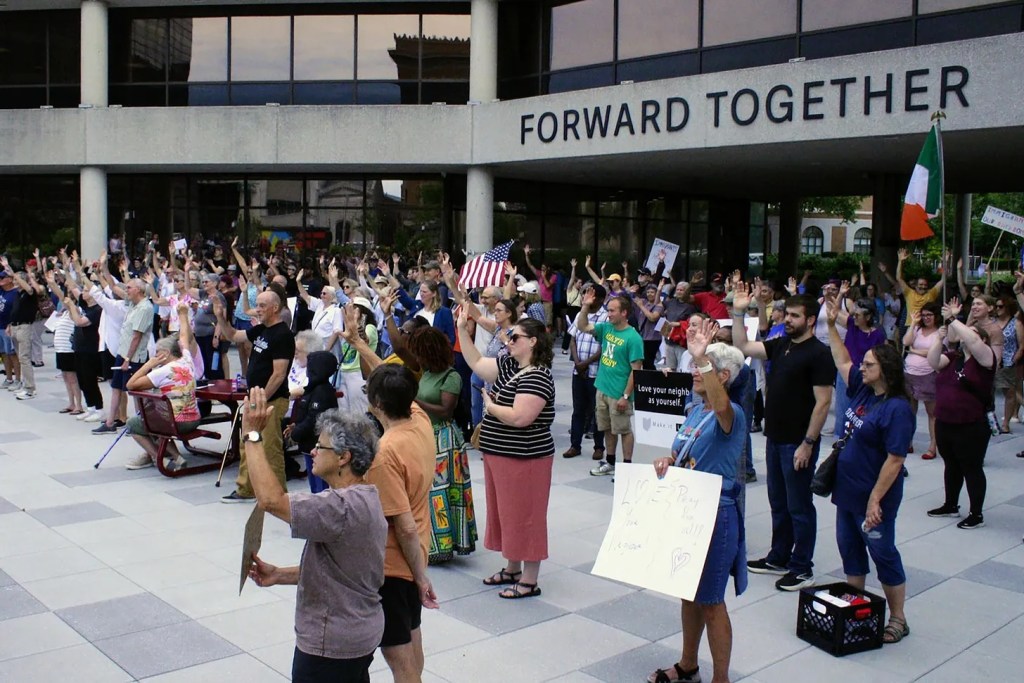
SPRINGFIELD, OHIO—What organizers had hoped would be an evening of celebration was instead an interfaith prayer service. Ministers, immigration lawyers, community organizers, Haitian families, and hundreds of their neighbors gathered in front of Springfield City Hall beneath the city’s motto, “Forward Together,” alternating between English and Creole as they decried the Supreme Court’s decision and prepared for what many fear could become mass deportations.
Thursday morning, after the Supreme Court cleared the way for the Trump administration to end temporary protected status for Haitians, the people who helped revive Springfield, Ohio, were trying to figure out how long they could keep their jobs and their driver’s licenses, and whether they should start preparing for deportation. Pastor Carl Ruby captured the mood: “We had hoped this would become a time of celebration . . . but it has become a time of lament.”
Fleeing gang violence and what has become a de facto civil war, thousands of Haitians have helped reverse decades of decline in Springfield since 2010. They filled factory jobs, opened businesses, started churches, and helped stabilize the city’s population after years of shrinkage. But that growth stopped after JD Vance amplified a pernicious lie about Haitians in Springfield eating dogs and cats.
Now the Trump administration is set on removing many of the very people who helped bring Springfield back.
Yesterday’s 6–3 ruling by the Supreme Court cleared the way for the Trump administration to end TPS, meaning that although litigation may continue, many Haitians here in Ohio and all across America under TPS are subject to deportation immediately.
On a live zoom press conference earlier yesterday held by Springfield G92, a volunteer-led group of churches and faith advocates that focus on immigrant rights and mutual aid, Geoff Pipoly, a lead attorney on the TPS case, Mullin v. Doe, explained that while they’re reviewing what’s left of the case to determine whether any further legal appeals from his plaintiffs were tenable, the situation for Haitians here varies by their status.
Haitians here under TPS could consider filing asylum claims—if they can find an immigration lawyer to help them. The immigration court system is, to put it mildly, a shitshow right now. Donald Trump is purging judges who don’t deport a lot of people, the New York Times reported this week.
The data say the purge is having its desired effect: In Fiscal Year 2025, the denial rate for asylum claims more than doubled—from 14.3 percent to 30.8 percent—while the grant rate fell from 12.0 percent to 9.9 percent, its lowest level since 2017.
Those here under TPS alone are facing a lot: Their state-issued driver’s licenses are set to expire on July 6, as Ohio provided them with temporary extensions due to the uncertainty of their TPS status. Before the stay, Haitians were unable to renew their driver’s licenses because DHS made it clear that Trump wanted to end their protected status. Their expiry in ten days will make driving illegal, not that many are going to be venturing out due to the chance that ICE could stop them and deport them. And, unless they have another legal basis to remain, they won’t have jobs to drive to: the end of TPS will mean the end of their work authorization.
Biassou Pierre, a community organizer from Haiti, told the crowd: assembled in front of city hall, “Today many people call me asking, ‘How will I feed my children if I lose my job? What will happen to my family if I get detained by ICE?’ Unfortunately, we don’t have a good answer.”
But even if one had the money and could find an immigration lawyer with availability to take up their case, that doesn’t mean a quick return to work. “People who have pending asylum applications may be eligible to apply for a work permit after their application has been pending for 180 days,” Katie Kersh, a senior attorney with Advocates for Basic Legal Equality in Dayton, told reporters. “But the administration is trying to extend the required waiting period to one year.”
At the rally last night, Kersh put this avoidable tragedy in these terms: “These individuals followed the law. They followed the law and applied for TPS, and often asylum. The law abandoned them.”
There is some hope in Congress in the form of H.R. 1689, which would extend TPS until the end of the Trump administration. By some small miracle, it passed the House in April on a bipartisan basis, with ten Republicans, including Ohio’s Mike Carey and Mike Turner (who represents Springfield), supporting it. But Haitians here now have to depend on the Senate, and Ohio’s senators are notably silent.
Sens. Moreno, an immigrant himself, and Jon Husted, who is up for election this fall, having been appointed to fill Vance’s seat, do not have a position on the bill. Outgoing Gov. Mike DeWine, who grew up in the area and has done charitable work in Haiti with his wife, has supported extending TPS and called Thursday’s ruling a mistake that was “not in the best interest of the United States nor Ohio.”
This has the potential to become a big campaign issue for both Husted and Vivek Ramaswamy, the controversial Republican candidate for governor. As Jonathan Cohn reported in these pages earlier this week, Haitian immigrants are a bedrock in multiple industries around the country, most notably healthcare.
Former Sen. Sherrod Brown, running against Husted, has been vocal in his support for the Haitian community, calling on both Husted and Moreno to support an extension of TPS for Haiti. Amy Acton, the Democratic nominee for governor, has been more careful in her wording, saying: “Law enforcement should be keeping people safe by going after dangerous criminals, not terrorizing communities.”
Viles Dorsainvil is a Haitian pastor and co-founder of the Haitian Support Center, which has been helping with utility bills, rent assistance, legal services, and transportation for Haitians who have been looking over their shoulder since Trump and Vance propagated heinous lies about them.
“Everything has changed in the community” Dorsainvil told reporters early Thursday, “And the worst thing now is that the employers will terminate workers immediately. . . . It was predictable that our community will be in trouble and that the decision will amplify the humanitarian crisis that we’ve already had here. That’s the reality. So as a center, we’ll continue to do our best, but we don’t know how long we’ll be able to survive.”
What awaits these Haitians in Springfield? Pastor Ruby, who welcomed me into Springfield Central Christian in February to talk and show me the preparations they had made to provide this community sanctuary, said, “We have had to think about issues of civil disobedience. We’ve had to think about the issue of providing sanctuary, and when there’s a conflict between man’s laws and God’s laws, we have an obligation to side with God’s laws.”
The situation in Haiti remains bleak. The State Department doesn’t advise Americans to travel there, as it’s one of the “most dangerous places on earth right now” Ruby says. He recounts a conversation with a young boy, about his life before coming to America: “I was talking with a 12-year-old boy . . . we were talking about farm animals. And he started talking about seeing huge pigs. . . . I said, ‘What were the huge pigs doing?’ And he said, “The huge hog was eating bodies.”
He added: “So that’s what Haitian children have observed. They’ve all been traumatized. This is gonna re-traumatize them. I can’t imagine the fear that they’re experiencing right now. There’s another person in our church . . . the decapitated body of a friend was left in front of his house. That’s what Haiti is like right now, and our justices knew that.”
Dorsainvil, for his part, is appreciative of the support his center has gotten from around the country. “We are grateful for people who’ve been standing in solidarity with us . . . because you understand our struggle . . . We will continue to count on you to stand in solidarity with our community here in Springfield.”
“I am no different from other folks.” he told reporters, “I just have a pending asylum. . . . Everything is in limbo now. I don’t know how that will be.”
Pierre, speaking to an audience beyond those assembled in front of him, pleaded: “We are not just immigration cases or statistics. We are your neighbors, your coworkers, and members of your church.”
“Please don’t forget us.”
You can donate to the Haitian Support Center here and other local charities here.
Source: “After SCOTUS Ruling, Haitians Prepare for Disaster,” The Bulwark, 26 June 2024
Adding Ingratitude to Injury
by William Kristol
America today has lots of hard-working immigrants, and plenty of native-born citizens who accept and respect them. But there are also plenty of Americans these days who were born on third base and think they hit a triple.
I hasten to say there’s no fault in being born on third base. Indeed, all of us, whether rich or poor, who were born in today’s America might be said, in the grand historical scheme of things, to have been born on third base. A healthy American patriotism begins with acknowledgment of our good fortune, and with gratitude for what our forebears—most of whom were not born on third base—did to make our privileged lives today possible.
Of course there’s nothing wrong with also taking pride in what we and our contemporaries have accomplished. And if we sometimes overestimate our own achievements and underrate those of our predecessors—and therefore underrate our simple good fortune in being born here—well, that’s human nature, and it’s probably not worth getting all worked up about.
But what is worth getting worked up about is those who have no sympathy for others who didn’t happen to enjoy good fortune. What’s worth getting worked up about is those who have contempt for and who revel in cruelty toward the less fortunate.
There are lots of those people in America today. They include our president. They include many in his administration. They include many in the world of MAGA.
And they include Megyn Kelly, who was so proud of what she said on her show yesterday after the Supreme Court’s TPS decision that she then posted the clip on X:
Megyn sends a message to the Haitians who lost their TPS today:
“Go home! Get out! We know our country is better than yours. That’s because we filled it with our work ethic, culture, and values. You being here only dilutes it for us . . . GO BACK TO FUCKING HAITI!”
Kelly thinks that “we” made America great with “our work ethic, culture, and values.” But most Americans of Kelly’s generation—and, to be clear, of mine—have had to do little in the way of heavy lifting to make America great. And is it clear that today’s culture and values are so exceptionally wonderful?
It was our forebears who made America great. Many of them were immigrants and refugees, whom earlier generations of nativists treated with hostility, bigotry, and cruelty.
The rhetoric of yesterday’s Court ruling is not itself bigoted or cruel. But the policies it permits are bigoted and cruel. They are the policies of people who found themselves, mostly by good fortune, standing on third base. Many of them aren’t particularly good hitters or fast runners. But they’ve decided to protect their status by making sure no one else—especially no one else of a different skin color or background—will have a chance to get up to bat.
Source: “After SCOTUS Ruling, Haitians Prepare for Disaster,” The Bulwark, 26 June 2024. Despite (or maybe even because of) my own leftist sympathies, I’m a proud subscriber and reader of The Bulwark, an online publication anchored by “recanted” (?) neocons like Bill Kristol. The younger me would have wondered how such an unbelievable thing could have come to pass, but I would explain to him that we need a united front against fascism right now, and the Bulwarkers, Kristol included, are quite explicitly, vocally, and usefully part of that front. ||||| trr