
KYIV, Ukraine — In the early 2000s, I was still a kid. Every summer, my grandma and I would travel to visit her relatives in Tuapse, a city in southern Russia on the Black Sea’s coast.
We took the ‘platzkart,’ the cheapest sleeper train where strangers shared one open space with no compartments, and always brought our own bed linen because it cost us less that way. The train stopped at what felt like every small town along the way. With a border crossing, the journey stretched well past twenty-four hours.
My grandma Lilia looked forward to every summer, as the children had a holiday from school. She skimped on everything just to save up for this trip. Soon, she would see her sister, and they would spend the whole summer together, just like they used to when they were kids.
I had no idea that twenty years later, I would watch that same city burn and feel nothing but satisfaction.
Today I woke up to news that Ukrainian long-range drones had attacked Russian oil refineries in Tuapse for the third time in the past two weeks — the latest in a campaign that has shut down the plant, destroyed the majority of its storage tanks, and left Russia’s only Black Sea refinery incapacitated with no signs of recovering
Volodymyr Zelenskyy has already said that Ukraine’s partners asked him to halt strikes on Russian oil refineries during the war in the Middle East. In their view, these strikes could further drive up the prices of oil and other energy resources, which have already reached record highs in recent months. The Ukrainian side, however, believes the impact on prices is limited because Russia still has restricted capacity to export its oil. So it will continue striking Russian oil, as this is one of the most effective ways to put pressure on Moscow.
At first glance, mockery and gloating over destruction deep inside Russia may seem cruel to many. But for me, it is the logical conclusion of a shattered identity — and a story about how war destroys not only homes but the very possibility of remembering anything good about the enemy.
Until my teenage years, I would spend the entire summer in a village called Nebug in Russia. It was just 17 kilometers from Tuapse, where our relatives owned a huge plot of land with several small houses, some of which they rented out to vacationers. From there, we often made trips to Tuapse, wandering between the nearby towns and soaking up every bit of the coast.
My relatives’ property in Nebug was massive. The house was located at the foot of a mountain, and if you headed down the stone steps, you would find yourself right by the river, which led you straight to the Black Sea. My distant cousin and I would come back inside at lunchtime to eat and then head right back to the water. Sunburned, skinny, and exhausted.
The best part was escaping to the wild beach to snorkel and explore the underwater world. When you’re ten, there’s nothing more captivating than that. Or we’d tie bits of sausage to a stick to bait crabs. The kittens living under the bridge got a share of that sausage, too. We had to smuggle it out in our mouths at breakfast so the grandmas wouldn’t scold us.
I still remember when Putin was elected president for the first time in 2000.
My relatives were overjoyed, and my grandma celebrated along with them. I was still too young to understand much, but from their conversations, I gathered that Russia was a “better” country than Ukraine. For the first time in my life, I felt ashamed of where I was from.
I was still holding on to those memories. They were my happy place. But in 2014, when Russia annexed Crimea, the last thread connecting me to my grandmother was gone, and communication with our relatives dwindled to almost nothing.
In 2022, they called and told us not to worry, promising that “Russia will save you very soon.” They were sincerely convinced that we were trapped in the clutches of ‘Ukro-Nazis.’
We’ve never picked up the phone since then.
Over the past two weeks, black smoke has stretched for dozens of kilometers from Tuapse. The city has seen ‘oil rains,’ coating it in black soot and ash. Russian authorities asked residents not to leave their homes and even announced an evacuation on several streets near oil refineries.
Ukraine has struck this facility multiple times. The recent strikes were the most devastating — waves of drones, fires that burned for days, 28 out of 47 storage tanks destroyed or seriously damaged. The port stopped functioning.
The consequences are felt across Russia. Production cuts, refineries shutting down one after another, gasoline prices up over 20 percent. Russia is losing around $100 million every single day, which means $100 million that will not be spent on shells, missiles, or soldiers killing Ukrainians.
The Tuapse refinery is the region’s main oil export hub. When it functioned properly, it processed 240,000 barrels a day, most of it shipped to China, Malaysia, Singapore, and Turkey. With Middle Eastern oil supplies disrupted, major buyers like China and India dramatically increased their imports from Russia, thereby massively boosting Russia’s fossil fuel revenues. In the first quarter of 2026, 90 percent of Russia’s crude exports went to China and India alone.
Russia found its window of opportunity in the chaos of the Hormuz crisis — oil prices up, buyers desperate, and sanctions suddenly weakened. But Ukraine is closing that window.
When I saw the news about Tuapse burning, I felt nothing for the people there. No grief, no worry about my relatives there. Just satisfaction.
I found a term — ‘schadenfreude.’ It’s a German word made up of two parts: Schaden — ‘damage’ and Freude — ‘joy.’ Literally, pleasure from someone else’s misfortune. Researchers at Emory University identify three forms of this emotion. Aggression-based is the satisfaction of seeing someone you actively hate suffer. Rivalry-based is the pleasure of watching a competitor fail. And justice-based, where a person feels that someone’s misfortune is a deserved consequence of their own actions.
What I feel is the third one.
Living in circumstances you can’t control, like war, people often feel a deep sense of powerlessness. But when Ukrainians see Russians also facing the consequences of their country’s actions, it creates a sense of reclaiming at least some control over the situation. It feels well-deserved, like finally, Russians are experiencing at least a fraction of what Ukrainians go through every day.
For twelve years — since the occupation of Crimea — my relatives chose not to notice the war in Ukraine, posting Russiaʼs propaganda on their social media. Not the war in Donbas, not the missile strikes, not the mass graves.
They went to the beach. They drank beer. They posed for photos in occupied Crimea.
The environmental disaster unfolding in Tuapse, with water, soil, and air polluted, seems to go unnoticed by Russian officials. Neither Putin nor other high-ranking officials have reacted to the catastrophe.
The only ones I pity are the animals. They have no part in this war. They are being widely contaminated by fuel oil from the ‘oil rains.’ Water from puddles or troughs, where stray cats and dogs might drink, can be dangerous for animals.
So, do I have the right to feel joy when my family i[n] Russia suffers? I think I do. Not because I hate them for who they are. But because for twelve years they chose not to see.
I can remember the smell of the sea in my childhood, and still know exactly what is on fire: the war machine that kills my people.
Source: Kateryna Antonenko, “Why I am happy when oil prices rise,” The Counteroffensive with Tim Mak, 28 April 2026. I subscribe to The Counteroffensive and am happy to depaywall their articles for my purposes here, but I would suggest you subscribe to them too. ||| TRR
In this week’s bulletin: Ukraine defence update/ Ukraine and Palestine/ Russia “Spring” trial/ Try Me For Treason: the film/ Russia fails to silence Crimean Tatars/ Could Belarus join war?/ Kherson torture diary/
News from the territories occupied by Russia:
Russia banned the voice of the Crimean Tatars — the Mejlis — 10 years ago, but failed to silence it (Crimea Platform, April 26th)
Russian FSB tortured Kherson men and fabricated “terrorism” case against them (Meduza, 24 April)
26-year-old Ukrainian sentenced to 22 years for alleged ‘plan to kill’ a Russian occupation prison chief (Kharkiv Human Rights Protection Group, April 24th)
Russian occupation court sentences 66-year-old doctor to 14 years for supporting Ukraine through war bonds (Kharkiv Human Rights Protection Group, April 24th)
Mission Discusses the Situation of Women’s Rights in Temporarily Occupied Crimea (Crimea Platform, April 24th)
EU Imposes Sanctions on Individuals Involved in Illegal Excavations in Crimea and the Militarisation of Ukrainian Children (Crimea Platform, April 24th)
The Face of Resistance: Crimean Tatar Activist Seyran Murtaza (Crimea Platform, April 24th)
From hell: the secret diary of a Ukrainian imprisoned and tortured by the FSB in Kherson (Mediazona, 23 April)
Russia stages fourth ‘trial’ of 67-year-old Crimean political prisoner to ensure he dies in captivity (Kharkiv Human Rights Protection Group, April 23rd)
Russia abducts Crimean Tatar trying to see dying aunt and accuses her of ‘treason’ for donations to Ukrainian Army (Kharkiv Human Rights Protection Group, April 22nd)
Birthday of illegally imprisoned Andrii Kuliievych (Crimea Platform, April 22nd)
Weekly Update on the Situation In Occupied Crimea (Crimea Platform, April 21st)
Ukrainian ex-military man sentenced to 18 years in Russian-occupied Crimea on surreal ‘treason’ charges (Kharkiv Human Rights Protection Group, April 21st)
Russia’s war for demographic control (Engelsberg Ideas, April 14th)
News from Ukraine:
How Ukraine solved the hardest problem in defence (Exponential View, April 24th)
Miners’ union new organisation near the front line (Confederation of Free Trade Unions of Ukraine, 8 April)
War-related news from Russia:
Required Reading: Russia’s new mandatory history textbook offers a glimpse of the present (The Insider, April 28th)
Russian losses in the war updated (Mediazona, 24 April)
Toxic smoke and ‘oil’ pours from fire at Russian oil terminal (Meduza, 24 April)
Censorship is reshaping Russia’s publishing industry (The Insider, 24 April)
Putin restores Soviet secret police founder Dzerzhinsky’s name to FSB Academy (Ukrainska Pravda, April 22nd)
The Verdict on Spring: The Vesna Case (Russian Reader, April 21st)
Security forces raid Russia’s largest publisher and detain its CEO in ‘LGBT propaganda’ case (Novaya Gazeta, April 21st)
Analysis and comment:
Russian ministry spokeswoman in lying attack on Latvian “Nazism” (The Insider, 25 April)
Zelensky claims danger: Might Belarus join Russia in the war? (iStories, 22 April)
Some facts: Ukraine, Russia, Palestine and Israel (Ukraine Solidarity Campaign, 21 April)
Research of human rights abuses:
Growing up waiting for their fathers: photo exhibition on children of Crimean Tatar political prisoners opens in Berlin (Zmina, April 20th)
How to prevent torture in places of detention: ZMINA held a specialised training (Zmina, April 21st)
ZMINA joined the presentation of the Crimea Global outcomes and the discussion of plans for 2026 (Zmina, April 17th)
Upcoming events:
Sunday 17 May: premiere of Try Me For Treason, the film. In-person premiere in London: 6.30pm, Upstairs room, the Lucas Arms, 245a Grays Inn Road, London WC1X 8QY (arrive for drinks from 6.0pm). Youtube premiere at 8.0pm. Information at trymefortreason.org.
==
This bulletin is put together by labour movement activists in solidarity with Ukrainian resistance. To receive it by email each Monday, email us at 2022ukrainesolidarity@gmail.com. To stop the bulletin, reply with the word “STOP” in the subject field. More information at https://ukraine-solidarity.org/. We are also on Twitter, Bluesky, Facebook and Substack, and the bulletin is stored online here.
Source: News from Ukraine Bulletin 193 (27 April 2026)
The Finnish Defence Forces will construct permanent combat positions in the Kymenlaakso region, which borders Russia.
The combat posts will be erected during May exercises of the Finnish Coast Guard, the Finnish Navy’s press office announced on Wednesday, 29 April.
“The fortifications built will remain in place after the exercises. Due to the construction work and the exercises, construction equipment will be present in and around the port of Klamila, checkpoints will be set up, and public access will be restricted,” the statement said.
The exercises will take place across a vast area of the Finnish coastline, including Kotka, Hamina, and Virolahhti.
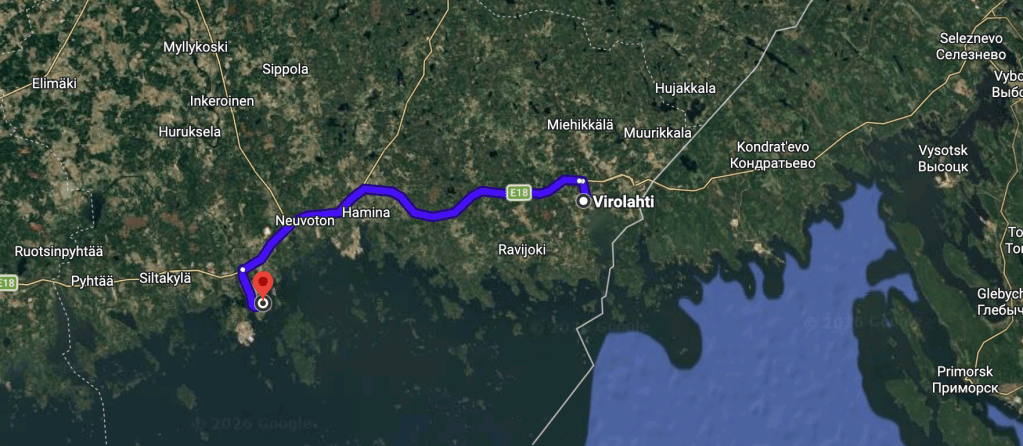
The exact locations of the combat positions have not been disclosed.
It is understood that they will be constructed from reinforced concrete modules, and some of the fortifications will consist of underground bunkers.
Finland has been building a fence along its border with Russia and plans to complete the bulk of the work by early autumn this year.
Estonia is fortifying its border with Russia with bunkers. The country’s Ministry of Defense has announced plans to construct 600 concrete structures by the end of 2027. They are modular structures that are buried underground.
In April, the Estonians began digging a twenty-kilometer-long anti-tank trench in Setomaa Parish, which borders the Pskov Region’s Pechora District.
Source: “Finnish Army setting up combat positions near border with Russia,” Delovoi Peterburg, 29 April 2026. Translated by the Russian Reader