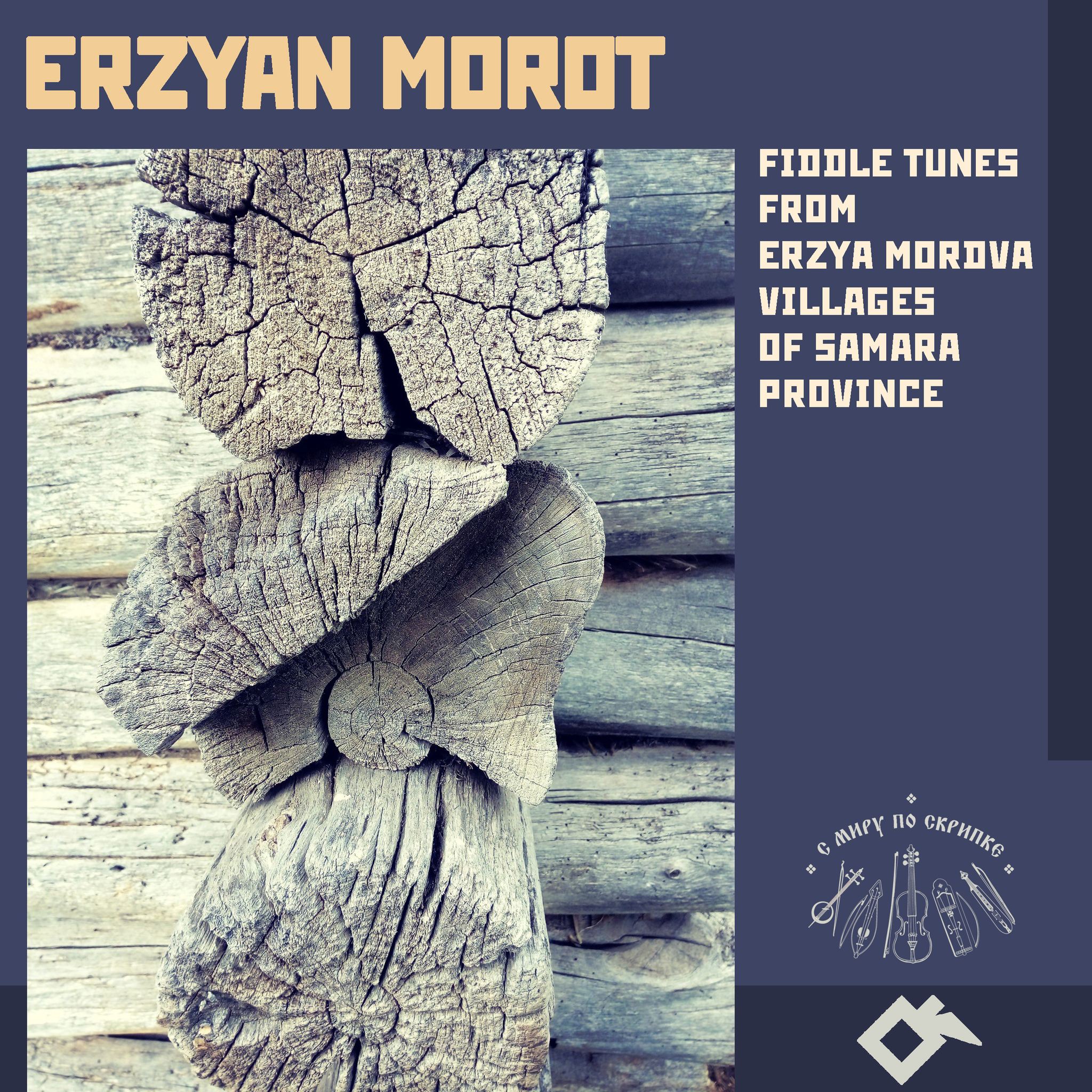
Armas Otto Väisänen (1890-1969) was a famous Finnish ethnomusicologist and ethnographer.
In 1914, when his native Finland was still part of the Russian Empire, he traveled around Samara province and recorded music of traditional fiddlers from local Erzya Mordva villages on wax cylinders. These recordings have been preserved in the Finnish archives.
The album Erzyan Morot (“Erzyan Melodies”) presents those tunes played by modern Russian fiddlers as close to the original as possible .
The number in the brackets after each melody is its number in the collection Mordwinische Melodien (“Mordovian Melodies”, Helsinki, 1948) compiled by Väisänen.
Performers:
Sofia Balueva (tracks 1-4), recorded August 14, 2021 in St. Petersburg
Sofia Fayzrakhmanova (tracks 5-10), recorded at the same place
Tatyana Yamberdova (track 11), recorded on October 23, 2021 in the town of Velikiye Luki
The idea of the project by Ksenia Goncharova and Andrey Davydov.
Source: Antonovka Records, Facebook, 25 November 2022
___________
Armas Otto Aapo Väisänen (9 April 1890 – 18 July 1969) was an eminent Finnish scholar of folk music, an ethnographer and ethnomusicologist.
Väisänen was born in Savonranta. In the early twentieth century he documented, in recordings and photographs, traditional Finnish music and musicians. With a scholarship from the Finno-Ugrian Society Väisänen traveled to Russia in 1914 to collect Finnish folk melodies. He made field trips to Mordovia, Ingria, Veps, Russian Karelia. His activities also marked the a new stage in the history of collecting Seto folk songs in Southern Estonia. After the first trip in 1912 he made 6 field trips to Estonia between 1912 and 1923.
A. O. Väisänen’s dissertation was presented in 1939 on Ob-Ugrian folk music in German: Untersuchungen über die Ob-ugrischen Melodien: eine vergleichende Studien nebst methodischer Einleitung.
Between 1926 and 1957 Väisänen hold the position of the head of the folk music department at the Sibelius Academy, Helsinki, Finland. He was the professor of musicology at University of Helsinki from 1956 to 1959. He died in Helsinki, aged 79.
Regarding the Convocation of a Congress of People’s Deputies of the Russian Federation in Poland
From open sources, we have learned about an undertaking to convene a Congress of People’s Deputies in the town of Jabłonna, Poland (November 4–7, 2022). The delegates to the Congress are parliamentary deputies of different years and different levels who were elected in internationally recognized elections. Rejection of the war between Russia and Ukraine that began in 2014 and a willingness to change the socio-political system established in the Russian Federation are their common platform. The event’s organizers have announced that they will adopt a “Declaration on the Constitutional Principles of a Free Russia after the Putin regime’s overthrow,” a “list of priority decisions by the post-Putin Russian government,” etc.
In the light of this news:
We cannot but note the fact that [free and fair] elections in the Russian Federation disappeared long before 2014. Ethno-national political parties were banned thirteen years before Ukrainian region of Crimea was annexed. Thus, despite the fact that the Russian Federation, according to its own constitution, is a federation, and most of the ethno-national republics within the Russian Federation are nation-states with their own constitutions, parliaments, and governments, we have been deprived of the opportunity to represent and defend our interests in representative bodies for decades.
We acknowledge that the Russian Federation as a state has gone too far both in its ethno-national policy (extolling the Russian nation as chosen and endowing it with a special status in the Russian Federal Constitution) and in its foreign policy, thus completely destroying the legal space of the federation. The Russian Federation currently has no clear and legitimate borders, nor does it have legitimate representative bodies, since there are “deputies” and “senators” seated in the Federal Assembly who were, allegedly, delegated by illegally annexed foreign territories.
In light of the above considerations, we, representatives of the ethno-national and regionalist movements united in the Free Nations League, declare the following:
1. We do not recognize any political forces and hubs that would justify maintaining the Russian Federation in its current form. We have no need of arbitrators from Moscow, neither from the authorities nor from the opposition. We are open to dialogue and contact only with those who publicly support the right of enslaved peoples to establish independent States.
2. The Russian Federation cannot be re-established by cutting off what was seized by force and holding new elections. It is not elections that are at issue, but the very nature of Russian statehood: it is imperialist and exudes aggression towards its neighbors. This means that we, representatives of ethno-national republics and regions, have the right to shape our own destiny. If there is a discussion of independence for certain lands, let the people themselves hold this discussion, let them decide which confederations or unions to join, free from the intervention of federal forces, be they the government or the opposition. Any attempts at “peacekeeping,” attempts to teach us how to exercise our right to self-determination, will be rejected by us, and if they are intrusive, they will be met with a forceful response.
3. The process of forming a new Russian state should be voluntary and undertaken exclusively by those federal subjects whose legislative bodies vote to join a new federation. All federal parties currently represented among the federal authorities should be banned since they profess a misanthropic ideology that has produced thousands of victims and millions of refugees. The legislative bodies of the former federal subjects must be re-elected democratically, by open and secret ballot, with the involvement of ethno-national and regional political parties. There can be no automatic entry into the “renewed” Russia, no joining it “by inheritance.”
This appeal has been signed by representatives of the following national movements:
Bashkir
Ruslan Gabbasov, head of the Bashkir National Political Center (BNPC)
Ilshat Kinzyabayev, member of the BNPC
Buryat
Radjana Dugar-DePonte, representative of the Erhatan Buryat Democratic Movement in the USA
Cossack
Vyacheslav Demin, elder of the Cossack National Liberation Movement
Source: Free Nations League, Facebook, 31 October 2022. Thanks to Sergey Ogurtsov for the heads-up. Translated by the Russian Reader
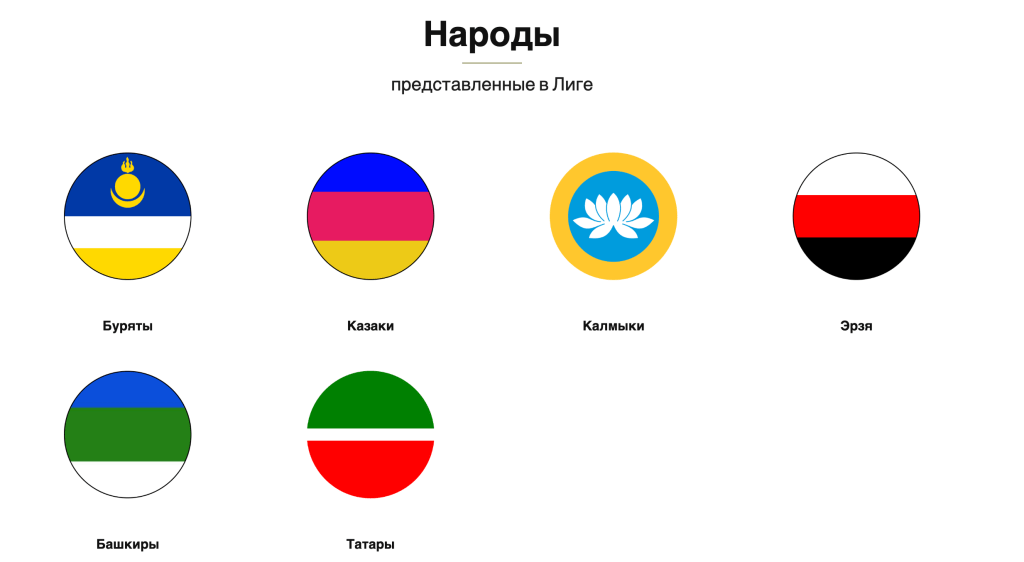
“Nations represented in the League: Buryats, Cossacks, Kalmyks, Erzya, Bashkirs, Tatars”
The FNL’s Principles
1
The Russian Federation is an empire that keeps its colonies in servitude by force. It is impossible to liberate them by holding a referendum, just as a referendum on the observance of human rights is impossible under conditions of state terror.
2
The peoples of the Russian Federation should be able to exercise their right to self-determination. Further federations or confederations can be established only a voluntary basis, not by diktat of the former federal center.
3
We declare the principle of the presumption of identity and agency [sub’ektnost’]. Accordingly, with the collapse of the current political regime in the Russian Federation, the regions have no need to appeal to anything to endow themselves with sovereignty. By definition, all regions acquire complete sovereignty and full independence from Moscow, and only then, as free territories, do they decide their future: whether they want to maintain independence, unite with other regions and republics, or create a confederation of states.
4
All subjects of the Russian Federation have the right to independently determine their future.
Source: “About Us,” Free Nations League. Translated by the Russian Reader

 We cannot but note the fact that [free and fair] elections in the Russian Federation disappeared long before 2014. Ethno-national political parties were banned thirteen years before Ukrainian region of Crimea was annexed. Thus, despite the fact that the Russian Federation, according to its own constitution, is a federation, and most of the ethno-national republics within the Russian Federation are nation-states with their own constitutions, parliaments, and governments, we have been deprived of the opportunity to represent and defend our interests in representative bodies for decades.