Ekaterina Andreyeva
Fond of Paradox
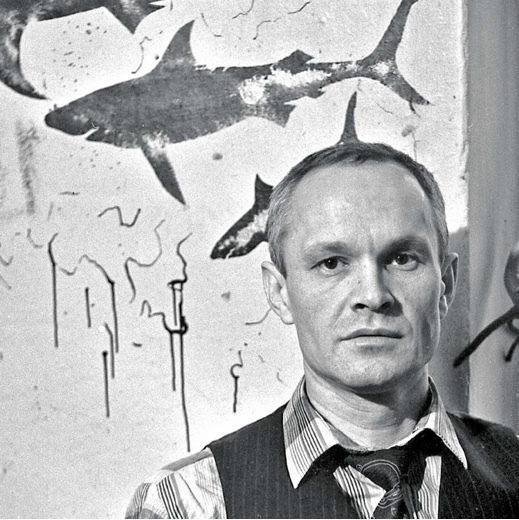
Vadim Ovchinnkov’s masterpieces have always been remembered in Petersburg. The paintings Window, Green Square, and What Is Ruining Us, which he exhibited at shows in the late 1980s and early 1990s, have become enmeshed in the local mythology, just like the image of the man who painted them. According to Dunya Smirnova, Ovchinnikov was “fond of paradox,” and had the looks of a brave, mysterious hero, a Petersburg James Bond.

Ovchinnikov spent the first part of his life in Pavlodar, Kazakhstan. He spent the second part on the Gulf of Finland, in Leningrad aka Petersburg, where he moved with his younger brother the artist Alexander Ovchinnikov. Seven factories were built in Pavlodar in the 1950s to assist in conquering the so-called virgin lands. One of Ovchinnikov’s first paintings, which was shown at an exhibition of the nonconformist Society for Experimental Visual Art (TEII), was entitled Factory Gates. Ovchinnikov found a familiar industrial landscape in Leningrad, but there was nothing familiar about his factory gates. They flashed and flared amid the darkness of the canvas like an alchemist’s crucible or a spaceship. What the steppes and the seas have in common is their vastness and inconstancy, and in the steppes, human historical time has been added to these immeasurable dimensions. (“The trough stands like a monument, / The backhoe, like a token of hope.”) The reality of Ovchinnikov’s perpetually mercurial paintings is grounded in the history of the steppes, where magic and industry share the same space. An Asian shaman, he relocated to the north to assemble the Chukchi Poems, which resemble a wizard’s arsenal; to rhyme colors and words by paying heed to the signals emitted by the imagination (“I found gold in the steppe. / It was flat on its back upholstered in sand and gloom”); to give shape to sounds; and to write mail-art letters that always inspired a sense of an unprecedented happening among their readers.
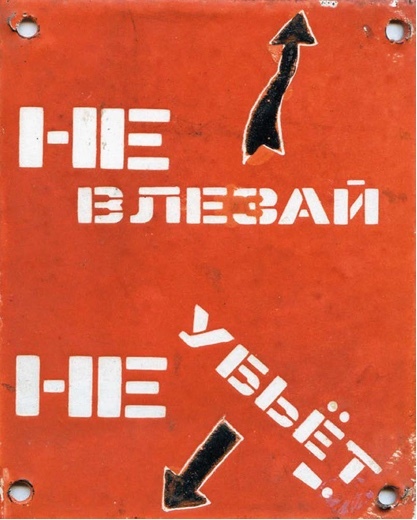
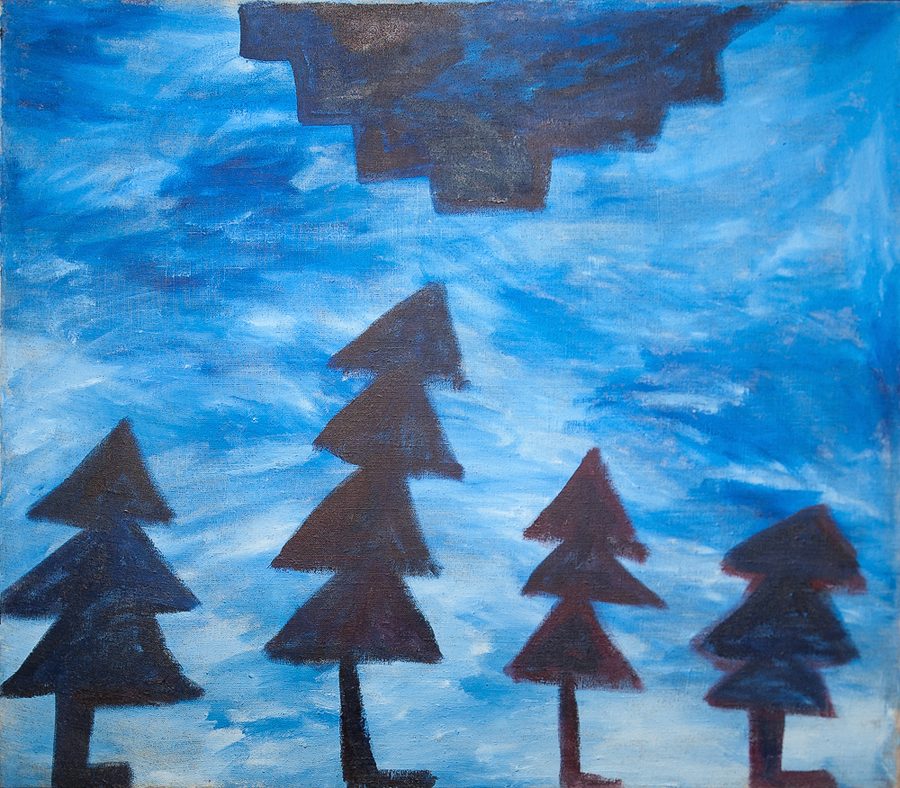
The symbols in Ovchinnikov’s paintings are often situated on horizon lines, thus resembling sheet music, but also the patterns on shamans’ tambourines, which facilitate the passage from the underworld to the earthly and heavenly realms. The geography of the voyages he undertook without leaving his studio almost defies description. Ovchinnikov lived several lives simultaneously and was in touch with various worlds. These imaginary spaces were recorded in pictorial series that stretched through the 1980s and 1990s: Spring in Chukotka, Atmospheric Phenomena, City by the Sea, The Life of Plants, Riders, and War Games. Ovchinnikov’s paintings takes viewers on trips to the peculiar worlds of Leningrad’s New Artists and the transavantgarde of the 1980s, while The Green Square: Symbol of the International Environmental Revolution gives them direct access to the Russian avant-garde’s experiments.
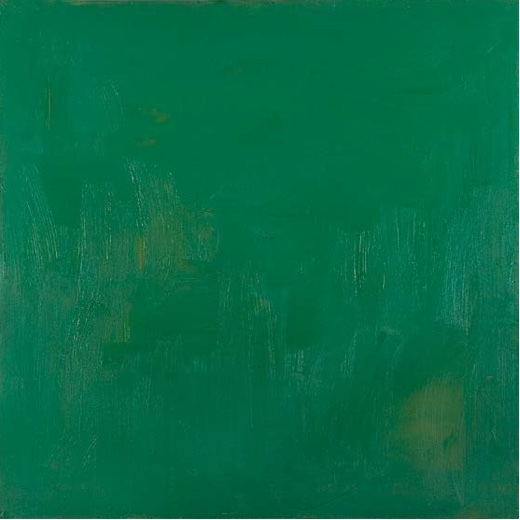
Partly predicted by Boris Ender, who once noted in his diary that a green square on a white field symbolizes the form of human life, the work consists of a sheet of plywood painted bright green. Ovchinnikov probably had not read Ender’s diary entry, but he half parodically and half seriously extended the series of Malevich’s squares by painting a piece of scrap wood he had found somewhere. Ovchinnikov would not have been able to see the paintings of Boris Ender and his sister Maria and Ksenia or the colorful abstractions of Mikhail Matyushin until the late 1980s, when they were exhibited at the Russian Museum for the first time after an interim of more than fifty years. However, he undoubtedly studied the few paintings by Pavel Filonov he had seen at the museum: Solar Energy No. 2 (1981) is painted in the pointillist crystalline manner devised by Filonov. But the dynamic freedom of color combinations and the primary element of color and sound waves fascinated him much more, and so by the mid 1980s he had recreated and completely transformed in his own way the painterly technique of the Matyushin school in the series The Life of Plants and Atmospheric Phenomena. Ovchinnikov’s take on Mikhail Matyushin’s so-called expanded vision involved a combination of imagination and observation. Ovchinnikov discovered and rediscovered the real world, which lives for color, in tense abstract compositions that elaborated Matyushin’s paradoxical notion of the universe, in which rays from different sources intersect after millions of years, where the vast sun permeates our tiny earth with its radiation, and things great thus incorporate themselves into things small. The freedom of the avant-garde’s ideas emerged before we were born, but in Ovchinnikov’s work they found their living, perfect shape.
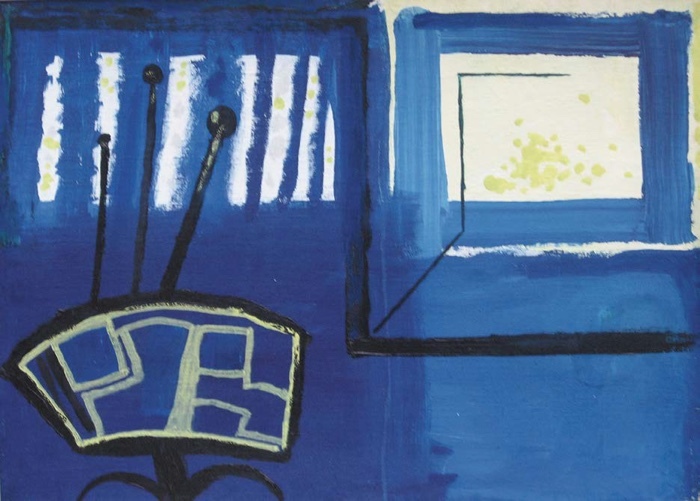
Among the New Artists who paid tribute to painting—Timur Novikov, Oleg Kotelnikov, Ivan Sotnikov, and Inal Savchenkov—Ovchinnikov stood out in the sense that his paintings were alive with a sense of the world’s unity, which was bound together by painterly matter. Moreover, the world, dynamic and amenable to harsh mergers and acquisitions, could indulge in contemplation of its own greatness only in the colored substance of paintings, pierced here and there by a sprout, an extraterrestrial beam of light, a magic arrow or an unforgettable hallucination. Like his comrade Timur Novikov, Ovchinnikov had his own philosophy of art making. Their minds sought to master the eastern technique of dashing between microworld and macroworld. Always in motion like the wind, Novikov managed in western fashion to accurately capture the harmony of the capstone, to the find the arch’s single focal point. Ovchinnikov, on the contrary, would quietly meditate in his studio for days on end, captivated by the endless changes, the alchemical process by which colors are sublimated into images, and the reverse process by which images dissolve into color. Ovchinnikov’s work was unique in that he freely drifted between figurative and abstract painting for many years. It helped him couple cross-sections of mythmaking, opened up sites of strength and poles of energy, the stories of flora and fauna before human being emerged, the legends of the saints, and dazzling visions at the limits of the heavens and his own consciousness.
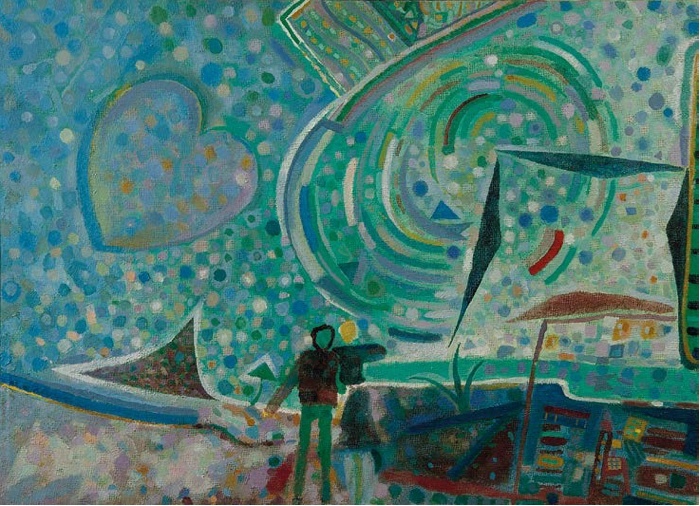
People who dwell with Ovchinnikov’s pictures on their walls know that, like living beings, they reveal themselves anew and differently every day, giving one the sense of witnessing a transfiguration. The texture of his pictures is as mercurial as a natural landscape.
In 1993, I wrote the following in the booklet for Ovchinnikov’s first solo museum show, A Walk (Progulka): “Next to them you live as it were outside, amidst nature, which ineffably transfigures from one minute to the next. They constantly reveal a changing dynamism of shapes and new shades of color while simultaneously hiding past shapes and colors. Like a living substance, their colorful surface interacts with light and is capable of transforming like the surface of the sea.”
Spatial extension in Ovchinnikov’s paintings and poems changes vis-à-vis the organic budlike capsules of Matyushin’s living spaces or the symbolic fusions of heavenly and earthly worlds in the work of Vladimir Sterligov. In Ovchinnkov’s works, readers and viewers are constantly moving along lines formed by slices of space, along the trajectories traced by pictograms and dialects.
As if it had bathed the rough flanks of cliffs,
The water drained away to the babble of bubbles and never came back.
I saw
Tower cranes constructing a temple,
Clouds from the east racing above them.
Girls from our class
Running along the shore in white dresses.
Unification and harmonization occur in this case thanks to incessant transpersonal movement. Like the contrail left by an airplane in the sky, it shapes the mercurial, intermittent lifeline of the totality, emerging again and again. This line captures acoustic accents and momentary images, simultaneously emancipating them from immediacy. Thus, the word potok (here, “class,” but literally, “stream” or “flow”) once again partakes of free movement, tossing off the shell of Soviet bureaucratese. This harmony is marked by the shade of drama, for it moves via losses and lives only in the temporal being of art, in the event of the creative act, whether pictorial, poetic or musical.
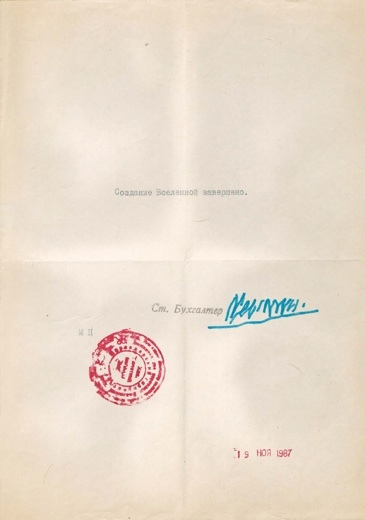
For many people, including quite sophisticated professional connoisseurs, the paintings of Vadim Ovchinnikov were testimony to a miracle, the presence of a living, universal art. In the late 1980s, the head editor of the New York-based magazine Art & Antiques was so stunned by Ovchinnikov’s paintings that he undertook something editors rarely undertake: an experiment. He placed on the magazine’s cover a photograph not of the front side but the back side of a painting by Ovchinnikov, that is, a piece of stretched canvas with inscriptions in Cyrillic, indecipherable to most of the magazine’s readers. He thus augmented the effect of a sudden artistic discovery. The painting itself took up a full page inside the magazine. In the historical circumstances of the times, Russia was thus marked out as a continent of new art. This now rather old story persuades us that it suffices for people who want to see authentic postmodernist or transavantgarde painting, meaning art freely transiting the borders of time and space, and implanting itself in the flesh of cultures, from the primitive to the global and urban, look at the work of Vadim Ovchinnikov alone in order to comprehend his illustrious contemporaries such as Francesco Clemente, Enzo Cucchi, and Sandro Chia. Especially because looking at Ovchinnikov’s pictures is endlessly interesting. For he always followed his own Rule No. 26, as published by the mysterious Collegium D.P.: “Painter! Skillfully using pattern, color, texture, color temperature, tone, daubing, line, tone value, varnish, and Chinese and Indian philosophy, tell the viewer everything, but do not give away any secrets.”
Vadim Ovchinnikov: The Mineshafts of Nirvana, a posthumous retrospective of works by Vadim Ovchinnikov (1951–1991), curated by Dr. Andreyeva and Svetlana Kozak, will be running at the Museum of 20th and 21st Century St. Petersburg Art, in Petersburg, until October 30, 2016. A slightly different version of this text, excerpted from the exhibition catalogue, has been published, in Russian, in ArtGuide. For more information on Vadim Ovchinnikov’s art and life, see the website ov-ov.com (in Russian). Translated by the Russian Reader