Victoria Lomasko: Drawing Lessons at a Juvenile Prison

Victoria Lomasko
Drawing Lessons at a Juvenile Prison

In August 2010, I visited the Mozhaysk Juvenile Prison for the first time as a volunteer for the Center for Prison Reform and gave a drawing lesson to inmates. I have continued working with the Center, teaching master classes on drawing at the girl’s penitentiaries in Novy Oskol and Ryazan, and the boy’s penitentiary in Aleksin, but Mozhaysk is the only place which I have visited more or less regularly.
lomasko-prison-photo

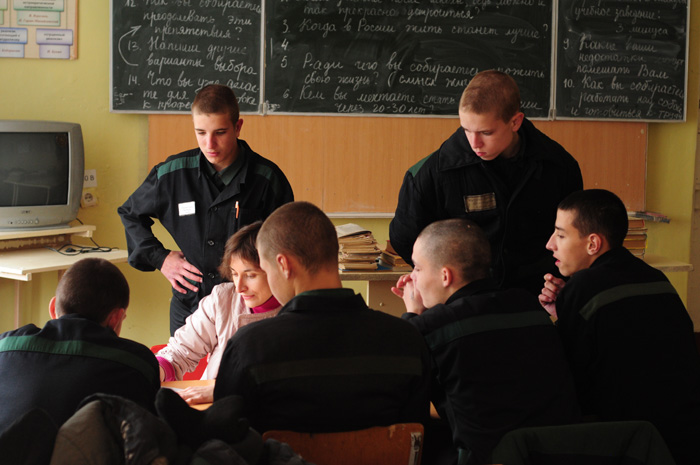
Victoria Lomasko with students at Mozhaysk Juvenile Prison

There is almost no funding for the trips. We travel by commuter train, carrying everything we need for classes in our backpacks, so with rare exceptions we use the simplest materials—paper and black pens—during the lessons.

The Center organizes the trips once a month on particular days. If you miss a trip, you have to wait for the next time round.

The rotation of inmates at the penitentiary is constant. Some are released on parole, while others are transferred to adult prisons. New inmates show up all the time. Over a six-month period, the roster of my drawing group changes completely.

Some teens are well educated, while everything is completely new to others. Many of them have psychological problems.

In short, teaching classes at a penitentiary is a tricky task: you have to experiment and develop your own lesson plan. At the exhibition Really Useful Knowledge you can look over two lessons from my program, “Form and Counterform” and “Ceramics Painting,” as well as the outcome of a creative exchange between the Mozhaysk Prison and prisons in Buenos Aires, which my friend the translator Anna Voronkova helped organize. After returning from Argentina, Anna became one of the main volunteers at the Center for Prison Reform.

Why do we travel to the prisons? The Center’s staff and volunteers bring clothing to inmates about to be released on parole, and hygiene items, birthday presents, and treats to the other inmates. Staff and volunteers also provide psychological assistance and collect material for preventive publications aimed at troubled teens. Another of the Center’s missions is to recruit creative people willing to work regularly with the teens, who need to interact with people from the outside world no less than they need shampoo and socks.

I realize I cannot teach someone to draw when lessons are so infrequent. My emphasis is on developing analytical thinking (the structure of the drawing) and empathy (working on the image). It is also vital to help the kids gain self-confidence, so all the pictures are shown at exhibitions. We photograph these exhibitions and bring the photos back to the prison to show the kids.

The kids find out about the drawing lessons from their minders, but more often they hear about them by word of mouth. Around five to ten students come to my classes. There is often a self-taught artist among them who really wants to learn to draw.
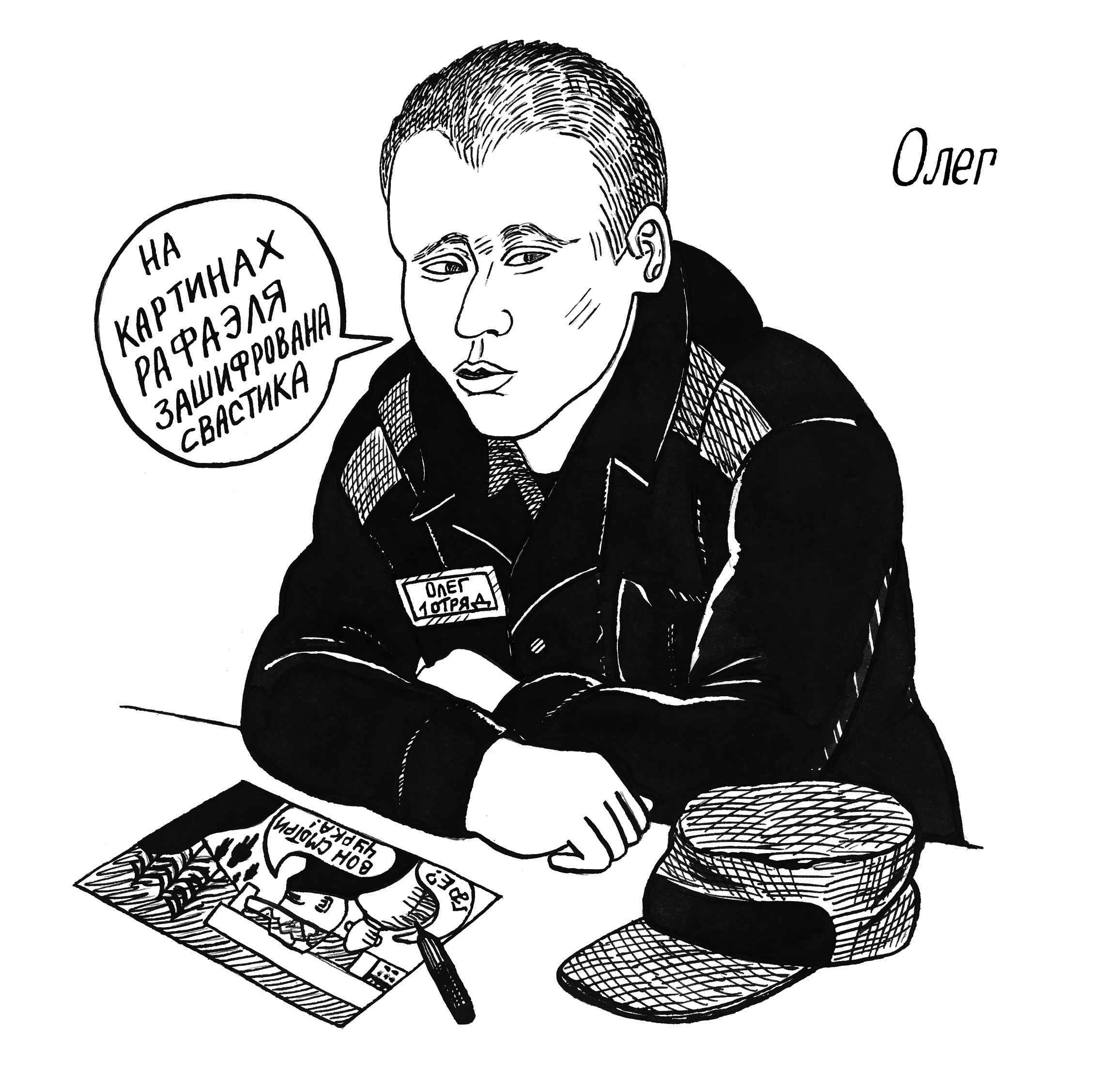
lomasko-prison-1Oleg: “There are swastikas encrypted in Raphael’s drawings.” 

Oleg draws a lot. He has his own views of Renaissance masterpieces.

lomasko-prison-2A drawing by Oleg. “Look over there—wogs!” “Where?” “Right there!”

Oleg is a skinhead. It all started when, aged eight, he witnessed the murder of a friend: teenagers from the Caucasus killed him to get hold of his telephone. At fourteen, Oleg organized a “fight club,” in which he was the youngest member. The fighters “staged flash mobs at Caucasian markets.” Oleg said that in his small provincial town, the population was divided into skinheads, people from the Caucasus, and suckers. He was convicted of a gang killing. He expected to be rewarded for his patriotism, not punished. Oleg had kept up his spirits at the penitentiary: he had been studying foreign languages, philosophy, and economics. He dreams of becoming a politician: “Yanukovych’s priors hadn’t stopped him from becoming president.”

In the autumn, he was transferred to an adult prison.
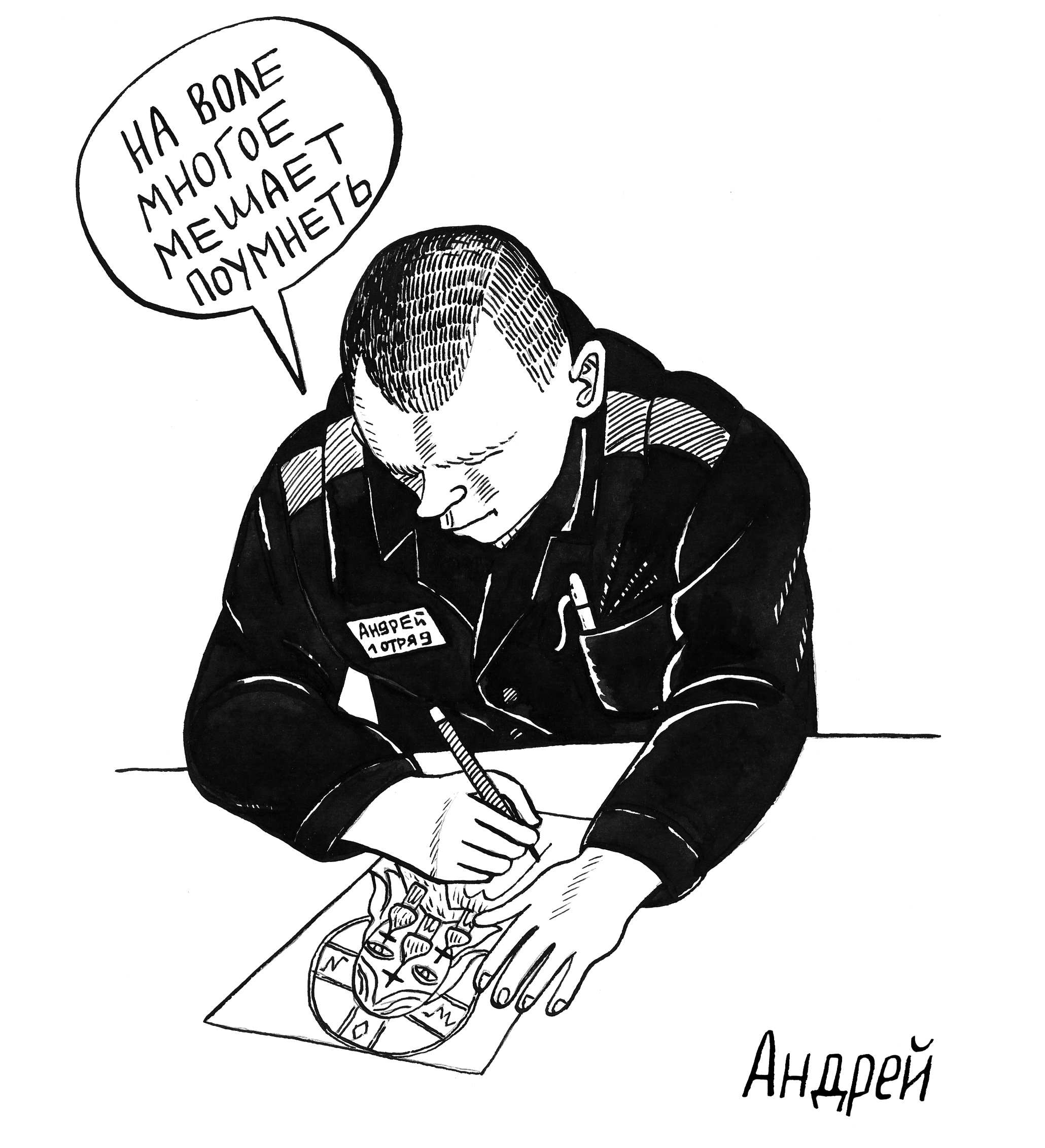
lomasko-prison-3Andrei: “On the outside, lots of things keep a guy from wising up.”

Andrei is a prison artist. He makes “bands” (drawings on handkerchiefs). He wants to draw beautifully and with feeling, but despises formal exercises. But he did like the lecture on concentration camp drawings. He reads Solzhenitsyn and has been teaching himself to draw by copying illustrations in books from the local library. Andrei’s sentence ended before the New Year, but no one is waiting for him on the outside.
lomasko-prison-4

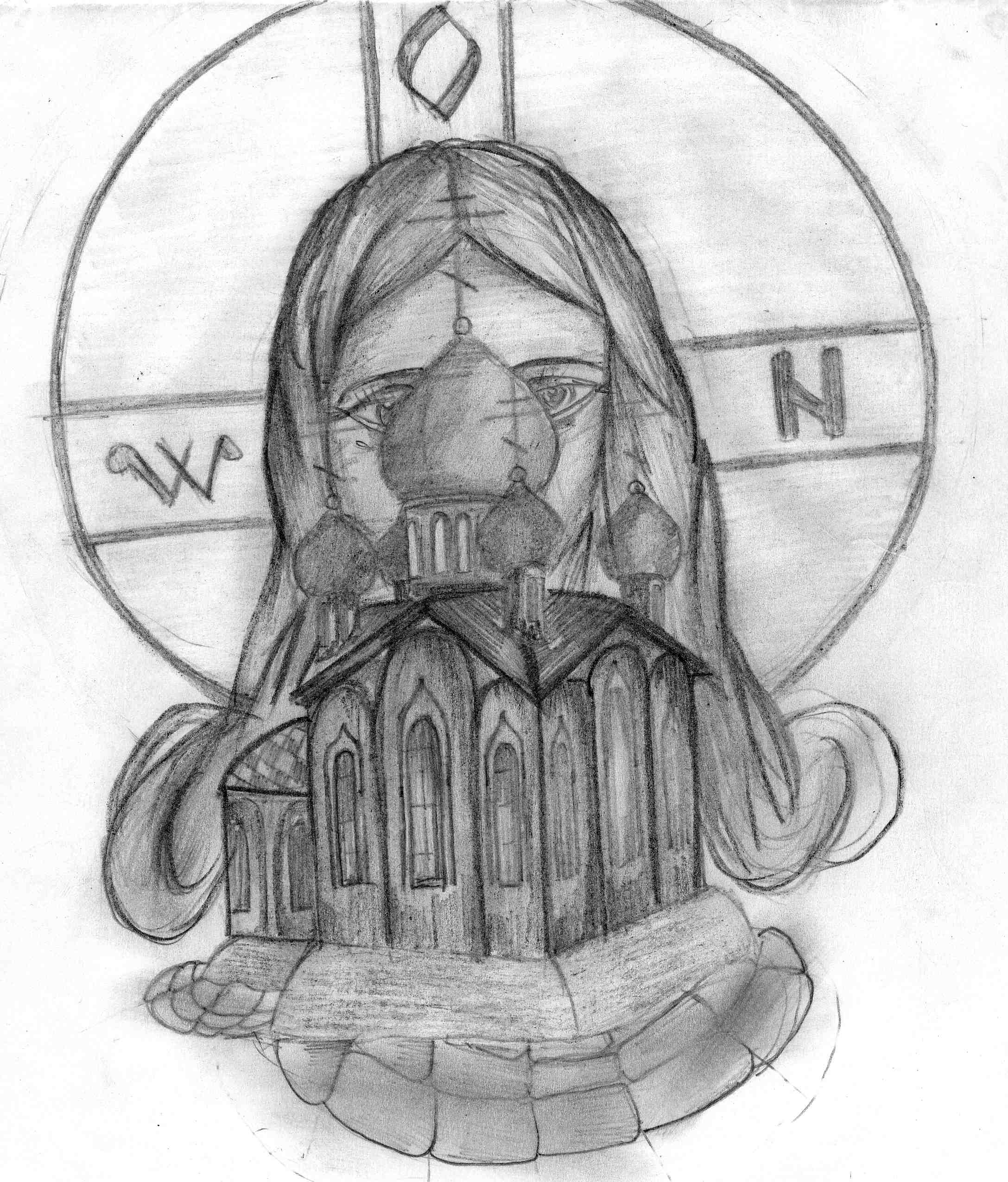
A drawing by Andrei

Yevgeny had been a gambler. He was sent to the colony for busting open a slot machine. He did not know how to draw and did not want to learn: he came to class to get things off his chest.
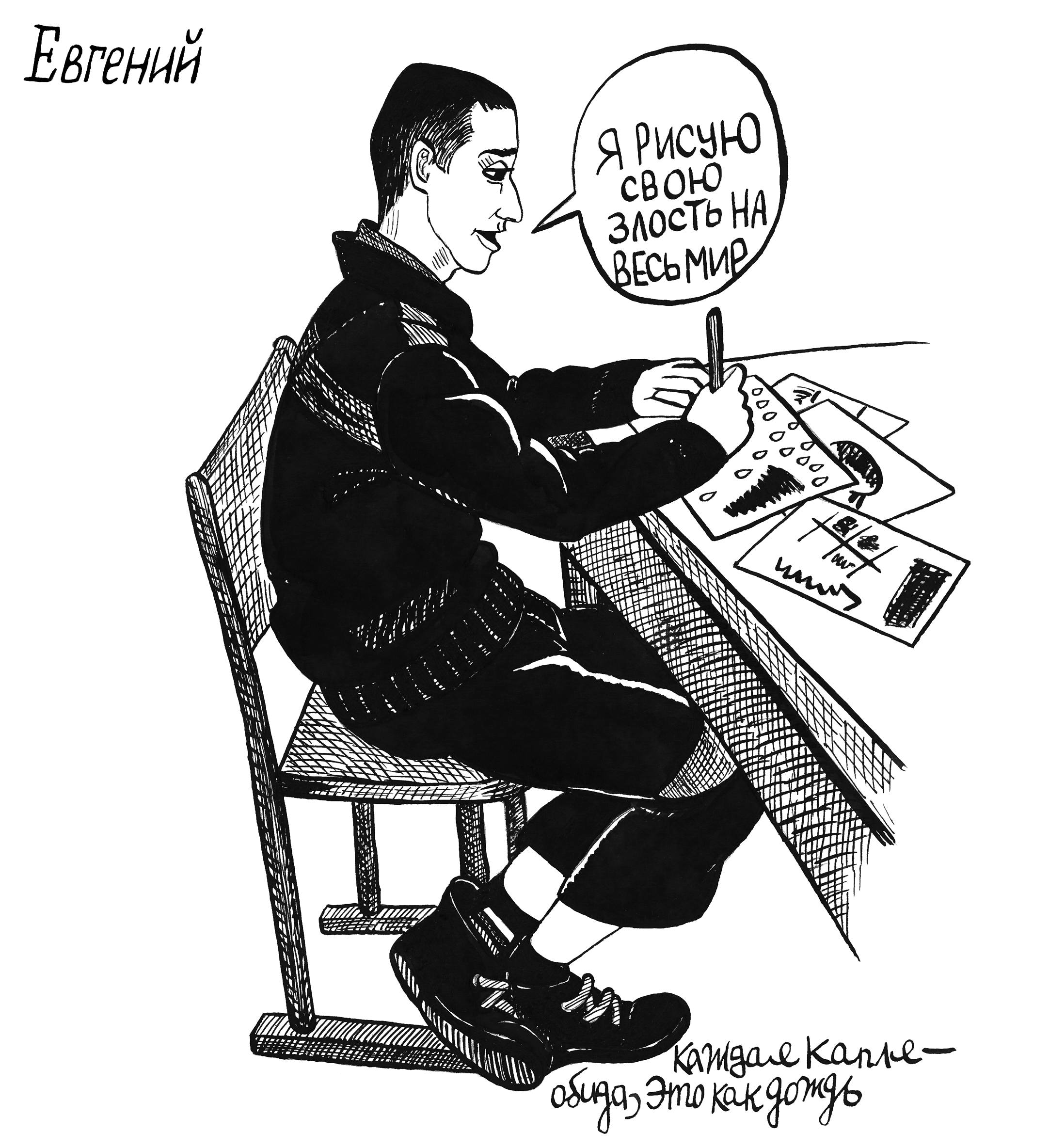
lomasko-prison-5Yevgeny: “I take out my anger on the world by drawing. Each drop is a grievance: it’s like rain.”

Yevgeny always looked tense. He hated his surroundings and once said he wanted to murder people.

“Shut up. You don’t know what murder is,” the skinhead Oleg said to Yevgeny, taking him down a peg.
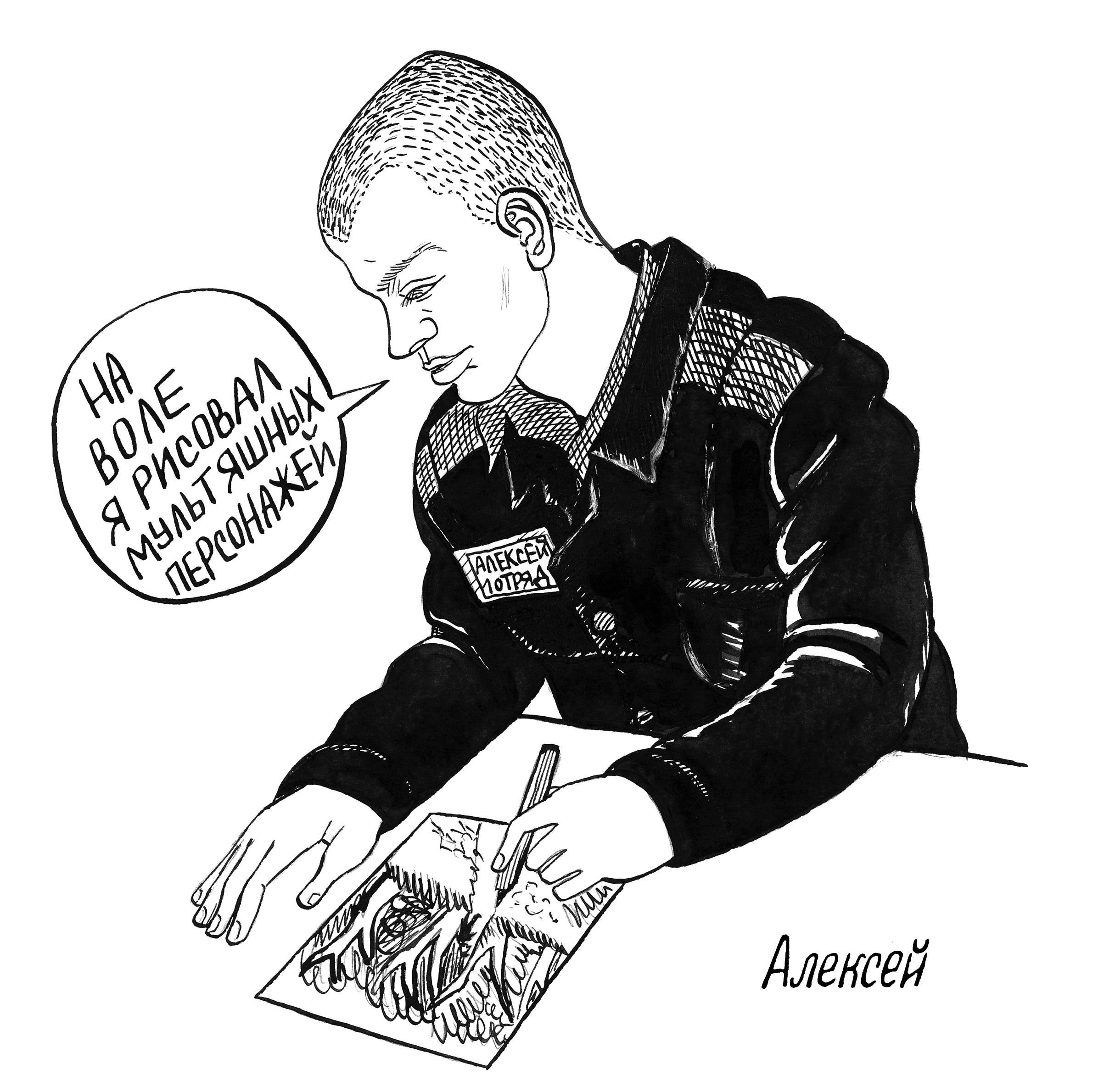
lomasko-prison-6Alexei: “On the outside, I drew cartoon characters.”

Alexei is a tall, handsome teenager. He is well read and has a good memory. What he liked most of all during the lessons was explanations of the abstract foundations of composition, which either irritated or dumfounded the other inmates.
lomasko-prison-7

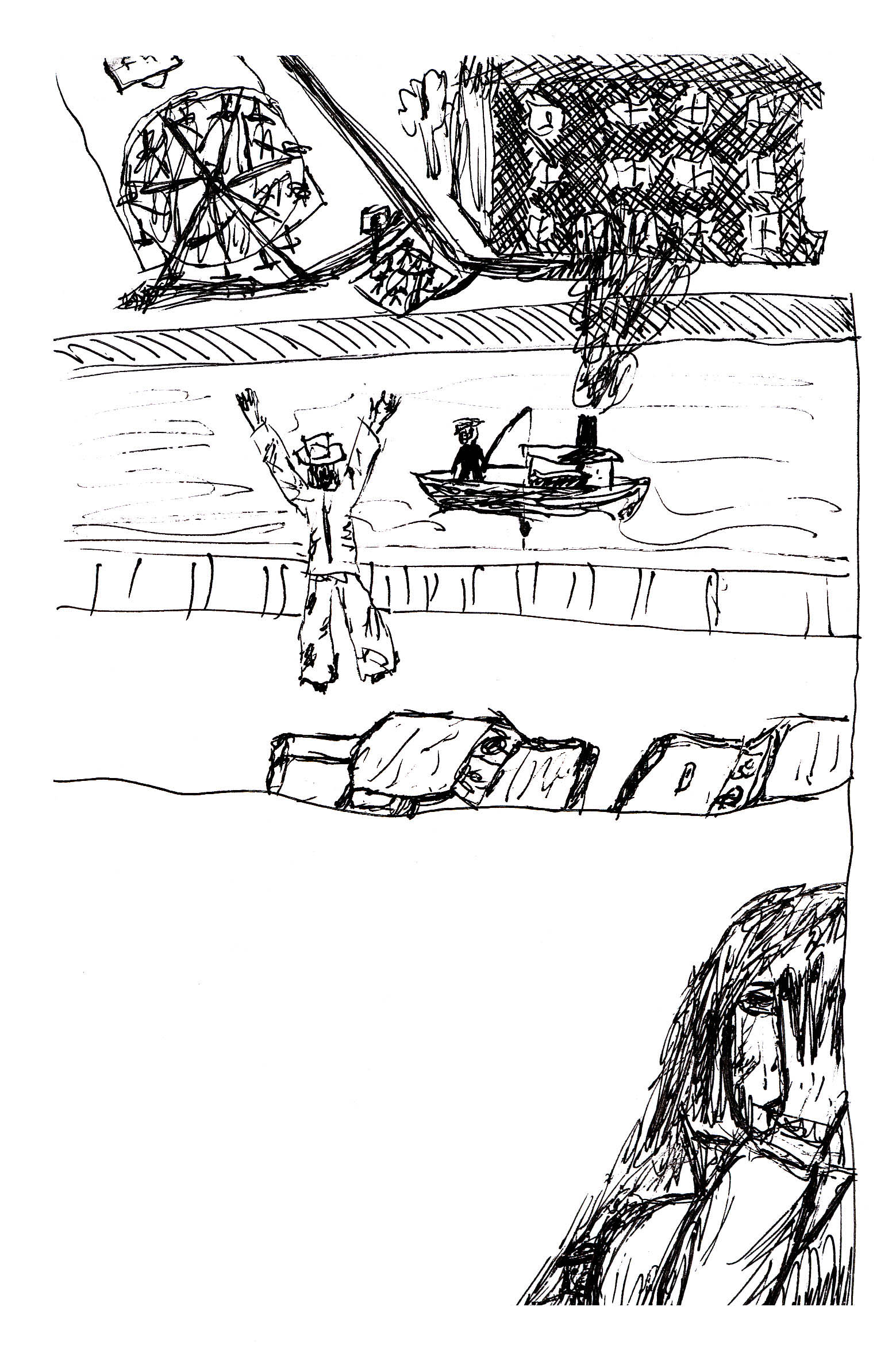
A drawing by Alexei

It was obvious the other boys avoided Alexei, and one of them half-jokingly called him a maniac. It turned out that once on New Year’s Eve, Alexei had committed a double murder while intoxicated: he had stabbed one of his victims around fifty times with a knife. Before the New Year, Alexei was transferred to an adult prison in Tambov, while the skinheads were sent to a prison in the Moscow Region.

lomasko-prison-8Natalia Dzyadko: “Why does no one come here to play football with the boys?”

Human rights activist Natalia Dzyadko has worked with the penitentiary for eight years. Along with staff members at the Center for Prison Reform, she brings candy and presents for the inmates’ birthdays, and invites people willing to work with the boys to the prison. It is difficult to gain entry to the prison without outside help. There are exceptions: the famous actor and musician Pyotr Mamonov has been granted the right to visit at any time, without a pass. True, he does not come that often, once or twice a year, but the inmates who have caught his concerts at the penitentiary still remember Mamonov.

lomasko-prison-9The inmates have almost no time for themselves: their lives are organized on a strict schedule. But when they do have free time, what they like doing most of all is playing football.
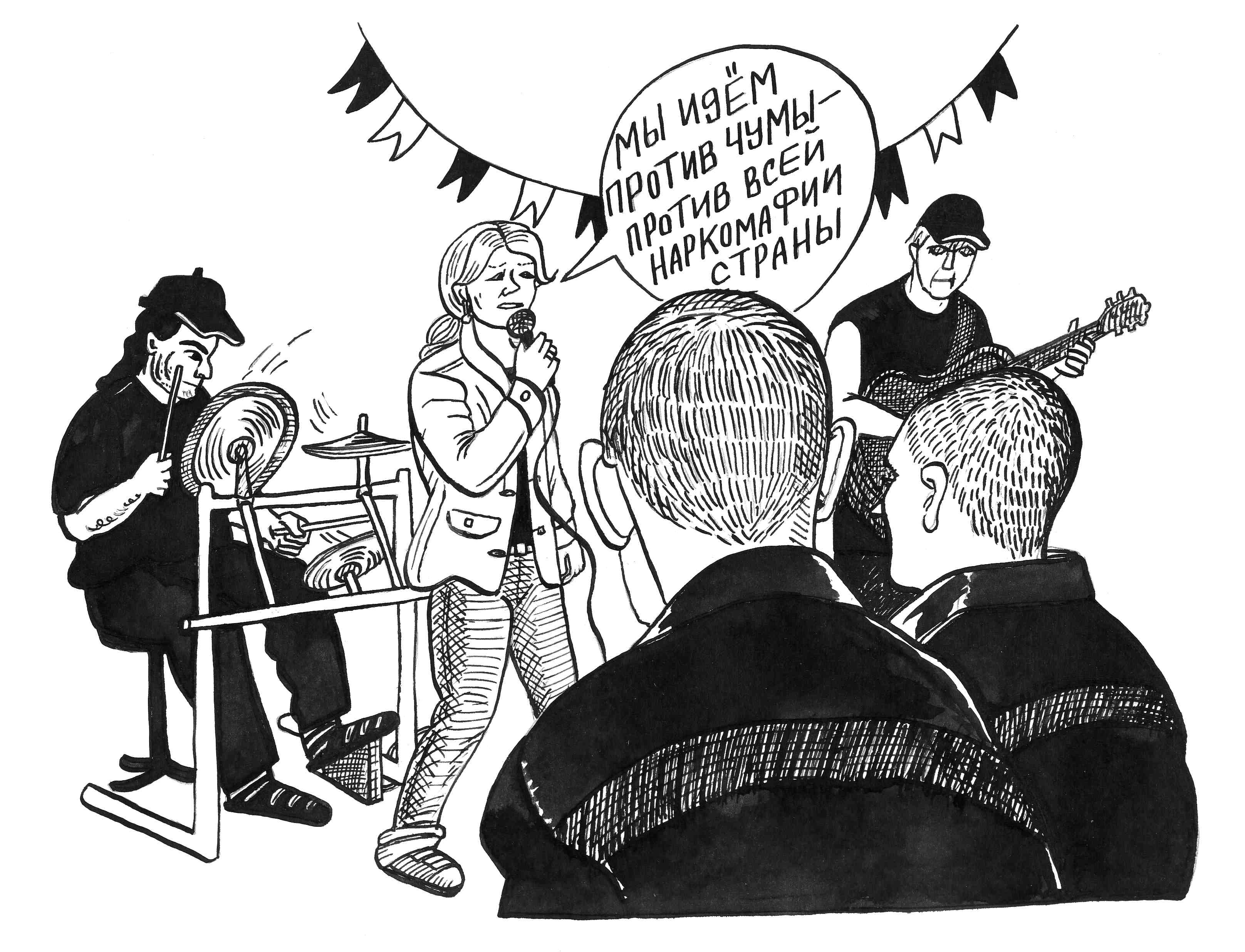
lomasko-prison-10Singer: “We’re fighting a plague, we’re fighting the entire Russian narcomafia.”

Activists sometimes visit the penitentiary, for example, a band made up of former alcoholics and drug addicts, from the organization Transfiguring Russia. The musicians performed for the boys songs they had written about the benefits of a healthy lifestyle.
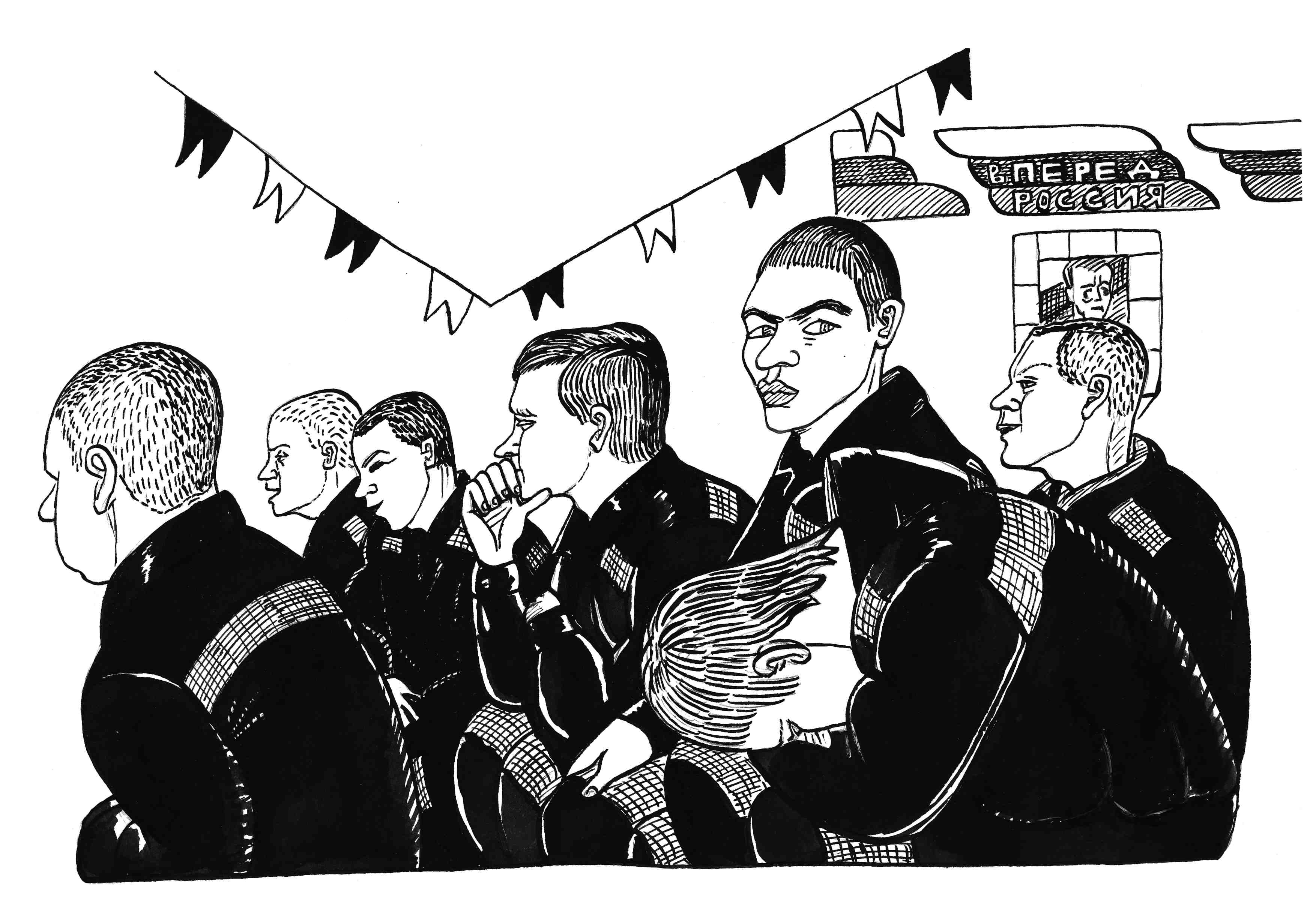
lomasko-prison-11The boys said the concert was cool, but that it was odd the musicians were wearing slippers and torn socks.
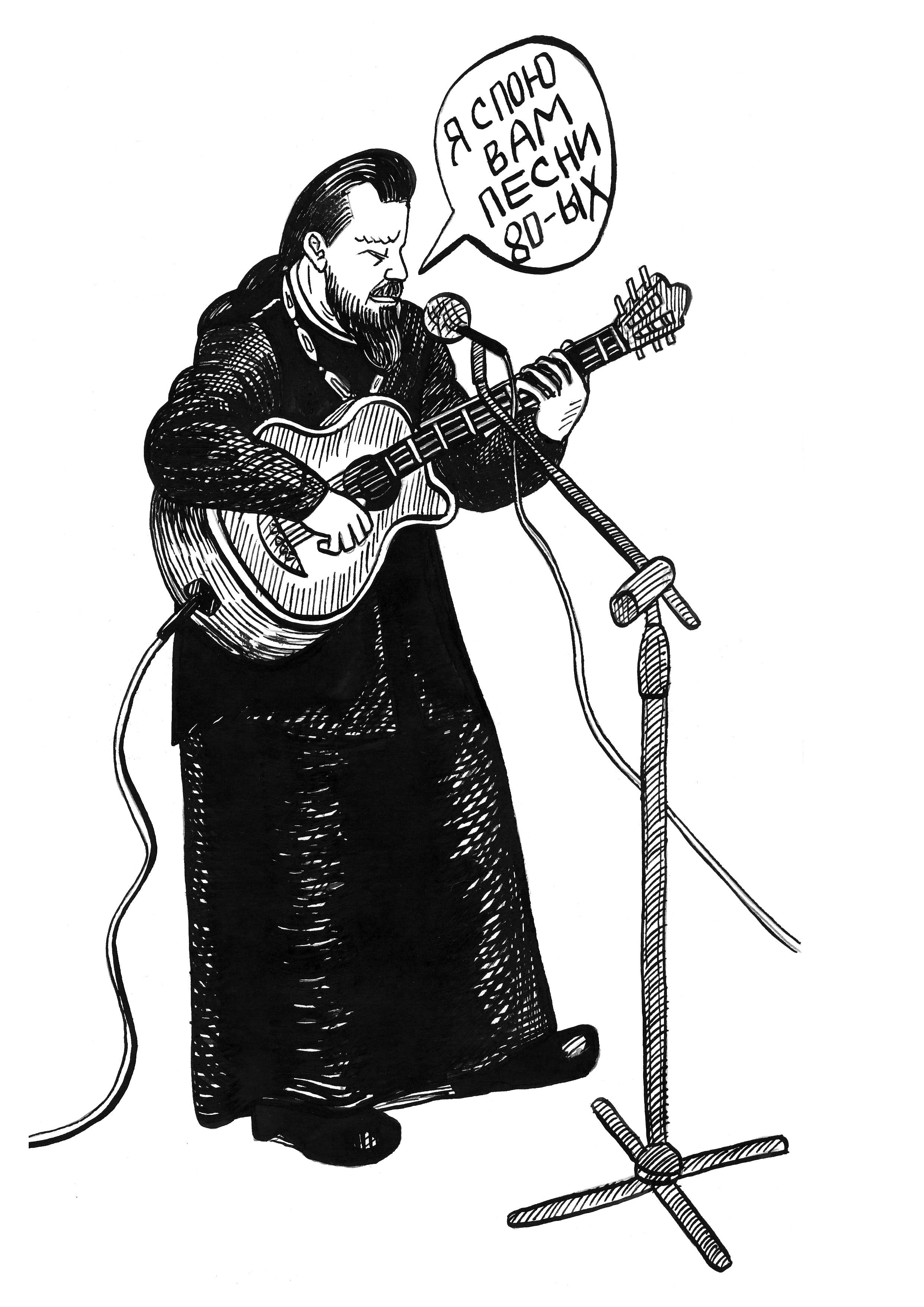
lomasko-prison-12Father Andrei: “I’m going to sing you songs from the ‘80s.”

Father Andrei from Descent of the Holy Spirit Church also visited the inmates. The church is famous for its prior, ex-rocker Sergei Rybko. The priest performed several songs at a concert in the prison.
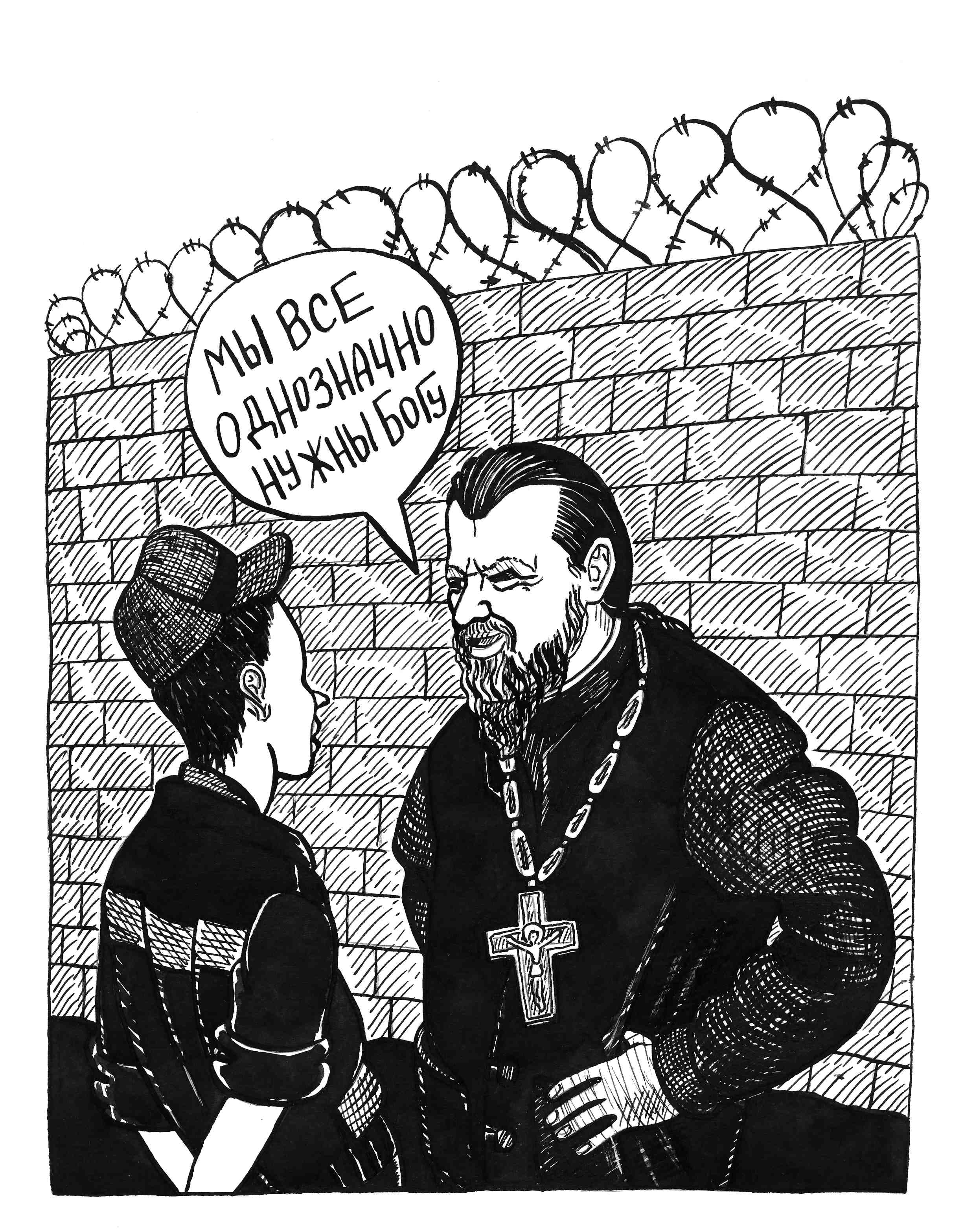
lomasko-prison-13Father Andrei: “God definitely needs all of us.”

As in adult prisons, many inmates at the juvenile penitentiary turn to religion. There is a tiny wooden church on the premises. There are lots of icons in every residential unit, and even the TV in the common room is ringed with icons. Orthodox priests frequently come on the weekends to receive confession, chat, and show films about Russian Orthodoxy. No one comes to see the Muslim boys.

lomasko-prison-14“They have put us up a crooked New Year’s tree with crooked decorations.”

As New Year’s approached, they were few boys left at the penitentiary. Some had been released, while others had been transferred to adult prisons.

Victoria Lomasko’s project Drawing Lessons at a Juvenile Prison is on display until February 9, 2015, at the Reina Sofia Museum in Madrid as part of the group show Really Useful Knowledge.

Victoria Lomasko: Socially Engaged Graphic Art in Russia

Victoria Lomasko on Socially Engaged Graphic Art
November 8, 2014
Openrussia.org

To get a more or less undistorted sense of reality in our country and transmit it to other people, you have to become a researcher yourself. Socially engaged artists have joined independent journalists, human rights activists, and sociologists in this field. I will try to briefly describe socially engaged graphic art and how it can help in shaping civil society.

It is easier to start the story by talking about my own experience. I would agree with what artist Kuzma Petrov-Vodkin said on this score: “If your work does not improve you, it is powerless to improve anyone else, and [art] has no other task than improving humanity.” For a long time I was hampered by the art scene’s insularity and especially by my own fear of venturing outside it. In 2008, I began making forays into other social milieux and drawing graphic reportages, illustrated documentary stories. I have produced stories about farm workers, village school teachers, migrants, Orthodox activists, the LGBT community, sex workers, and juvenile prison inmates, among others. I have seen that these other milieux are no less isolated from each other, generating mutual contempt, fear, and hatred.

lomasko-soc-1 From the series Black Portraits, 2010. (Left panel) Stoneworker Sergei, who used to be a militant atheist, is now an Orthodox activist: “The West wants to destroy the bold and beautiful Russian people.” (Right panel) Viktor Mizin, a political science lecturer at MGIMO, was born at the Grauerman maternity hospital in central Moscow: “Russians are shit, but I’m a seventh-generation member of the intelligentsia.”

I drew these two portraits on the same day. I meet the Orthodox activist at a prayer meeting against a proposed new redevelopment plan for Moscow, and the “member of the intelligentsia” in a bar on Bolshaya Nikitskaya. The diptych—an illustration of our extreme anomie and mutual disrespect—сame together on its own.

lomasko-soc-2

Teacher: “Is ‘Moscow’ a person’s name or a place name?” First-grader Sasha: “It’s a street.”

The drawing, above, is from the graphic reportage A Village School, which takes place in a village near Tula. When I expressed my surprise that the children did not know what the capital of Russia was, I was told that Moscow was a big dump inhabited by freaks.

The situation is aggravated by the official media, which produce repulsive, clichéd images of many social groups. I was thus afraid to go a juvenile prison for the first time, expecting to see young degenerates there. In reality, black and white were intertwined, and I found it impossible to judge other people’s actions.


From the project Drawing Lessons in a Juvenile Prison, 2010—2014. (Left panel) Oleg: “There are swastikas encrypted in Raphael’s drawings.” Oleg draws a lot. He has his own views of Renaissance masterpieces. (Right panel)  Oleg is a skinhead. It all started when, aged eight, he witnessed the murder of a friend: teenagers from the Caucasus killed him to get hold of his telephone. At fourteen, Oleg organized a “fight club,” in which he was the youngest member. The fighters “staged flash mobs at Caucasian markets.” Oleg said that in his small provincial town, the population was divided into skinheads, people from the Caucasus, and suckers. He was convicted of a gang killing. He expected to be rewarded for his patriotism, not punished. Oleg had kept up his spirits at the penitentiary: he had been studying foreign languages, philosophy, and economics. He dreams of becoming a politician: “Yanukovych’s priors hadn’t stopped him from becoming president.” In the autumn, he was transferred to an adult prison.

Before meeting sex workers, the image of them I had in my head—of brazen, heavily made-up prostitutes—had also been shaped by the media. But in real life they were tired women in casual clothes. Many were single mothers who had gone into prostitution to feed their children.

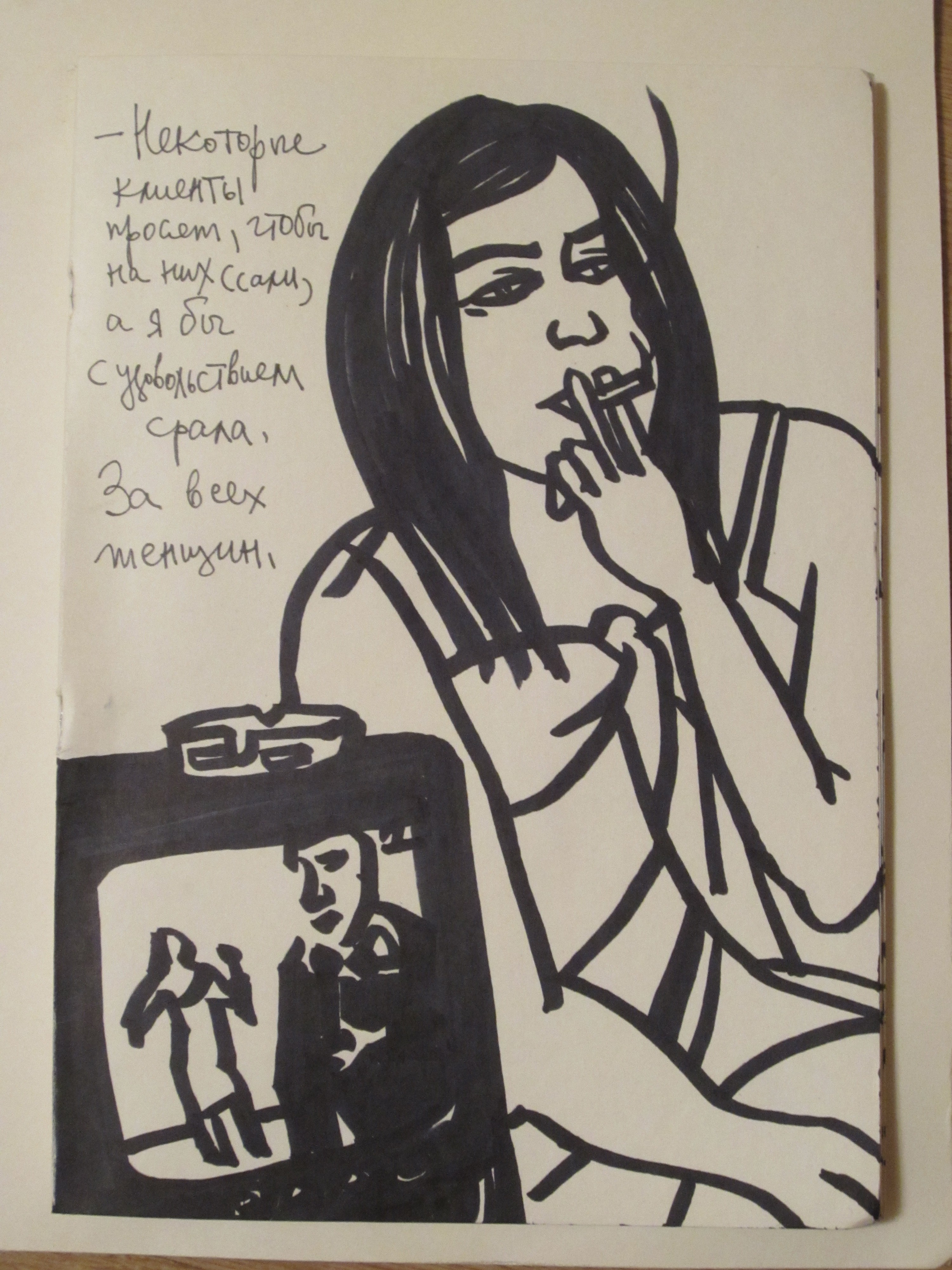
lomasko-girls-6From The “Girls” of Nizhny Novgorod, 2013. “Some clients ask us to piss on them, but I’d be happy to shit on them on behalf of all women.”

When I had just started making graphic reportages, it was considered something marginal in Russia. The situation has changed in recent years: there have been more and more graphic art non-fiction stories on social topics. Here are a few examples.

lomasko-soc-5Tatyana Faskhutdinova, Unknown Stories from the Life of Lyonya Rodin, 2012. (Left panel) People often take me for an extraterrestrial. One winter, the firewood ran out and there was no fuel for the stove. My friend and I decided to rent a flat. The landlady had a fit when she saw me. Lyona: “How much is the flat?” Landlady: “Ahhh! And he talks, too!” (Right panel) In our town, no one has any use for people like me. Disabled people have no way to get around normally. Tram driver: “Hurry up and get on!”

“Lyonya Rodin is my friend. He has been disabled since birth. […] It was not so much the absurd, maddening situations that happen to him now and then, situations caused by people’s indifference and society’s unwillingness and reluctance to accept people with disabilities, that I wanted to recount, but rather his ability to make friends, to dream, to make plans and carry them out, his passion for what he does, his utter lack of bitterness at life, and his inner calm and pride, despite the harshness and even cruelty of his circumstances.”

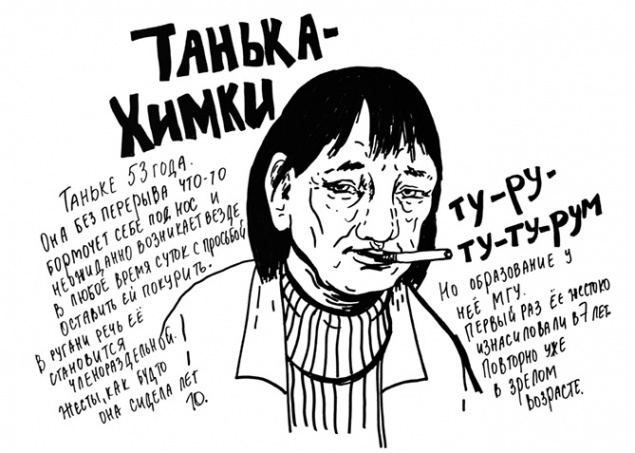
lomasko-soc-6Yana Smetanina, The Inhabitants of Psychiatric Hospital N0. 5 in Khotkovo, 2013. TANKA KHIMKI. Tanka is 53. She endlessly mumbles to herself and unexpectedly pops up everywhere at any time asking for a smoke. When she cusses, you can make out what she’s saying. She gestures like a woman who spent ten years in prison. TOO-ROO-TOO-TOO-ROOM. But she got her education at Moscow State University. She was brutally raped for the first time when she was 7. She was raped again as an adult.

“As a child I was really afraid of ‘crazy’ people. […] When, almost three decades later, I came to meet the inhabitants of Psychiatric Hospital No. 5 in Khotkovo, you can imagine my surprise when I realized that nearly all these women had been rape victims and that was why they had lost either their minds or their strength and their will to live. […]  They had been victims of rape, including incest, early in life, assaults on the street, and beatings by their own husbands.”

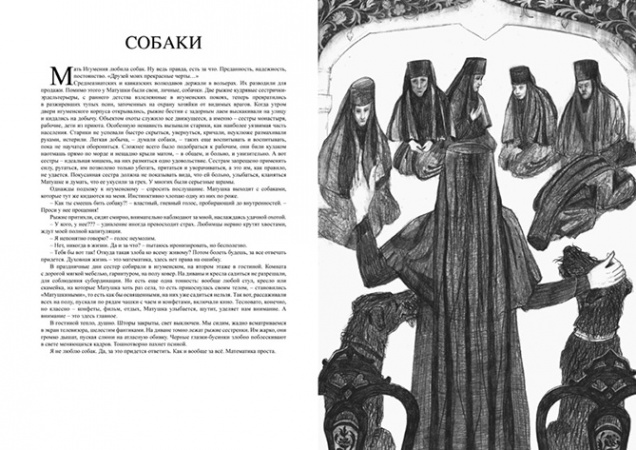
lomasko-soc-7Ilmira Bolotyan (illustrations) and Natasha Milantyeva (texts), A Nun’s Life, 2013

“Natasha Milantyeva, my girlfriend’s cousin, spent over 18 years in a convent. A Russian Orthodox nun, she was forced to leave her convent because life there threatened her health and the people in charge no longer wanted to see her among their ranks. Her unique experience has been the basis of short stories and plays about convent life. Natasha has witnessed events that no journalist could either record or depict.”

These works and many others were shown at Feminist Pencil, a series of exhibitions of socially engaged graphic art curated by Nadia Plungian and me.

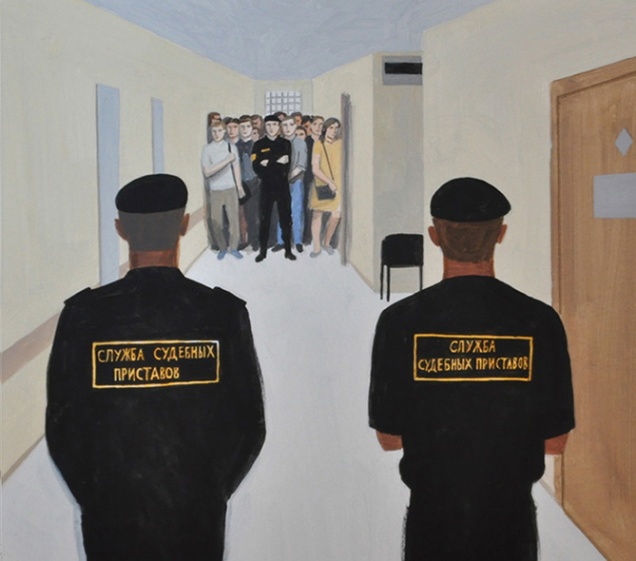
Graphic reportage is especially appropriate in court, since it is forbidden to take pictures and shoot video during hearings. Activist artists in different Russian cities and other parts of the former Soviet Union have taken to sketching court proceedings during political trials.

lomasko-soc-8
Radik Vildanov, Bailiffs Blocking the Corridor (Bolotnaya Square Trial), 2014

Zlata Ponirovskaya and I run the web site Drawing the Court, an archive of drawings from political trials and informative texts about these cases.

There are other grassroots initiatives involving drawing. The Women’s Crisis Center in Petersburg, for example, has begun engaging female artists to document court hearings on cases of domestic and sexual violence against its clients.

In Germany, Belarusian artist Marina Naprushkina sketches court hearings in the cases of asylum seekers from different countries, archiving them on the web site Refugees’ Library. Although her project only partly involves Russia (many of the refugees are from Chechnya and Dagestan), I cannot pass up this happy synthesis of socially engaged drawing and human rights work in my overview.

“I put together notebooks at the hearings, which people then translate into different languages. Having the web site function as an informational platform for refugees themselves is our main objective. The refugees are often not ready for the hearings: they don’t know they go, and what they should expect there. The notebooks are already read in many countries around the world,” says Naprushkina.

Like court sketches, graphic art produced for rallies has to make a clear, emotional statement. Many activist artists have been involved in making placards for opposition rallies and even helping to design the look of whole columns.  For example, at a 2012 rally in support of the Bolotnaya Square defendants, the Left Front’s column marched with portraits of the political prisoners drawn by artist Nikolay Oleynikov. In 2014, Oleynikov also organized an Anti-Fascist Creative Workshop at which he helped activists collectively produce placards for the annual Stanislav Markelov and Anastasia Baburova memorial rally on January 19. Portraits graced most of the placards at the rally.

lomasko-soc-9Anti-Fascist Creative Workshop. Photo by Vasily Petrov

However, portraits of political activists belong more to the realm of political art than to graphic art focused on social issues. It would also be a stretch to include the numerous examples of graphic art that appeared at protest rallies in 2012 and 2013 in this body of work. The main subjects were criticism of Putin and support for Pussy Riot: I don’t remember seeing placards dealing with societal problems there.

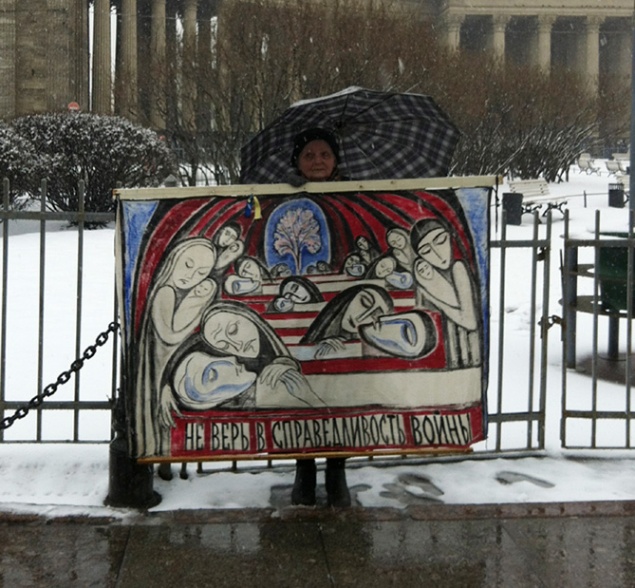
The works of Petersburg artist Yelena Osipova are outstanding in this regard. Even before the upsurge of protests in 2012, Osipova had been attending rallies and solo pickets with large, hand-drawn placards that took on such topics as the demolition of historic buildings, tuberculosis, everyday racism, children involved in the drug trade, and the murders of journalists.

lomasko-soc-10
Yelena Osipova, Don’t Believe in the Justice of War, March 2014. Photo by Asya Khodyreva

Osipova illuminates even the war in Ukraine from a social angle. Such posters of hers as Don’t Go to War, Sonny and Stop the War, Mothers and Wives, and her large-format colored placard Don’t Believe in the Justice of War treat war not as an abstract evil but as the personal tragedy of women who have lost sons and husbands.

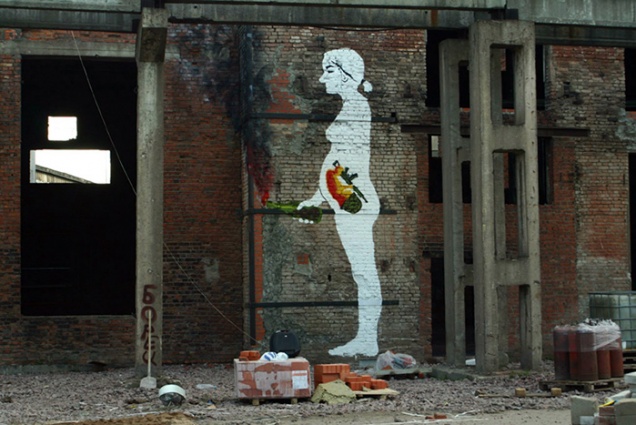
City walls are another good place for socially engaged graphic art. Over the past two years, the Petersburg group Gandhi has become a notable presence in socially engaged street art. Most often, the group makes large stencils in a laconic, poster-like style, for example, its series depicting female migrants or its latest work, a fresco on the fence of the Social Adaptation Center for the Homeless in Moscow.

lomasko-soc-11

Stencils made by the group Gandhi for the Solidarity Art Festival, 2014. Photo by Anton Androsov

Gandhi has made one of the few statements by Russian artists on the war in Ukraine. At the Street Art Museum in Petersburg, they produced a fresco entitled Broads Will Give Birth to New Ones, explaining it as follows: “We see and hear what is happening—a war that has not been formally declared but which is permanently conducted on the external and internal fronts. […] Our subject is a woman holding a Molotov cocktail. Glowing inside her is an infant soldier, doomed to fight for the money and power of strangers. The woman has chosen to rebel, knowing that if she fails, her child will himself, in the future, go after her with a gun.”

lomasko-soc-12Gandhi, Broads Will Give Birth to New Ones, 2014. Photo taken from the group’s Facebook page

Samizdat has always been a means of spreading leftist ideas. Graphic artists have been actively collaborating with such independent publications in Russia.

The newspaper Chto Delat has been published for many years by an eponymous group of leftist artists, philosophers, writers, researchers, and activists. Back issues of the paper are accessible on their web site.  The newspaper is filled with graphic art. These are not illustrations, however, but series of works by artists, linked to the articles by a common theme.

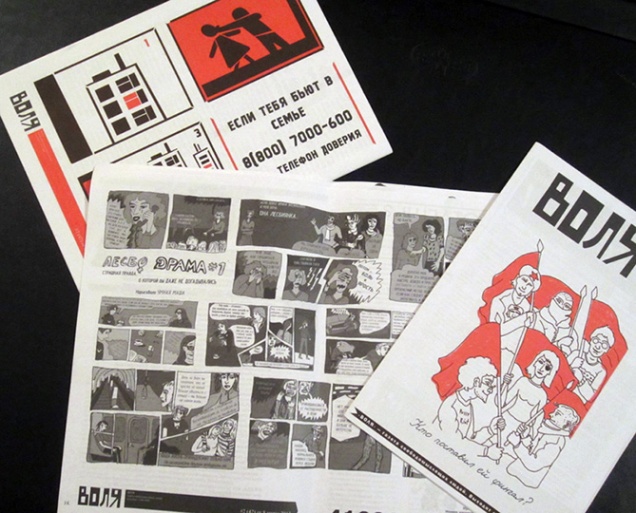
Lots of graphic art is printed in the anarchist newspaper Volya (Liberty).

lomasko-soc-13

Anarchist newspaper Volya

The 2013 International Women’s Day issue of Volya, featuring the works of feminist artists, was especially interesting visually. Such a variety of genres—posters, stencils, comics, graphic reportage, logos, and cover art—cannot be found in the official press.

Feminist zines are gradually emerging in Russia. In 2013, the first issue of Molota ved’m (Malleus Maleficarum) was published.

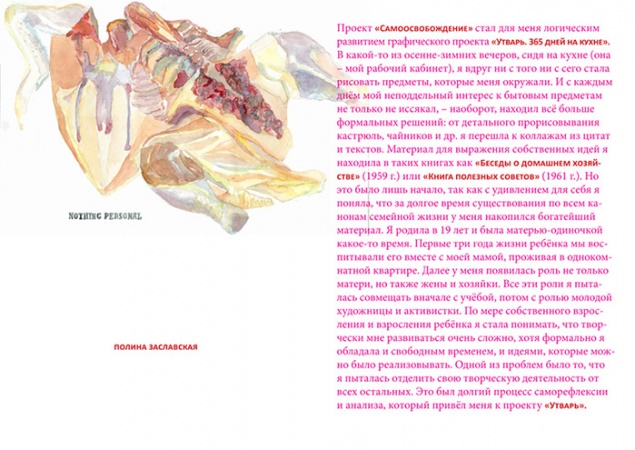
In the next few days, the first issue of the queer feminist zine Naglaya rvanina (Insolent Gash) will be released.

lomasko-soc-14Spread from queer feminist zine Naglaya rvanina, 2014

I am particularly interested in how socially engaged graphic art can become a part of human rights work and educational projects. Since 2010, I have worked as a volunteer with the Center for Prison Reform, participating in art trips to juvenile prisons. My project Drawing Lessons is part of the Center’s human rights and educational program. The project includes summaries of lessons specifically designed for juvenile prisons, drawings made by the inmates during these lessons, my own sketches in the prisons, and various samizdat (calendars, postcards, and brochures).

lomasko-soc-15

Calendar for the Novy Oskol Prison for Girls, 2012

I have posted most of the material from Drawing Lessons on my blog.

Another example is the Nasreddin Hodja Joke Contest, a project by Petersburg artist Olga Jitlina. Every week for several months, Jitlina organized informal meetings with migrants at teahouses, cafes, and other places.  Over cups of tea, participants analyzed the kinds of ethnic discrimination experienced by migrants in Russia and came up with succinct, witty responses that would put their offenders in their place without inciting them to violence. Artist Anna Tereshkina drew comics for the project about the modern-day Nasreddin and his fictional sister Dilfuza, who find themselves in typical conflicts in Russia. The speech balloons were left either entirely blank or only the lines of the victimizers were filled in. The migrants themselves came up with Nasreddin and Dilfuza’s rejoinders, and the wittiest lines were incorporated into the comics.

lomasko-soc-16

Olga Jitlina meeting with Nasreddin Hodja Joke Contest participants at a Petersburg teahouse, 2014. Photo by Victoria Lomasko

I hope even this fragmentary overview of Russian socially engaged graphic art gives some idea of its variety, especially in comparison with the situation in the 2000s. However, due to the tightening of censorship, the range of topics on which one can speak publicly without fear of incurring fines, criminal penalties or some other form of pressure from the government has begun to shrink rapidly.

Even worse than official censorship is the internal censorship practiced by the organizers of socially engaged projects.  For example, I was asked to leave in the pitiful stories of migrants in a graphic reportage I was doing while removing everything about the perpetrators of their misadventures—Russian police officers, judges, and officials who abuse their power. Such decisions are explained by the fact that castrated socially engaged works are “better than nothing.” As a result, instead of analyzing phenomena in their entirety, they once again leave viewers and readers with distorted images.

Artists reacted to events in political and public life in 2012 and 2013 with a flood of works. Many of them were superficial and lacking in professionalism, but this was made up for by the urgency and timeliness of their topics. Now we will have to react less and reflect more. In principle, any social topic can be used to reveal Russian society’s fundamental evil: our total alienation from each other and disrespect. And for the most radical works there are still the social networks, the streets, and samizdat.