April Fools’ Day

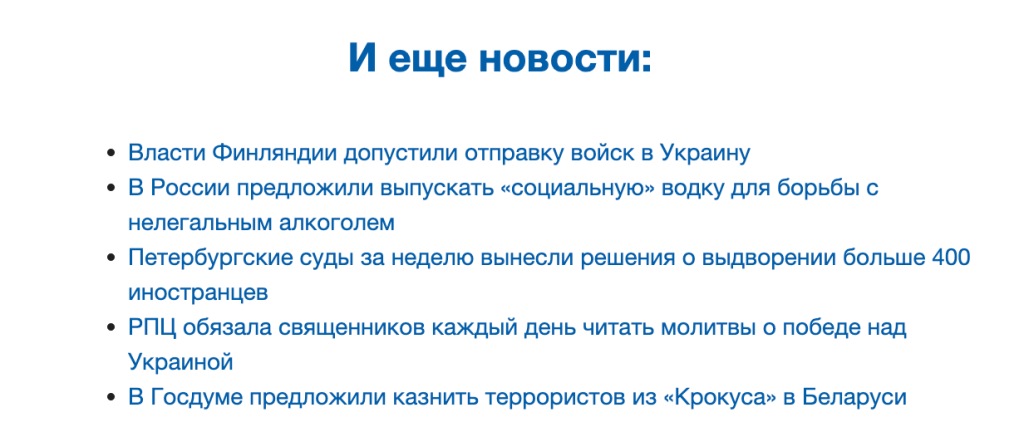
And more news:

Source: Moscow Times Russian Service daily newsletter, 1 April 2024. Translated by the Russian Reader. Unfortunately, none of these headlines is a joke.


State Duma (Russia’s lower chamber of parliament) Maria Butina has proposed an option that would allow the Russian authorities to implement the previously voiced threat to execute those involved in the Crocus City Hall terrorist attack.  Agenstvo news agency says she has proposed to extradite the Crocus City Hall terror attack suspects to Belarus, which maintains the death penalty.    

“Unfortunately, the tragedy has become common to us, because citizens of Belarus also died there.  I am quite knowledgeable about your legislation, including the death penalty, which is maintained [in Belarus].  In this case, it is the murder of two or more persons, therefore you have exactly the same right to try these people as the Russian Federation,” MP Butina was quoted as saying.

“I think that discussions are already underway among the competent authorities.  If they count on the fact that, since Russia has imposed moratorium on the death penalty they will be able to escape this type of punishment, then let’s wait and see, because negotiations are underway,” Butina was cited as saying in an interview with Belarus 1 TV Channel.    

Pervy Otdel (First Department) lawyer Yevgeny Smirnov told Agenstvo that “indeed, the Russian legislation allows, on the basis of an international agreement, to extradite people who committed a crime in the territory of Russia to another country.”  

According to him, “if a request arises from Belarus, the agreement with it will have priority over Russian norms.”

“However, in the case of at least one accused — Alisher Kasimov, who rented out the apartment to other defendants – it is impossible, because he has Russian citizenship,” Smirnov noted.  

Belarus still maintains the death penalty. 

Capital punishment is a legal penalty in Belarus. At least one execution was carried out in the country in 2022.  Also known as an Exceptional Measure of Punishment it has been a part of the country’s legal system since gaining independence from the Soviet Union on August 25, 1991.  The current national constitution prescribes this punishment for “grave crimes.”  Later laws have clarified the specific crimes for which capital punishment can be used.  The death penalty can be imposed for crimes that occur against the state or against individuals.  As of 2021, Belarus is the only country in Europe that continues to carry out the death penalty.   

Maria Butina (born November 10, 1988) is a Russian politician, political activist, journalist, and former entrepreneur who was convicted in 2018 of acting as an unregistered foreign agent of Russia within the United States.[

While residing in Washington, D.C., Butina was arrested by the FBI in July 2018 and charged with acting as an agent of the Russian Federation “without prior notification to the Attorney General.”  In December 2018, she pleaded guilty to felony charges of conspiracy to act as an unregistered foreign agent of Russia.  In April 2019, a federal judge sentenced her to 18 months in prison.  She served around five months at Tallahassee Federal Correctional Institution.  Her 9-month pretrial prison term was counted towards her sentence.  She was released and deported back to Russia in October 2019.  She publicly denied being a Russian spy.  In 2021, she was elected to the State Duma as a member of United Russia.  

Source: “Russian MP proposes to extradite Crocus City hall terror attack suspects to Belarus,” Asia-Plus, 1 April 2024

That’s When We Reach for Our Revolvers

The trigger fingers at Fontanka.ru, a popular Petersburg news and commentary website, are getting itchy as Russia’s officials and wagging tongues publicly contemplate exiting the Council of Europe and jettisoning all the cumbersome obligations of membership, including a moratorium on the death penalty that has been in place since 1996.

Even today, January 30, 2015, the Russian Federal Penitentiary Service maintains lists of volunteers obliged, if necessary, to shoot those sentenced to death. The moratorium, after all, is a temporary understanding. State Duma deputy speaker Lebedev’s comment that if Russia exits the Council of Europe, it will have the right to restore capital punishment, is a good occasion to discuss how executions technically happen. The door to secret room 2/0 has not creaked for a long time in the depths of the Crosses Prison.

[…]

In the second cross at the Crosses there is a wing that previously held prisoners sentenced to death. Now those sentenced to life imprisonment wait there to be transferred.

The wing is known as 2/1. It is harder to access than the other sections of the prison. The corridor is shorter than in the others, containing not thirty cells, but something like twenty-five. One “cell” there is exceptional. Its door looks like the other doors, but it leads into a secret basement codenamed 2/0.

I have no idea what governs departmental orders in early 2015, but under the Soviet regime the guidelines for selecting executioners had an ideological tinge. Only volunteers could execute prisoners. The guidelines stressed that volunteers would receive no perks or, God forbid, any monetary remuneration.

The takers were few, of course. Age and length of service also had to be taken into account. You could not send a young officer to do the job. Thus, when drawing up the annual lists, the warden at the Crosses would summon veterans and tell them someone had to do it.

People at the prison would guess who was on the list, but it was bad form to gab about it. The incognitos [sic] themselves signed nondisclosure agreements.

When the time came, the officer had the right to examine the case file, to peruse photo records of dismembered bodies or strangled children. It mattered that hand and heart did not tremble in doubt.

At the right time in the evening, the condemned man was visited in solitary confinement by the prison warden, the responsible prosecutor, a doctor, two attending officers and himself [sic]. The prosecutor would briefly read out the Supreme Court’s final decision and denial of clemency. The guards quickly snapped handcuffs on the criminal. Hands behind the back.

At this moment the condemned man’s behavior would become clear. Some would go into a trance and become wobbly, while others would go berserk. It was then that a towel would be thrown over their heads and tied at the back so their screams and curses would be inaudible.

“What kind of towel?” I asked, somewhat surprised, in my conversation with a prison officer.

“A white honeycomb towel, the kind issued to all the prisoners,” he replied.

And the man would be dragged to where he no longer existed [sic], to the door of “cell” 2/0.

It is [sic] already open, the steps leading down. He [?] didn’t count how many. The march ends. A dimly lit basement space with a container in it, something like a trough. The head is bent down, the command is given, a shot from a Makarov pistol, the doctor’s diagnosis.

They say that it would happen that the first bullet didn’t kill. Then it would happen again: command, shot, diagnosis.

The body would be wrapped and, accompanied by a document reading “This transport not subject to checks,” would be taken in a prison vehicle to a cemetery. In Soviet times, this would have been [Petersburg’s] Northern Cemetery. A pit had already been dug in advance, whose significance only the cemetery director knew. The body would be buried and forgotten.

In the archives, this place will forever be designated by a three-digit secret number.

It’s all humdrum. None of the myths about drawing lots or firing squads in which only man’s gun is loaded with live rounds [is true.]

“I come home once after this, and my wife is partying with guests in the kitchen. They’re listening to ABBA on a tape recorder. I take off my coat, sit down, and peck at a salad. My wife starts in on me: ‘Why are you spoiling our mood?’ What could I say to her?” an executioner recalled to me twenty-five years ago or so.

That’s right: if you destroy a dozen unknown boys in battle you’re a hero, but if you kill a maniac you’re a hangman.

That door—to cell 2/0—has not opened since the moratorium was announced in 1996.

The state is sturdily organized: the moratorium is not a dogma, but a timeout.  The formal lists of firing squad members are constantly drawn up and amended depending on personnel changes at the Federal Penitentiary Service for Saint Petersburg and Leningrad Region.

So if push comes to shove, they could be ready today, January 30, by nightfall.

source: Fontanka.ru

____________

Since I’m not a very good translator, it is hard for me to convey the hard-boiled relish with which Fontanka.ru journalist Yevgeny Vyshenkov, an ex-cop, contemplates the return of capital punishment in Russia. Maybe this will do the trick instead:

Here, Alexei Didenko, deputy leader of the LDPR faction in the Russian State Duma, excitedly reports that within “24 hours” of exiting the Council of Europe and its Parliamentary Assembly all the legal mechanisms would be in place for executing “millions and millions of perverts, rapists, and pedophiles.”

Since the prison population in Russia was reported as 671,700 inmates as of December 1, 2014, one wonders where Didenko is going to find all those “millions and millions of perverts.”