Grand Theft Auto

Grand Theft Auto aka Watch Out for Cars! (Eldar Ryazanov, 1966). In Russian, with English subtitles

The restoration of the film was performed by a team of professionals from Mosfilm’s Computer Graphics Group. Learn more at https://cg.mosfilm.ru

Film comedy. Insurance agent Yuri Detochkin—a completely wholesome and naive man—driven by a sense of justice, steals cars from people living on illegal income, sells them, and gives the profits to orphanages.

Director: Eldar Ryazanov
Screenplay: Eldar Ryazanov and Emil Braginsky
Film Score: Andrei Petrov
Camera: Vladimir Nakhabtsev and Anatoly Mukasei
Production design: Boris Nemechek and Lev Semyonov

Starring: Andrei Mironov, Oleg Yefremov, Anatoly Papanov, Lyubov Dobrzhanskaya, Innokenty Smoktunovsky, Yevgeny Yevstigneyev, Georgy Zhzhonov, Tatiana Gavrilova, Olga Aroseva, Gottlieb Roninson, Sergei Kulagin, Viktoria Radunskaya, and Boris Runge

Source: Mosfilm (YouTube), 21 June 2016. Annotation translated by the Russian Reader


The wife’s all-time favorite Soviet comedy and certainly well up there among my Top 10, Beregis/Auto has survived into the new millennium and continues to flourish as a New Year staple on Moscow TV—which is sorely strained these days to offer viewers something, indeed anything, to laugh about.

What strikes me today, while looking back at the mini-review below—in the role of a post-post-Soviet appraiser eyeing a post-Soviet impression of a mid-Soviet comedy—is not just how other-worldly both of these recent pasts can now seem (which of course they do), but how much the human mind (and heart) want to keep these eras, with their flawed but well-understood mores, sensibilities and now-appreciated modest virtues, from being erased altogether.

Because part of you, you recognize, goes off the chalk board with them—the part the new nihilists desperately want you to abandon as they clumsily and ahistorically attempt to redesign the past, social and political, to serve their nefarious present purposes.

Orwell was not only right, he was right twice, in stages. Put briefly, we need to remember both why Beregis/Auto worked so well when we first saw it—and then why it could still serve as an anchor in reality while a new generation of bad guys was busily turning their sad and saddening unreality into a Double Plus Good fake-reality that nobody could call out in public. And now decidedly can’t.

But praise be: Beregis/Auto is still there, on celluloid and on television, to remind Muscovites and everyone else that decency could and did appear and persist in consecutive yet differently indecent times—and can now raise our hopes that it will reappear as this dark period finally gives way to dawn.

Source: Mark H. Teeter (Facebook), 2 January 2024. Thanks to Mark for his kind permission to repost his somber New Year’s reflection and the eighth-year-old movie review (below) which prompted it on this website.


MOSCOW TV TONITE: The USSR’s Auto-Robbin’ Hood

Берегись автомобиля/Grand Theft Auto (USSR, 1966)(Dom Kino, 19:00)

If you get the joke at the heart of Beregis’/Auto, you get the Soviet Union, a society in which irony knew no limits and “found humor” was literally all around you, just daring you to laugh…which was the risky part. The movie is based on the jocular metaphor of a Soviet Robin Hood – a morally upright socialist citizen who is pursued by the police, naturally, for taking morality into his own hands: he steals cars from “bad people” (who make “illegal income”) and gives them to good ones (OK, orphanages).

With this suggestive premise E. Ryazanov began an unbroken string of 7 serio-comic Mosfilm hits that ran through Гараж/Garage (1979), with the latter affirming that even if you could steal automobiles in good conscience, as in Beregis’/Auto, there was still no safe place to park them!

The Ryazanov Septet corresponded with the onset, entrenchment and fossilization of late-Soviet Глубокий застой (“Deep Stagnation 9”) and neatly defined the predominant modi vivendi of High Brezhnevism – gaming the system and/or simple theft – but did so, remarkably, without getting the director incarcerated or, even curiouser, blackballed by Goskino. Eventually somebody’s dissertation will tell us why.

Beregis’/Auto was ER’s first collaboration w/ screenwriter E. Bagrinsky and one of the best: the two carefully crafted a “good-hearted saddening comedy” (“добрую, грустную комедию”) about two “friendly enemies,” one representing the state and the other the individual. They are doomed to find themselves eternally at odds, the viewer understands, as the social system they inhabit can’t cope with abstract legality any better than it can abstract art.

Yet however telling its plot and finely tuned its direction, Beregis’/Auto still wouldn’t succeed without its exceptional cast. The праведник-hero – a childlike naïf nicely dubbed Detochkin – is played by the only person who *could* have played him, in retrospect: I. Smoktunovsky, the actor of his generation, who could do (and did) everything from Chekhov to Shakespeare – indeed, he had just done his stunning turn as Hamlet for G. Kozintsev (Lenfilm, 1964) when Beregis’ came out, making the movie’s amateur play-within-a-film staging of the melancholy Dane a big “inside” joke that every contemporary Soviet viewer got immediately.

Supporting, indeed matching Smoktunovsky as Detochkin’s Inspector Javert is O. Efremov in one of the great roles of a great career, making you *believe* in a Soviet police detective who both does his job and regrets its consequences – the only appropriate response there was to the Detochkin case – and on whose office wall in place of the standard Dzerzhinsky photo hangs a picture of…Stanislavsky! Beyond these two beacons of Soviet cinema, Beregis’/Auto offers a collection of supporting players that’s hard to match in *any* film of its era: A. Papanov, A. Mironov, E. Evstigneev, G. Zhzhenov – even D. Banionis (later the hero of Solaris) has a cameo (undubbed) as a bribe-taking Baltic pastor!

Enough. Add Beregis’/Auto to your must-see list and tune it in this evening (or watch on YouTube below).

Oh, and some free advice: if you (try to) drive in the Greater Moscow area, remember to keep your nose clean and your car insurance paid up. If today’s anti-corruption Robin Hoods start stealing cars, there’s no guarantee they’ll distinguish between your Škoda and Alexei Miller’s Lamborghini.
Source: Moscow TV Tonite (Facebook), 2 January 2016

Syrias

Here are four very different but complementary reflections on the dangers of Putin’s new Syrian adventure by, respectively, an electrician and veteran grassroots activist, a sociologist, a magazine editor, and a political scientist and leftist activist.

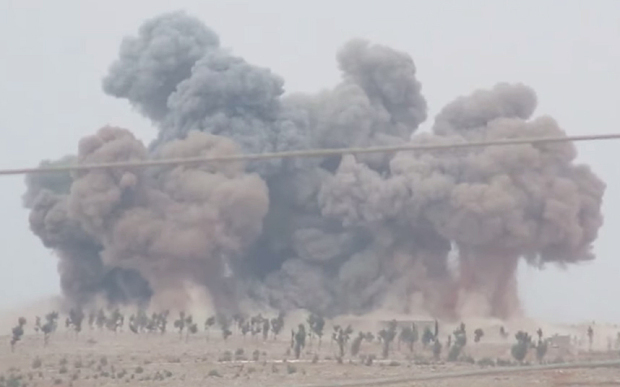
A video released on YouTube claimed to show Russian air raids targeting the ruins of al-Rabiyah and Shinsharah near Kafranbel

George Losev
October 1, 2015
Facebook

Russia pacified the North Caucasus just as the US pacified Afghanistan. The Taliban have disappeared from the news but not from life.

The US has started many wars, and the Russian Federation has already started two. The US has got into conflicts in the Middle East primarily for domestic political reasons, and the Russian Federation has done the exact same thing.

The US lies constantly, and the Russian Federation does, too. (As do the EU, Israel, Iran, Saudi Arabia, and everybody else.)

But is there even a single reason to support the dispatch of Russian forces to Syria? There are no such reasons, just as there were no reasons to support the NATO bombing of Libya or the [US/UK] bombing of Iraq.

And now, as in the case of the war in Ukraine, just watch carefully and take note of what you see.

P.S. That is, while there is no chance to do anything more substantial.

__________

Greg Yudin
October 1, 2015
Facebook

You would have to be Putin, of course, to support Assad by way of restoring order.

Assad is a man who, in the past four years, has:

  • let slip an armed grassroots uprising;
  • permitted a civil war with hundreds of thousands of victims;
  • used chemical weapons against his own citizens;
  • allowed the full-scale deployment of an international terrorist group;
  • and lost control of two-thirds of his country.

And this man, of course, is the man who will pacify all of Syria and calm everyone down.

It has often been said of Putin that he takes a cynical (i.e., “realistic”) approach to foreign policy. It is nothing like this. In the case of Syria, it is Obama, who says we should get together and appoint them a leader who can restore order, who has taken the cynical approach.

The approach of Putin and his elite, however, is not cynical but stupid. The point of this approach is that you should always support the current regime. Simply put, the boss is always right just because he is the boss. They arrived at this hard-won conviction through their own uncomplaining obedience. This belief is the basis of their power and their philosophy in life. For its sake they are even willing to entangle themselves in an international conflict.

________

Alexander Feldberg
October 1, 2015
Facebook

Until today, this business with Syria seemed strange to me in the sense that it would not be easy to sweep the Russian people off its feet with it. I understand about small victorious wars, but I imagined that this was not like Ukraine, which is next door, or Hungarian geese, which we could even fondle with our own hands until recently. And then, we are talking about a country that has lived through a war in Afghanistan, despite the incomparable scale of the conflicts and so on. But this morning I was riding the subway and saw this guy, an ordinary guy in his forties with a decent face, even, a guy who looked a little like actor Yevgeny Mironov. This guy was riding the subway and looking at something on his telephone. He was not just looking but literally devouring the phone with his eyes and putting it next to his ear from time to time to make out the sound over the roar of the subway. (For some reason he was not using earphones.) I peeped a little and saw that Sergei Ivanov was on the screen of the dude’s phone. This was when I got curious and a bit anxious, because, on the one hand, it is hard to imagine a situation in which a normal person would get so excited by a speech by Sergei Ivanov. On the other hand, in the morning I had heard on the radio about the Federation Council, which Putin had again asked for authorization, just like that other time, and that had made me a little queasy. So I broke down and gently asked the man what was happening.

yevgeny mironov
Russian actor Yevgeny Mironov

“Sy-ri-a!” he mouthed to me, clearly afraid to miss something important in the broadcast.

Then he briefly turned to me again and sighed, “We are going to bomb!”

He said it as if a weight had finally been lifted from his shoulders, as if the going had been tough, but now, thank God, it had been decided.

And at that moment I had the terrible desire not to be here, to disappear somewhere completely. I realize this was cowardice, a momentary weakness, but I felt it all the same. And I also remember a conversation I had with Bob when we were sailing down the Irrawaddy River, and thought that perhaps he had been right: “You may hate him, but you cannot get rid of him.” I don’t want to be responsible for these motherfuckers. I don’t want to think constantly about whom else they have taken it into their heads to crush or bomb. Let them build underwater chapels for scuba divers and invisible bus stops, but please, please, don’t let them bomb anyone.

invisible bus stop
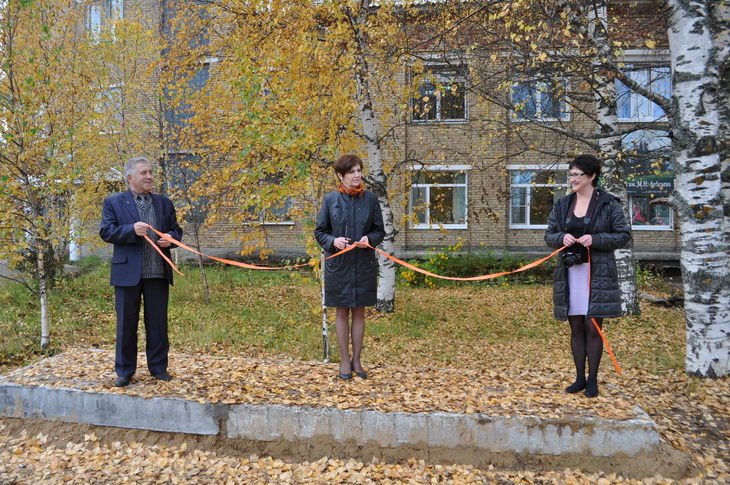
Officials opening an “invisible” bus stop in the village of Körtkerös, Komi Republic, on September 22

Bob
Bob, an Australian who looked like a gray-haired Homer Simpson, spoke intermittently and passionately, now and then dipping his elongated head into his third glass of claret.

“Very well, I know you Russians have it hard. You always have someone to answer for, either Putin or Stalin. ‘He’s Russian? Very well, let’s ask him about Putin.’ It’s the same crap with the Americans. At the drop of a hat they get told, ‘It’s all because you made a mess of things in Iraq, fellows!” You guys are constantly confused with someone else, with some big, important motherfucker. We have it much easier in this sense. ‘Australia? Isn’t that the place where there are kangaroos ?’ We are just Aussies, you know, Alex? I travel where I wish, live where I can earn money, and nobody is going to torment me with your Putin.”

“I already told you,” I replied, “I don’t like Putin.”

“Bingo!” Bob roused himself. “You may hate him, but you cannot get rid of him. Although I know that things are even more complicated in Russia. You Russians hate yourselves most of all.”

Then, in keeping with the conventions of bad movies, Bob laughed heartily and, winking conspiratorially, said, “I’ve read Tolstoyevsky!”

__________

Ilya Matveev
October 1, 2015
Facebook

If I were in Putin’s shoes I would think hard about the following paradox. Of course, you can accuse America of “destroying sovereignty” everywhere from Libya to Ukraine all the time. But America cannot just up and destroy sovereignty. It can encourage the opposition. It can even drop bombs. But it is not capable of just up and destroying state institutions themselves. The problem is that wherever a state has collapsed, it had already been weak. And a state’s weakness lies in the absence of its autonomy vis-à-vis narrow group interests, be they elite clans, oligarchs, tribes, and so on. A weak state is also labeled “patrimonial,” meaning it has been “privatized” by particular interests. This weak state syndrome was typical of absolutely all the countries Putin thinks the State Department got to. The paradox is that the Russian state, the Putinist state, is weak. It has low autonomy vis-à-vis elite groupings, and its formal institutions are window dressing for backroom deals. The more Putin “immunizes” the state from the opposition, the “fifth column,” and so, the more he strengthens precisely these same elite groups, all those Sechins and other “friends of the president,” who have an interest in weak institutions. Thus, everything Putin does only weakens the state. The easiest way to illustrate all this is with the dilemma of his successor. Putin has built a state in which no one knows what will happen after Putin, including himself. Ukraine-scale chaos is quite possible at the very least; Libya-scale chaos, at the very most. But unlike Libya and even Ukraine, Putin will only have himself to blame for this. After fifteen years, there is nothing left of the government, the parliament or the courts. All that remains are Putin’s “friends” and his “manual control.” It is a sure bet that the State Department and American imperialism are not to blame for this. In this case, it is homemade.

__________

My thanks to George Losev, Greg Yudin, Alexander Feldberg, and Ilya Matveev for their permission to translate and publish their remarks here. Click on the links, above, to read their previous contributions to this blog. Images courtesy of the Telegraph/YouTube, Tochka.net, and Zvezdakomi.ru