On May 16, 2022, the Ukrainian artist Bohdan Ziza poured blue and yellow paint – the colours of his country’s flag – on to a municipal administration building in his home town, Yevpatoria, in Crimea.
Ziza posted a video of the action online, with a call to “adherents of graffiti culture, all the vandals of Crimea, Russia and Belarus” to protest against “the most horrific war” unleashed by “[Vladimir] Putin and the machine of state.” He was soon arrested and charged with “committing a terrorist act” and “incitement to terrorism”.
In June 2023, Ziza used his final statement to the Russian military court that sentenced him to fifteen years’ imprisonment to denounce the war again: “My action was a cry from the heart, from my conscience, to those who were and are afraid — just as I was afraid — but who also did not want this war.”
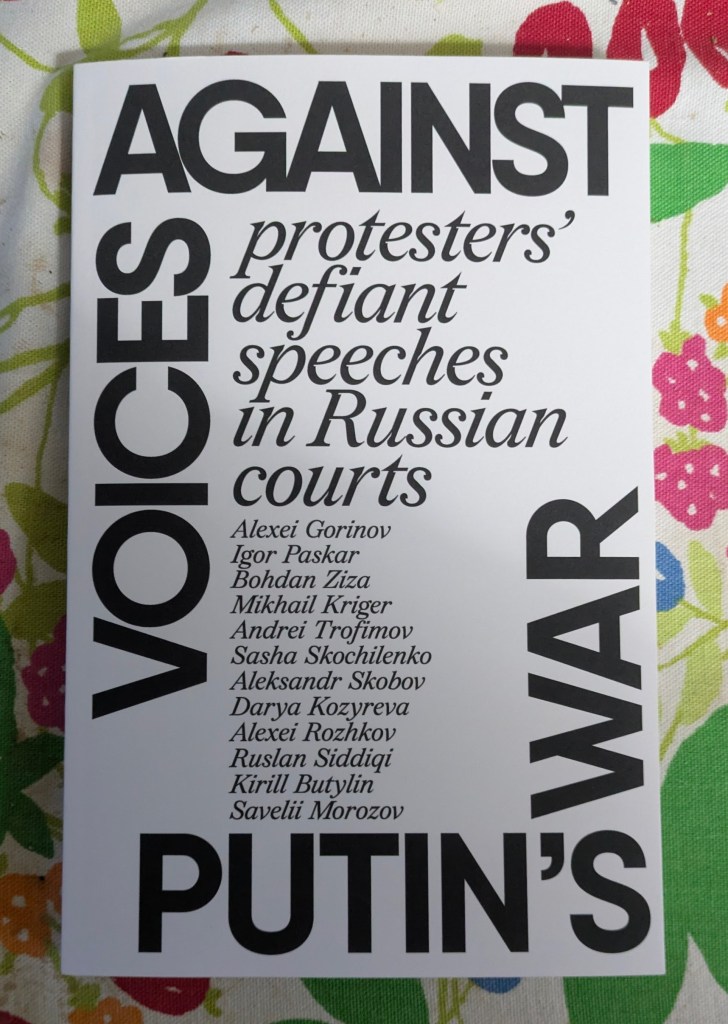
Ziza is one of ten anti-war protesters whose speeches are published this month, in English translation, in Voices Against Putin’s War: protesters’ defiant speeches in Russian courts. The collection also includes two statements made outside court, related interviews and letters, a summary of seventeen other anti-war speeches in court, and a survey of the anti-war protest movement and the repression against it.
In Russia, dissenters since the Populist rebels of the 1870s have used their final statement in court to urge resistance to power. The tradition flourished in the workers’ movements that preceded the 1917 revolution, was broken by the 1930s Stalinist show trials with their formulaic confessions, and reborn after the 1950s “thaw”, with dissidents such as the writers Andrei Sinyavsky and Yulii Daniel.
In 2022, Russia’s all-out invasion of Ukraine was followed by a brutal crackdown on civil society in occupied territory, Crimea included, as well as repression of domestic dissent. Protest was driven off the streets. Individual non-violent direct actions like Ziza’s, or writing or speaking against the war, were punished with long jail sentences, such as those now being served by most of the protagonists in Voices Against Putin’s War.
Ruslan Siddiqi, the Russian-Italian anarchist, went further: he is serving twenty-nine years’ imprisonment for derailing a train that was carrying munitions to Russian army units in Ukraine.
In court, he declared himself a prisoner of war, rather than a political prisoner: “My targets were Russian military equipment and the logistical chains used to transport military hardware and fuel. I wanted to impede military operations against Ukraine.”
Acting according to one’s conscience, in a dystopian world of militarism and big lies, was a central consideration for many of the protagonists.
Alexei Rozhkov, who firebombed a military recruitment centre in Sverdlovsk region, fled to Kyrgyzstan while on bail, before he was kidnapped by Russian special forces and returned to be put on trial.
He told the court that sentenced him to sixteen years: “Although I have never been a politician or a statesman, I could not remain indifferent when the war began. I have a conscience, and I preferred to hold on to it.”
The book’s protagonists oppose the war from a wide range of political viewpoints. On one hand, there are pacifists such as Sasha Skochilenko, the artist jailed for seven years for replacing labels in a supermarket with handwritten anti-war messages (and later freed in a prisoner swap between Russia and Western countries), who told the court: “Wars don’t end thanks to warriors — they end thanks to pacifists.”
On the other hand, there are political activists who spoke of Ukraine’s right to resist Russia militarily. Aleksandr Skobov, 67, the oldest protagonist, first jailed for activity in the socialist wing of the Soviet dissident movement in 1978, refused to stand when the judge came into court.
Skobov wished death on the “murderer, tyrant and scoundrel Putin.” He said he would never stop calling on honest Russians to join the Ukrainian armed forces, and for air strikes on Russia’s military facilities.
No less adamant in support of Ukraine was the youngest protagonist, Darya Kozyreva, 19, sentenced to two years and eight months’ imprisonment for laying flowers and a poem at the statue of Ukraine’s national poet, Taras Shevchenko, in St Petersburg.
In court, Bohdan Ziza denounced not only the 2022 invasion but also the frenzied assault on Crimean Tatar organisations that preceded it in Crimea, which Russia annexed in 2014. “Those who so passionately seek ‘Nazis’ in Ukraine have not opened their eyes to the Nazism in Russia, with its ephemeral ‘Russian world’,” with which the armed forces have “tried to extirpate Ukrainian identity”.
(Last month Ziza, on his own demand, had the Russian citizenship that was imposed on him along with all Crimean residents revoked. He is today in Vladimir Central jail, where “politicals” have been incarcerated since the 19th century.)
Voices Against Putin’s War results from the work of a small volunteer group of translators supporting Russian anti-war organisations, of which I was part, and is supported by the European Network for Solidarity With Ukraine. On top of the speeches published, we have summarised seventeen more from the wonderful “Poslednee Slovo” (“last word”) website.
The trials highlighted in the book also provide a snapshot of Russia’s wartime lurch towards a form of fascism. Against those who take non-violent direct action, charges under terrorism laws were standardised in 2022, with jail sentences of between ten and twenty years. Torture of detainees is routine.
Long sentences are designed to terrorise people into silence: Andrei Trofimov got ten years for social media posts justifying Ukrainian military actions against Russia.
For his two-minute speech in the military court, which ended “Glory to Ukraine! Putin is a dickhead” he was charged with “condoning terrorism” and “defaming the army”: a further three years were added to his sentence.
The monstrosity of Russia’s domestic repression may properly be understood in the context of the bloodbath it has visited on Ukraine, and especially on the occupied territories.
Hundreds of thousands of Russian and Ukrainian soldiers have been killed and wounded in action, and millions of Ukrainian civilians have been uprooted from their homes by bombing. Added to that, people in the occupied areas have faced enforced imposition of Russian citizenship, mass deportations including of children (the basis of a case against Putin in the International Criminal Court), legal nihilism, and an economic slump.
The primary instrument of social discipline in the occupied areas is enforced disappearances, including imprisonment. In September 2024, Ukraine’s register of persons “missing under special circumstances” counted some 48,324 names, of which 4,700 were confirmed by the Ukrainian government to be in captivity, although the true number may be far higher.
The Organisation for Security and Cooperation in Europe estimated that 16,000 people on the register were adult civilians. The Kharkiv Human Rights Protection Group identified 5,000 victims of enforced disappearances while preparing material for the International Criminal Court, and the Ukrainian ombudsman is working on 1,700 such cases. (All these numbers relate to civilians detained or missing, as distinct from Ukrainian prisoners of war, of which there are some 8,000–10,000.)
In short, Russia has taken many thousands of civilian prisoners in the occupied territories, whose fates often remain unknown. Many are political prisoners: 585 journalists, community leaders and activists from newly-occupied territories identified by human-rights organizations, 265 counted by the Crimean Human Rights Group, and others.
Furthermore, there are the thousands of civilian prisoners jailed by the so-called “People’s Republics” in Donetsk and Luhansk between 2014 and 2022, including for political offences, who have been transferred to prisons in Russia.
Alongside this orgy of violence, Russia’s machine of domestic repression has gone into overdrive.
A swathe of new censorious laws, for instance penalizing “disseminating knowingly false information about the Russian military” (which includes calling the war a war) have been added to the pre-existing laws on “foreign agents”, “undesirable organizations” and “extremism” from the last decade. Deranged police sweeps of people whose critical comments are harvested from social media have intensified.
The leading human-rights organisation Memorial: Political Prisoners Support, now based abroad, lists over 3,000 political detainees today, compared to just 50 in 2015 and 420 in 2021. After the post-Stalin “thaw”, historians reckon the number of political detainees in the Soviet Union fell to 5,000-10,000 in the 1970s (in the fifteen-republic union, with a population nearly twice that of Russia alone).
The trend reflected in these numbers justifies the term we have used in Voices Against Putin’s War: a “21st-century gulag.”
Amidst an international tide of rising right-wing authoritarianism and militarism, culminating in the genocide in Gaza, the speeches in the book are significant far beyond Russia. In his foreword, John McDonnell, a left-wing Labour MP in the UK, calls them “an inspiration to all those across the globe who see an injustice, and who refuse to passively comply”, from Israeli draft refuseniks and Palestine Action supporters in Britain to women demonstrating for life and liberty in Iran. That is where hope lies in our dark times.
□ Thursday 20 November, 7:00 p.m. TRY ME FOR TREASON. Readings from anti-war protesters’ speeches in Russian courts, and book launch for Voices Against Putin’s War. Pelican House, 144 Cambridge Heath Road, Bethnal Green London E1 5QJ. Register free on Eventbrite here.
Does it make sense to torch military enlistment offices? The short answer is no. And here’s why not.
From the outset of the mobilization in Russia, military enlistment offices have been targeted by arson attacks. We realized that this appears striking and effective and may seem like a good way to voice your protest. But is this really the case? Let’s unpack it.
1. It is ineffective. Most often, arson does not damage individual records in any way — the fire is either put out in time, or there is no fire at all. There are no exact statistics here, but an analysis of news reports about the arson attacks confirms that in most cases they didn’t accomplish anything.
Moreover, the authorities have now started digitizing conscript databases, which will soon render the destruction of paper files meaningless.
2. It involves very (!) high risks. Statistics show that arsonists are very often tracked down by the police: 48% of activists involved in arson attacks have been detained.
If you are caught, a criminal case and a hefty prison sentence are virtually inevitable. Moreover, these arson attacks are most often charged as “terrorism” — and the people charged face up to fifteen years in prison if convicted.
3. It endangers others. Military enlistment offices are often guarded, which means that the watchmen may suffer. In addition, military enlistment offices are sometimes located in or near residential buildings, and the fire can spread to them.
4. There are other ways to resist that are safer and more effective. Considering all of the above, simply talking to friends and relatives (and writing on social media) about how to avoid mobilization seems to be a much more effective and safer means of resistance.
We have compiled a complete list of methods of online and offline resistance here.
What protest methods you choose is your decision alone, of course. But we urge you to be aware and prudent in this matter and not to give in to emotions. Much more good comes from activists who aren’t in jail.
“Russian Army: A Time of Heroes Has Chosen Us.” Source: Igor Stomakhin, Facebook, 5 January 2023
On January 11, Vesna surprised me more than ever. Have you already read the post [translated, above] with (almost) the same name?
I’ll admit that I didn’t even know about this movement until February 24. But after the start of they full-scale invasion, they proved their mettle, unlike other public movements. From the earliest days of the war, they spoke out against the invasion and urged people to protest. Vesna announced mass protests while other liberal democratic organizations took no decisive action. Neither [Alexei Navalny’s] Anti-Corruption Foundation nor [opposition liberal party] Yabloko, for example, supported the call for mass street protests then. Vesna called for and was involved in the protests themselves, for which its members were persecuted and the movement was designated “extremist” by the authorities.
I try not to criticize methods and approaches to anti-war protests: everyone has the right to protest and resist as they are able and see fit. Today, however I want to speak critically about Vesna and respond to the piece, entitled “Does it make sense to torch military enlistment offices? The short answer is no. And here’s why not.”
Let’s analyze the arguments made in the post.
1. Ineffectiveness. Vesna claims that torching military enlistment offices makes no sense, since military enlistment records are not destroyed as a result of these actions. Indeed, many arson attacks on military enlistment offices have caused quite superficial damage: the flames did not spread into the offices where the paper files of conscripts might have been stored. However, this has not always been the case. For example, as a result of the actions taken by Ilya Farber (a village schoolteacher), the room in a military enlistment office where official documents were stored was destroyed by fire, as was a room at a recruiting office containing the personal belongings of employees. Moreover, we should bear in mind that the authorities and propagandists have a stake in downplaying the damage from such attacks.
When analyzing direct actions, it is also important to take into account what the guerrillas themselves say, and not to talk about the abstract results of possible actions. Did they want to destroy records at all? Moreover, it is not only military enlistment offices that are set on fire. For example, Bogdan Ziza, who threw a Molotov cocktail into a municipal administration building in Crimea, explained his motives as follows: “[I did it] so that those who are against this war, who are sitting at home and are afraid to voice their opinion, see that they are not alone.” And Alexei Rozhkov, who torched a military enlistment office on March 11, argues that the actions of guerrillas forced the authorities to withdraw conscripts from the combat zone.
If we talk about effectiveness in terms of direct action, then Vesna’s criticism is patently ridiculous: the movement has never proposed direct action tactics. If the railway saboteurs, for example, argued that torching military enlistment offices was “ineffective,” that would be a different conversation.
As for the digitization of draftee records, at the moment there is no information that it has been successfully implemented, except for claims by the authorities about staring the process. On the basis of the first wave of mobilization, the Moscow Times explained why rapid digitization of the Russian draft registration system is impossible under present conditions.
2. High risks. Indeed, people are persecuted for torching military enlistment offices. But anything else you do to counteract the Russian military machine is also fraught with high risks. You can now get a long stint in prison for the things you say. Not only Moscow municipal district councilor Alexei Gorinov (7 years) and politician Ilya Yashin (8.5 years) but also Vologda engineer [sic] Vladimir Rumyantsev (3 years) have already been handed harsh prison sentences for, allegedly, disseminating “fake news” about the army. To date, these sentences have been even harsher than those already handed down for anti-war arson. It is impossible to assess in which case it would be easier for the state to track you down and persecute you — after you torched a military enlistment office, or after you publicly posted the truth about the war. It all depends, primarily, on the security precautions you take.
3. Endangering lives. Vesna’s arguments on this score completely echo the wording of pro-government media and prosecutors’ speeches: allegedly, when a military enlistment office is torched, people could get hurt. Attention! Since the beginning of the full-scale invasion, guerrillas have carried out more than eighty anti-war arson attacks and not a single living being has been harmed! The guerrillas carry out their actions at night and plan attacks so that people do not get hurt. This is how they are discussed on the direct action Telegram channels, and the guerrillas themselves say the same thing.
4, Unsafe and ineffective. As an alternative to arson, Vesna suggests educating friends and relatives about how to avoid mobilization. Educating is, of course, an important and necessary thing to do. However, it alone is not enough to stop the war. They mention no other effective methods of resistance in their post.
I would suggest that you draw your own conclusions.
Finally, I have a few wishes. If you are planning any action that the state may regard as a criminal offense — a guerrilla action or an anti-war statement — please assess the risks and take all possible security precautions. To do this, use the guides that have been compiled online and study the know-how of forerunners. Keep in mind that even this may not be enough. Recommendations on physical security from the Combat Organization of Anarcho-Communists (BOAK) can be found in this article published DOXA. And to learn the basics of digital security, take a look the website Security in a Box.
You can find even more guides to security on the internet: don’t neglect perusing them and follow the rules they establish daily. The time you spend working through questions of security will in any case be less than the time spent in police custody in the event of your arrest after a protest action or a careless statement on the internet.
Study the safety guides mentioned in the introduction, if you thought it was not so important or had put it off for later.
How сan you take your minds off things?
Listen to the 10th edition of the podcast Zhenskii srok (“Women’s Prison Stint”) about how women revolutionaries fought the good fight and how they did time in Tsarist Russia. Among other things, the podcast explains what was mean by the term “oranges” back then and why officials and security forces were afraid of “oranges.”
For many years the Russian opposition propagandised a particular manner of protest: clean, peaceful protest of the urban class, not dirtied with violence or even any pretension to violence. I was politicised at that time. I am 25, and I first went to a street demonstration when I was 17, in the second year of study at university. And I learned the lessons conscientiously: when somebody urges people to free a demonstrator who is being detained – that’s a provocation. If someone proposes to stay put on a square and not leave, or to occupy a government building – that’s a provocateur, and that person should be paid no heed.
We are better than them, because we do not use violence, and they do. Let everyone see us and our principles as unarmed, peaceful protesters, who are beaten by cosmonauts [Russian riot police] in full combat gear. Then they will understand what is going on. Why go on a demonstration? To express our opinion, to show that we are here. And if there are enough of us, that will produce a split in the elite.
Evidently, this strategy didn’t work. Whether it worked at one time is probably not so important now. I am convinced, by my own life experience, that it has failed. A year and a half ago, I recorded an inoffensive video to support student protests – and for that got a year’s house arrest. [Reported here, SP.] And in that year, the Russian authorities succeeded in destroying the remains of the electoral system, and invading Ukraine. No peaceful protest could stop them.
During that time, as the anti-Putin opposition de-escalated protests and adapted to new prohibitions — you need to give advance notice about a demo? OK. You need to set up metal detectors on site? Very good — the authorities, by contrast, escalated the conflict with society. They pursued ever-more-contrived legal cases — for actions ranging from throwing a plastic cup at a cop, to liking stuff or joking on Twitter.
We have been retreating tactically for a long time, and finally wound up on the edge of a precipice —in a situation where not to protest would be immoral, but where, at the same time, the most inoffensive action could result in the most serious sanctions. The neurosis in which a large part of Russian society now finds itself — all those arguments about who is more ethically immaculate: those who have left, those who have stayed, those who have half-left or one-quarter-stayed; who has the moral right to speak about something and who doesn’t — all this is a result of living in a paradox.
For the first few weeks after the invasion, this logic of conflict — that the opposition de-escalates and the state escalates — reached its limits. Peaceful protests came to an end. Resistance didn’t stop: several hundred people, at a minimum, set fire to military recruitment offices or dismantled railways on which the Russian army was sending arms, and soldiers, to the front.
And when this started to happen, a big part of the opposition had nothing to say. Our editorial group was one of the first to try to report on these actions, despite the shortage of information. We were even able to speak to some of the railway partisans in Russia. But much of the independent media and opposition politicians were silent.
The silence ended on 4 October, when [Alexei] Navalny’s team announced that it would again open branches across the whole country, and support different methods of protest, including setting fire to recruitment centres. A month before that, in an interview with Ilya Azara [of Novaya Gazeta, SP], Leonid Volkov [a leading member of Navalny’s team, SP] answered a question about radical actions in this way:
I am ready to congratulate everyone who goes to set fire to a recruitment office or derail a train. But I don’t understand where these people have come from, where to find them, or whether it’s possible to organise them.
Evidently, in the course of a month, something changed. In October, the branches began to collect forms from potential supporters, and on 23 December a platform was set up on the dark web, which could only be accessed via a TOR browser. Navalny’s team stated that the platform will not retain any details of its supporters. [In an interview with DOXA, Navalny’s team clarified that the branches would be clandestine online “networks”, SP.]
For some mysterious reason, news of the reopening of the branches, and of the setting-up of the platform, went practically unnoticed in the Russian media. In October, we were apparently the only (!) publication that talked with members of the Navalny team about the reopening of the branches. Organised antiwar resistance did not make it to the top of the news agenda.
It seems to me that, notwithstanding the mass of questions that political activists want to ask Navaly’s team about this, organised resistance is the only way left to us, out of the war and out of Putinism.
I have had many discussions with antiwar activists and journalists lately, about how they assess their work, nearly a year after the start of full-scale war. The majority of them (of us) are burned out: they don’t see any point in what we are doing. I think part of the problem is that a big part of our activity concerns not resistance, but help and treatment of the symptoms — evacuation and support for refugees. Our activities don’t bring the end of the war nearer, they just alleviate its consequences.
You can count the initiatives focused on resistance on the fingers of two hands. And alas, they are not very effective. A comrade of mine, with whom at the start we put together guides about how to talk to your family members about the war, joked, bitterly:
The Russian army killed another hundred people while we were thinking about how to change the minds of one-and-a-half grandmas.
To get out of this dead end, we must together think of the future that we can achieve by our collective efforts. It’s time to reject fatalism: stop waiting for everything to be decided on the field of battle and putting all our hopes in the Ukrainian armed forces (although much will of course be decided there); stop relying on the prospect that Putin will die soon, that the elite will split and that out of this split shoots of democracy will somehow magically grow. We will not take back for ourselves freedom and the right to shape our own future, unless we ourselves take power away from this elite. The only way that we can do this, under conditions of military dictatorship, is organised resistance.
Such resistance must be based on cooperation between those who have remained in Russia and those who have left. And also those who continue to come and go (and there are many of them). Such resistance can not be coordinated by some allegedly authoritative organisation. It has to be built, by developing cooperation with other antiwar initiatives —especially the feminists and decolonising initiatives, that is, with organisations that have done a huge amount of activity since the all-out invasion and who bring together many thousands of committed supporters.
Most important of all, resistance must expand the boundaries of what we understand by non-violent protest and the permissibility of political violence. We can not allow the dictatorship to impose a language that describes setting fire to a military recruitment office, with no human victims, as “terrorism” and “extremism”.
Political struggle has always required a wide range of instruments, and if we want to defeat a dictatorship we have to learn how to use them; we need to understand clearly what each of them is good for. For many years we have paid no attention to methods of resistance that, although they are not violent, require much more decisiveness and organisation. It is to these methods that we need now to return.
There is no other way of building democracy in Russia (any democracy — liberal or socialist) without a grassroots resistance movement that can win widespread support. If the majority of opposition politicians in the pre-war period hoped that democracy could fall into their laps as a gift from the elite (as a so-called gesture of goodwill), then this year it has become completely clear: we will never have any power, if we can not ourselves take it in to our own hands.
Ulrike Meinhof [a leader of the Red Army Faction in Germany, 1970–72, SP] once quoted the words of a Black Panther activist [probablyFred Hampton, SP], spoken at a conference in February 1968 against the war in Vietnam:
Protest is when I say I don’t like this. Resistance is when I put an end to what I don’t like. Protest is when I say I refuse to go along with this anymore. Resistance is when I make sure everybody else stops going along too.
This comment was published by DOXA, an independent Russian web site that has grown out of a student magazine to become a prominent voice against the war. Translation by Simon Pirani
Berlin-Friedrichshain, January 2019. Photo by the Russian Reader
There is an interesting controversy on Twitter between DOXA (a left-wing media outlet) and the Vesna Movement (liberals) about violence.
Vesna wheeled out a text arguing that torching military enlistment offices is bad, and DOXA and other leftists responded by explaining why there is no way to do without such tactics now.
In response, the liberals and the publication Kotyol (“Boiler”), which took their side, have deployed a super argument: so why don’t you go to Russia and torch these places yourself, instead of advising others to do it? They also claimed that DOXA embraces Putin’s way of thinking by sending others to get killed instead of themselves.
I’ll join in the fray and answer for myself. First, it’s none of your damn business where I go or don’t go and why.
Second, waging an armed struggle requires financing, training, experience, support bases, and much more. Now of this exists now.
Third, if you liberal assholes had not consistently advocated against every form of illegal resistance for all Putin’s years and decades in power, if you had not demonized “radicals,” just as you are doing now, if you had not readily dubbed “terrorists” all those at whom the authorities pointed a finger, the situation in paragraph 2 would have been different.
Yes, it was you who shat your pants, soiling not only us, but everyone, including the Ukrainians.
The leftists are “talking shit” about violence, but are not traveling to Russia to torch things? Well, at least we’re talking shit!
Look at yourself. The bravest of you, and there are relatively few of those, raise money for the Armed Forces of Ukraine so that Ukrainians will fight and die on your behalf. But you yourselves advocate nonviolence, my ass. Which of us are the hypocrites? Who has embraced Putin’s way of thinking?
If you have at least a drop of conscience, you’ll recall what the liberals wrote in the late nineteenth century about the Decembrists and Narodniks and at least shut your traps on the question of violence.
Source: George Losev (Facebook), 17 January 2023. Translated by Thomas Campbell
The Sverdlovsk Region is one of the leading Russian regions in terms of the number of casualties among mobilized men. Many of them perished in the Kherson Region, from whose capital Russian army retreated after eight months of occupation. Relatives of the mobilized men said that, despite the fact that the authorities promised not to send untrained soldiers to the front line, their loved ones were killed a week after they were drafted. Some were killed literally within a few days. Despite this, the mothers, wives and children of the mobilized men support the war and thank Putin. Our film explains why.
00:00 Sverdlovsk Region is among the leaders in numbers of mobilized men killed 01:15 “They were quickly dispatched to the Kherson Region” 04:57 A man who had four children was taken away 08:43 How a father went to fight instead of his conscript son 13:10 “We had a funeral, but we didn’t see who we were burying” 14:55 What relatives of dead draftees receive 16:40 The mobilization’s end result
Source: “The Mobilization’s Aftermath: What the War Has Done to Russia,” iStories (YouTube), 14 January 2023 (in Russian, with Russian closed captions).
Alexei Rozhkov responded with Molotov cocktails to the decision by the Russian authorities to launch a full-scale invasion of Ukraine. On March 11, he set fire to a military enlistment office in the suburbs of Yekaterinburg. He was detained the same day and charged with “attempted murder”: allegedly, there had been a watchman in the building at the time. The young man faced up to fifteen years in prison.
Alexei was held in a pretrial detention center for six months. The charges were then unexpectedly reduced to a less serious crime — “property damage” — and the insurgent was released on his own recognizance. After a time, thanks to the support of a human rights organization, Rozhkov left Russia, and we were able to speak to him.
Tell me what you did before February 24. Did you have a job? Any hobbies? Were you interested in politics?
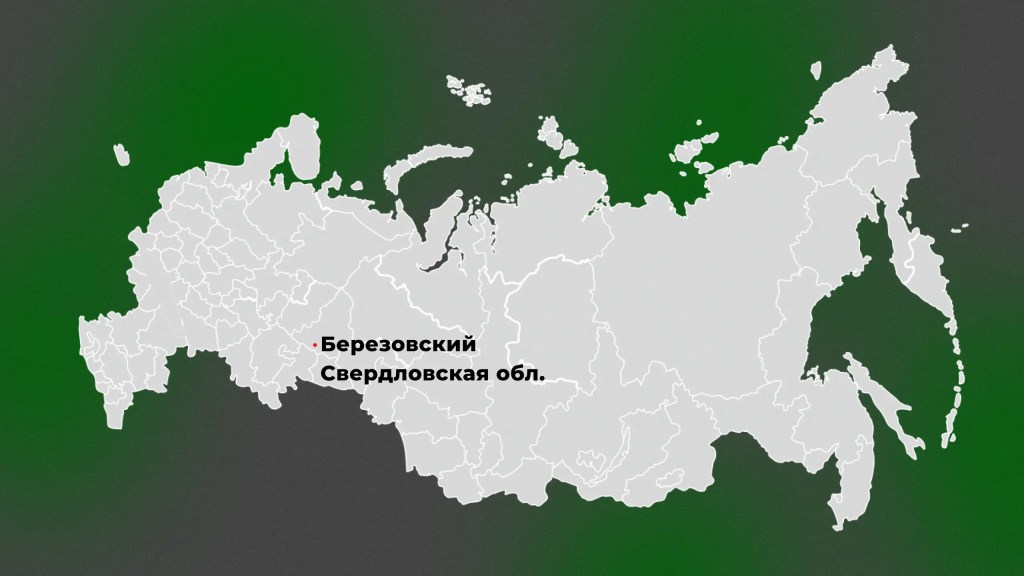
Rozhkov: I lived in the city of Beryozovsky, a suburb of Yekaterinburg with a population of about 100 thousand. Yekaterinburg itself can be reached by bus in twenty or thirty minutes. I worked as a sales consultant at a DNS store.
I was fond of music — I’m a guitarist, a bassist. About six years ago, I had a band, Tell Me the Reason. I started recording a solo album [before February 24], which is still not finished due to the war, having to moving around, and being in prison.
I love dynamic, energetic music: it invigorates me, helps me get out of depression, and gets me warmed up and excited.
I have been interested in politics since I was fourteen. [Alexei is now twenty-five.] My views have changed over time. Previously, they were more democratic or something, more legal. Now I can call myself a left-wing anarchist. I have always campaigned to open people’s eyes and make them see what is happening with the country — for example, with the standard of living. I talked to my family and acquaintances, friends and even strangers. I drew leaflets and spray-painted walls. Do you know those big advertising banners? At night, I would climb up and write “Putin is a thief” on them. At the time, he was merely a thief. But now, of course, he is not just a thief but also a murderer. I wrote on such billboards at night so that people would also start asking questions and arrive at the same opinion.
Tell me why you decided to set fire to the military enlistment office. What did you hope to achieve?
Rozhkov: Since February 22, I had been closely following independent media and social media channels. I expected the war to start in the last week of month, because Russian troops were amassed in Belgorod, Belarus, and other border areas. It was obvious that some kind of movement of troops would begin. And it kicked off on February 24. I began to go into a depression. I was constantly flipping channels and reading the news. I was getting worse every day. I just understood that it was impossible to remain indifferent. What is happening now is illegitimate; it is illegal. Any war means death for ordinary folks. A war in the twenty-first century seems somehow alien to me, especially for such ridiculous, made-up reasons. We annexed Crimea in 2014, and I said already back then that it was wrong. Crimea is not ours and will never be ours. I said there would be consequences. And that’s how it turned out.
It is really awful for me to get my head around the fact that people are getting killed — civilians are dying, and those who do not want to fight, but have been drafted, are also getting killed. I wanted to make some kind of appeal for people to start fighting against this war. I wanted to impact the situation, to do something to stop it all or at least weaken [Russian troops]. So, I set fire to the military enlistment office in the city of Beryozovsky. I didn’t try to burn it down. I threw three Molotov cocktails at the glass doors, which broke. I didn’t even expect them to shatter. Actually, I was thinking that I would just set fire to the door, to the entrance. I was unlucky: at that moment, traffic cops were driving past and noticed what I did. [They] put out the fire, and then they followed me. I couldn’t get far. I ran about a kilometer, and I was blinded by the high beam from their vehicle. I tried to get out of there, to run away, but they threatened to shoot me, and I was forced to surrender.
Tell me how you prepared for this. How spontaneous was this protest?
Rozhkov: It happened quite spontaneously. I didn’t even develop an exit plan and was operating in unfamiliar territory. It seemed to me like some kind of self-sacrifice. I perfectly imagined that I would be held [criminally] liable for this, but I had no fear.
After my protest action was carried out, Putin admitted on Channel One that conscript soldiers had been deployed to the military special operation zone, and [said] that they would be withdrawn from there and that those who had sent them would be punished. It was after my arson attempt that he said this. I was the third person in Russia to set fire to a military enlistment office, and this is [an example of how] several people made an impact to save guys like us, guys our same age. [Conscripts] were not killed in the war. None [of them] were killed: they were simply transferred back to Russia, leaving only contract soldiers [in the war zone].
So you think that the arsons of military enlistment offices also influenced this decision by the authorities?
Rozhkov: Yes, I think so. I’m certain of it.
How did you feel while you were in police custody? Was there any pressure from the investigative authorities? What actually happened after you were detained?
Rozhkov: I was detained, handcuffed, searched, thrown into a paddy wagon, and taken to the police station. I was treated pretty badly at the station. The police chief of the city of Beryozovsky threatened me personally that he would piss on me and beat me with a stick — those were literally his words. But there were also decent people [among the police officers] who did not threaten me and talked to me calmly. They supported me so that I would not go into complete shock.
At Pretrial Detention Center No. 1 in Yekaterinburg, I was quarantined at first. They didn’t issue me bed linens, they didn’t give me a pillow or a blanket — they only gave me a pissed-stained mattress. Thank God I didn’t spend much time there. On the fourth day, the head doctor of the psychiatric ward summoned me. Since I have some ailments, she put herself in my shoes and I was transferred to the hospital wing, to the “psycho hut.” Basically, I liked it there. Despite the fact that some people in my cell were wacky, I had almost no conflicts with them. It wasn’t the first time my cellmates had been in prison. I was the only first-timer.
[In the pretrial detention center] they gave me very strong drugs, which made me feel lousy. One of those drugs was risperidone, which is prescribed to schizophrenics. I was given a triple dose. I suffered from restlessness [akathisia], I had panic attacks, I was short of breath and suffered from insomnia. That is, the treatment wasn’t right for me. Nevertheless, I’m glad that I was sent there, and not to gen pop.
I was a “road worker” [the person in a prison cell or block responsible for the “road,” the illegal system of communication among cells] — they respected me and listened to my opinion. Basically, everything was fine while I was in the joint. The prison staff were mostly supportive: you could talk to them a little bit during inspections or when the gruel was served.
During the period of my imprisonment, I was taken for an inpatient mental competency examination to the psychiatric hospital on the Siberian Route [i.e., Sverdlovsk Regional Clinical Psychiatric Hospital]. I stayed there for twenty-one days. There, on the contrary, the prison staff behaved aggressively and tried to provoke many people, including me, into conflict.
Those who succumbed to provocations were tasered and locked up in solitary confinement. The worst, most deranged prison staff, I believe, were in the tenth ward of the psychiatric regional hospital on the Siberian Route.
Did anyone support you while you were in prison, such as relatives, friends, or maybe human rights campaigners?
Rozhkov: When I was in the pretrial detention center, a lawyer from the Anarchist Back Cross came to visit me and offered their help. They also asked whether I wanted to receive letters, [financial?] assistance, care packages, and publicity for my case. I turned down the assistance and publicity, but decided that it would be nice to get letters from concerned folks who help people like us who are in prison. The letters really gave me a boost. My parents and concerned people from Yekaterinburg helped me by bringing me care packages. I won’t name names, but they helped me and are still helping me.
Why did you decide to turn down the assistance from the Anarchist Black Cross?
Rozhkov: Because I gave into the persuasions of my parents and lawyer. They were against my case being [widely] publicized — allegedly, so as to avoid hounding the investigator in my case. They were afraid that he would toughen the punishment if I attracted public attention. So, due to pressure from [my parents and lawyer], I had to turn down this help.
And yet, when you were in the pretrial detention center, as far as I remember, you were facing the rather harsh charge of attempted murder, right?
Rozhkov: Yes, I had been charged with violating Article 105, part two, in combination with Article 30 — “attempted murder, committed with extreme cruelty, from hooligan motives, in a generally dangerous way.” The crime carries a sentence of between eight years to life in prison.
Do you think that someone’s life was actually threatened as a result of what you did?
Rozhkov: I’m absolutely sure that this wasn’t the case. I doubt that there actually was a woman [night watchperson] of some kind in the military enlistment office building. According to the testimony of the policemen who detained me, who helped extinguish the fire, there were no lights turned anywhere on the premises, and they did not see this woman either. So, I doubt that she was there. In addition, in other such cases — I monitored similar cases — no one was charged under the same article of the criminal code as me. There were no guards there.
When you were released on your own recognizance, you didn’t leave the country immediately. What was holding you back?
Rozhkov: I was promised that the charges against me would be light: Article 167 in combination with Article 30, which translates into “attempted destruction of property,” and carries a maximum sentence of five years. But, after looking at the other cases, I realized that sooner or later, Article 205 [“terrorism”] would be rolled out against all of us.
I also wanted to spend as much time as possible with my family, with relatives and friends, so that I could at least somehow restore our relations and thank them. But ultimately I left. I was evacuated from the country.
How did your relatives react to your actions and to your prosecution?
Rozhkov: They said that I had acted stupidly, that it was impossible to go against the system and that I had let everyone else down. They accused me of suffering from a guilt complex. But I believe that I saved people and that my life is a small sacrifice compared to the number of people who survived thanks to what I did. Even if I had been shot when they were detaining me, I would still have achieved more than anyone else.
How are you feeling right now?
Rozhkov: I feel sad and lonely. I am not in my native country. But I have a friend — I am lucky that he ended up here for the same political reasons — and he helps and supports me. I am also supported by evacuation organizations. I feel pretty bad. But now I’ve purchased the medications prescribed by a psychotherapist, and things are getting easier and easier in my head every day. But sometimes a powerful sadness rolls over me, a melancholy due to the fact that I am lonely and had to leave the country.
Berezovsky and Sverdlovsk Region, on a map of the Russian Federation. Image courtesy of DOXA
When we were agreeing to do this interview, you said that after you had left [Russia], you tattooed the anarchy symbol on the back of your hand. Can you tell me about it for the interview?
Rozhkov: The symbol means a lot to me. I am an anarchist myself, a leftist; I espouse this political position. And although a society without powerful authorities and hierarchies seems like a utopia, we could get there. Power should belong to the people, not to a bunch of corrupt bastards who commit terrible crimes. My symbol also means that I share the views of the people who helped me when I was in prison. It says that I am close to these people. And that I, in turn, will also help political prisoners at the first opportunity.
Maybe you would like to convey something to Ukrainians?
Rozhkov: Yes, I would. I want them to know that there are dissenters, people [in Russia] who do not want war with Ukraine or any war at all. I hope that soon no one else will suffer due to this shit that Putin has made happen. Ukrainians are doing a good job of retaking their territory and destroying Russian troops. I think everything will be fine sooner or later. Ukrainians are very strong, motivated people and will defend their territory to the end. I respect them for that. I would have done the same thing in their place.