As temperatures in Kyiv plunged to -20°C (-4°F), Russia intensified its attacks on Ukraine’s energy infrastructure, leaving millions in total darkness and biting cold. Though Russia has tried this strategy before, this winter is different. The scale and relentlessness of these attacks have reached unprecedented levels. Many Ukrainians are now forced to survive winter without steady heat, without light, without the basic infrastructure that makes normal life possible.
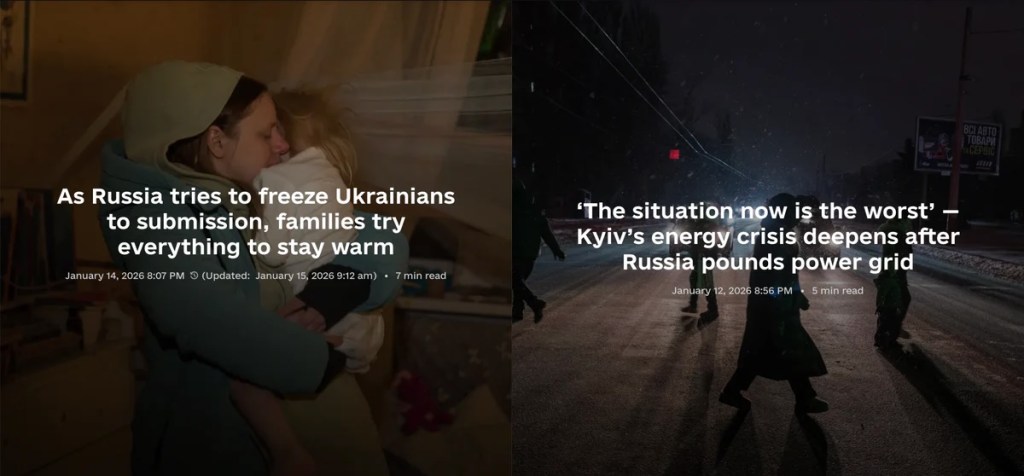
• “As Russia tries to freeze Ukrainians to submission, families try everything to stay warm”
• “‘The situation now is the worst’ — Kyiv’s energy crisis deepens after Russia pounds power grid”
The reality behind the headlines
While this crisis unfolds, international coverage has been limited. We want you to see what’s actually happening on the ground.
Our journalists are reporting these stories while living them — and so is everyone else in Kyiv, rushing to charge phones during brief power windows, cooking on camping stoves in their kitchens, huddling under blankets in apartments that feel like freezers. For the elderly, it’s worse. When elevators stop working, they are stuck in their own homes, unable to reach food or medical care. What was occasional last winter is now constant.
To light the darkness
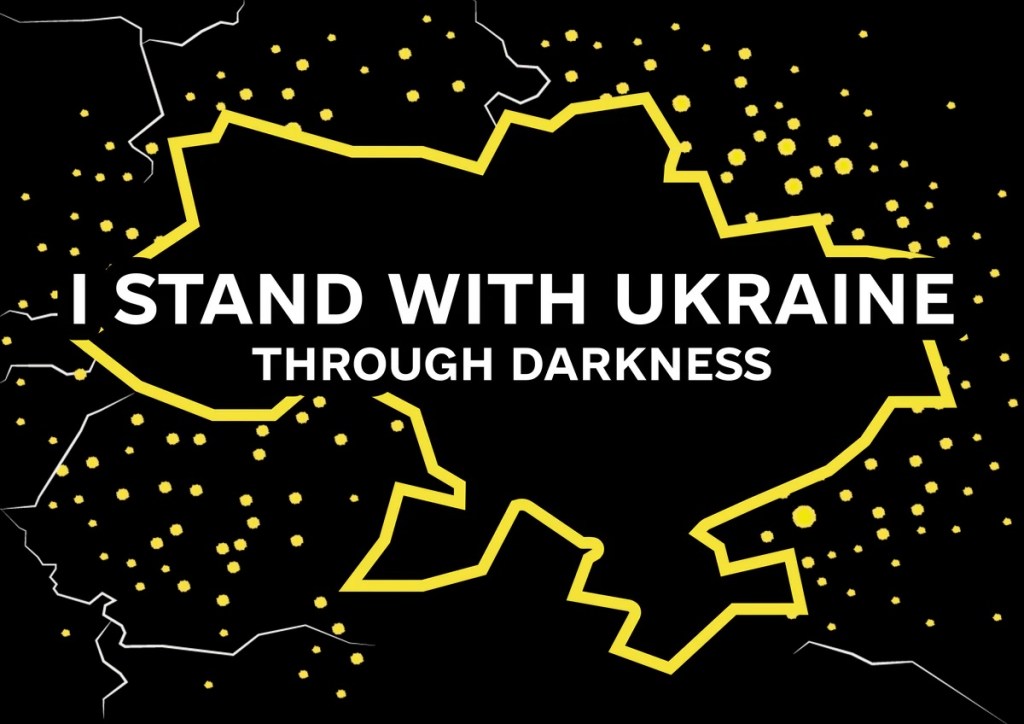
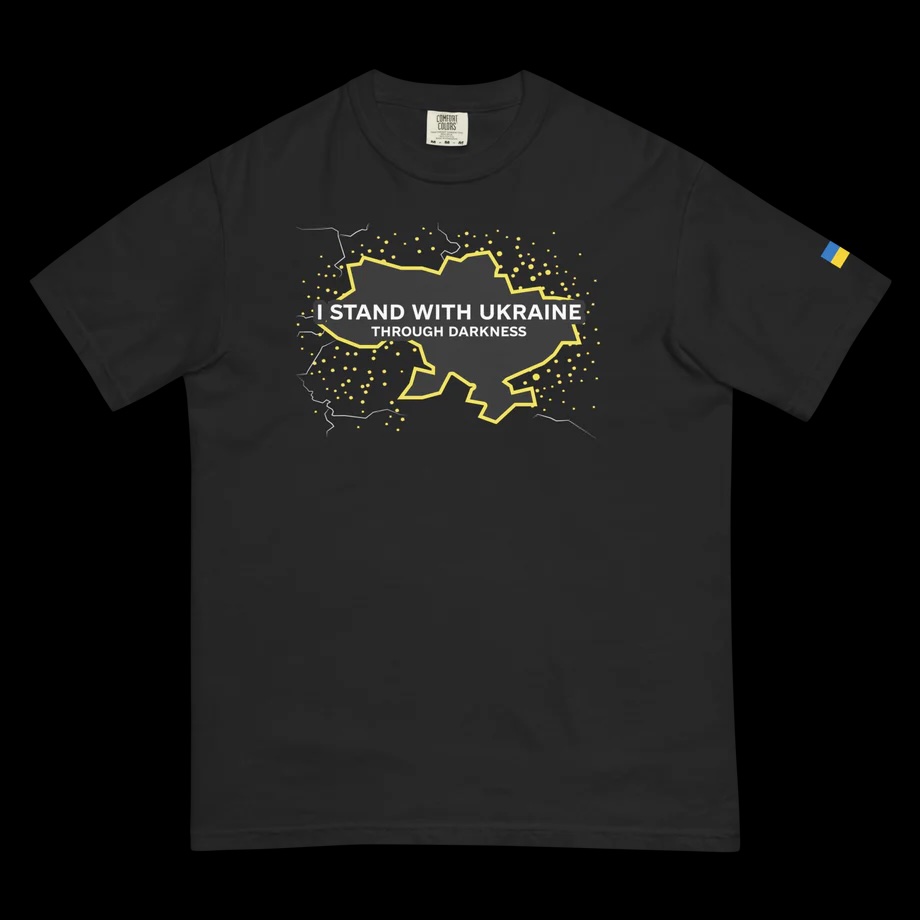
Building on our “I Stand with Ukraine” T-shirt, we’re launching I Stand with Ukraine Through Darkness — available as a T-shirt and hoodie.
From January 20 through February 3, all proceeds from this collection go to supporting the charitable organization Starenki, which helps older people living in vulnerable situations.
This winter Starenki’s volunteers provide a lifeline by:
Delivering essentials — Food and hygiene kits for older people, especially those who are physically unable to navigate stairs to reach shops. When high-rise buildings are left without power, elevators become inoperable — effectively trapping seniors in their apartments.
Providing emotional aid — Companionship and conversation to combat the profound isolation that comes with darkness.
SHOP I STAND WITH UKRAINE THROUGH DARKNESS
Why this matters now
As Ukraine enters its fourth winter of war, international attention is fading. The reality of these freezing blackouts is slipping from the headlines.
By wearing this design, you do more than help support the elderly in Ukraine — you raise awareness of the situation and keep Ukraine from slipping from the world’s attention.
Share this. Wear this. Spread the word.
Source: The Kyiv Independent Store email newsletter, 20 January 2026. I have purchased one of these t-shirts and would urge you to do so as well. ||||| TRR
[Editor’s note: On January 21, Kyiv’s Mayor, Vitali Klitschko, urged the city’s inhabitants to “leave if you can.” 600,000 have already left these last two weeks since Russia intensified its attack on the city’s energy infrastructure. The mayor says that the constant Russian attacks are pushing the city towards “a humanitarian catastrophe.” Temperatures are plunging to as low as –18°C (0°F). According to Klitschko, “the situation is critical with basic services – heating, water, electricity. Right now, 5,600 apartment buildings are without heating.” This morning, President Zelenskiy said that one million people in Kyiv are now without power. The city’s authorities have now have been forced to drain the city’s central heating and water system to prevent pipes from freezing and bursting. A couple of days ago, Ukraine’s Minister of Energy, Denys Shmyhal, said that “there is not a single power plant in Ukraine that has not been hit by the enemy during the war.”]
Today we received this from a dear, long-term friend in Kyiv:
BY OLEKSIY KURKA, resident of Kyiv, works in diplomacy and policymaking
I’ve written about Russian attacks so many times that the words no longer convey any new meaning, muted by repetition. But friends abroad cared to check in with me after last night, so here is an update.
As of this hour, only a fraction of the capital has electricity. I’ve been without power for about 24 hours now; others for much longer. It isn’t clear when it might return.
The heating is also off. The building is gradually cooling down. Soon I’ll be breathing out vapour, like some of my friends. Those living through ‘no-heat’ situations for longer – such as those near the front lines – are now camping out in their flats. It’s 5-7°C warmer inside a tent inside your flat.
The attack caused massive disruptions to public transport. Segments of the Metro I use to commute were closed due to electricity shortages. Many, myself included, had to stay and work from home.
My portable power station is gradually running out. Not having a predictable source of power is beginning to worry me more. I can predict one thing: our foes will stop at nothing to inflict more suffering on Ukrainians – while they can.
On a brighter note, I found and successfully installed a solution to the lack of internet at home. It’s an external antenna that catches and amplifies signals from nearby towers. Even during prolonged outages, I have about 15-20 Mbps, which is brilliant.
As for the power, I was inspired by my neighbour who took a mini petrol generator out to the courtyard and recharged his upper-floor flat via an extension lead. Now I fancy having the same system – and solar panels, for when there’s more daylight. Anything that minimises energy dependence is a win.
I went for a walk on the slippery, ice-clad streets of my district in an off-grid darkness that once again revealed the starred heavens. Most businesses and shops are running off generators, their light bulbs making up for the absence of proper street lights, coupled with the headlights from cars. This is how we see. That, and the torches in our hands.
Earlier today, we chatted with a visiting colleague who asked many questions about life these days. I made the point that a war of attrition forces things upon you that you’d otherwise never have thought you’d need.
But when it happens a few times, you spot the trend and start thinking even more creatively about what is yet to come. Do I need to consider satellite internet now, or are the mobile towers maintained well enough for me to avoid rushed decisions and unnecessary costs? Thinking ahead and learning from others makes the unpredictability a tiny bit more predictable, as it were.
Do I plan to leave Kyiv because of these ‘inconveniences’? I said a long time ago that there are two conditions for me to make such a significant decision: when there is no drinking water, and when the prospect of Russian occupation looms larger.
The first is not yet a reality for Kyiv, and I hope it never will be. The latter is no longer a reality, thanks to the Ukrainian army and our partners who provide Ukraine with air defence, long-range, and other weapon systems.
One more thing: Even if I leave the place, it’s only to come back.
Source: “#blackoutnotes [Ukraine],” Two Grumpy Old Men on Ukraine, 21 January 2026

The sun floods the room like a Christmas postcard: snow-covered trees, silence, a fairy tale.
But it ends at the windowpane.
I stand in the middle of the room in two sweaters and a robe, clutching a cup of hot tea as if it could save me. The thermometer indoors reads +9°C (48°F). It’s the third day without heat, and every hour the cold settles deeper into the walls.
In my arms is my six-month-old son, Ustym. I hold him tighter than I should, trying to give him my warmth. And suddenly it hits me: I don’t know how to protect him from the cold.
I can endure it. He can’t.
I cry quietly so he won’t hear. The tears on my sleeve are warmer than the air in the room.
I pack to leave the city.
There, the power may go out—but there is warmth. What a strange word now. A luxury. A reason to flee your own home.
I thought this fear was mine alone. But when I wrote to my colleague Nastia, I realized the cold does not discriminate. She has no child, but the same thermometer, the same сold walls, and made the same decision to leave.
As a result of Russia’s prolonged strikes on Ukraine’s energy infrastructure, including power plants and substations, large parts of Kyiv were left without heating for several days as temperatures dropped to –15°C — the lowest in recent years. During the January 9 attacks, damage to the power grid led to heating outages in approximately 6,000 apartment buildings, nearly half of the city, demonstrating how winter has become yet another front in the war.
Kyiv Mayor Vitalii Klitschko called the situation the most difficult for the capital since the start of the full-scale invasion and urged residents to temporarily leave the city, despite the opening of hundreds of heating centers. 600,000 Kyivans have fled the capital since January 9. For many, leaving the city is no longer a matter of comfort but one of survival.
It is a reminder that in times of war, even a major city can turn perilous overnight, and true security depends not only on the absence of missiles but on access to basic needs like heat, electricity, and water.
Our apartments turned into cold traps we had to escape. We came together to share this strange, frightening feeling, when every minute at home feels like a test, and survival becomes a daily struggle.
Nastia: On the night before the major strike that left us without heat, January 8, I took a hot shower for the first time in a week and had uninterrupted electricity for the whole evening.
Restoration work on hot water and heating had been underway in my building before, we always had problems with heating and water.
I felt like a human being again — someone who, after work, can properly warm up in the shower, instead of heating up a kettle 5 times.
After the attack, I was back to not having water, heating and electricity. When I woke up under two blankets I felt powerless again: I already knew I would cancel the plans I had that evening because of how exhausted I felt.
I didn’t even try to catch the internet in my apartment, because I knew I’d fail. I just washed my face under freezing water and went to the cafe nearby to work.
Later I was riding the metro and barely held back tears. Not even because of the cold, but because I would yet again have to spend my evening in a dark apartment all alone. Such evenings just gnaw at me, creating a deep sense of isolation. I know that when I set foot in the apartment nothing will be waiting for me there, except darkness, silence, and piercing cold.
“Please, come home. Don’t be there alone in the cold,” my parents told me. My dad suggested I go with his friend, who was also planning to leave Kyiv on January 9. I was hesitant at first: I had friends, plans, and work to do. But if I had been able to find ways to function with blackouts and distract myself before, this time I just couldn’t find the strength to bear it.
Myroslava: During the latest Russian attack on Friday, January 9, we immediately lost both electricity and heat. The boiler in the building runs on electricity, so it was clear that if there’s no power, there won’t be heat either.
At first I was calm; this was not the first time, and we’d get through it. But then Mayor Klitschko urged people to leave the city for the weekend, and that was alarming. The apartment was getting colder and colder.
My husband and I decided to go to his parents’ village to wait it out for the weekend, hoping that heat would return soon. On Sunday evening, we returned to Kyiv: heating had already come back in parts of the city. But not in ours. In the morning I took Ustym to my parents, where it was warmer, and went to work.
I dressed him in layers and held him close to share my warmth.
He seemed fine. It was I and even more so his grandparents who were truly scared.
I knew that we would only leave the Kyiv apartment at the most critical moment, when we had no strength left to endure. That’s exactly what happened on the last two nights–not only because my son woke up frequently, but also because of the cold, in which it was impossible to sleep. I was in warm pajamas, under a duvet and three blankets, surrounded by cats – and it still didn’t help.
I left for the Kyiv region on January 13th for my in-laws’ house, which has its own heating. The situation was so bad I couldn’t even wait for my husband to finish work. The frost had turned the roads into solid ice, and with darkness falling early, driving was dangerous. So my father-in-law drove out to pick up Ustym and me.
Nastia: As I was leaving Kyiv it was darker than usual – the blackouts had taken over the capital. Sorrow and the shame of leaving my own home kept me quiet and bitter in the taxi, but it changed when I met with my dad’s army friend; he cheered me up with conversations about life. The roads were covered with ice and snow.
That evening I got a message from my friend.
“I’ve never regretted more… the day I moved to Kyiv,” she said with an exhausted voice.
I often thought the same, but with the same thoughts I realized it was the best decision – it’s the city where I met most of my great friends, found work I love, and made plenty of great memories I want to keep until my last day.
For now I have to witness it from social media and news, or from my friends’ messages.
Energy workers are active around the clock. And they have been working under tremendous pressure for months. The brutal weather makes it much more difficult – just imagine working in the frost night and day, breaking through snow and ice to repair something, while Russia continues destroying more and more facilities.

Myroslava: The thought that we had to leave Kyiv hurts the most; it breaks me from the inside. I always saw the capital as a fortress, a place that must hold out under any conditions. In 2022, many Ukrainians stayed here even when the Russians stood on the outskirts of the city, because they believed Kyiv would be defended to the end. Now people are leaving not because of a military offensive, but because of the weather.
This is exactly what Russia wants – to make Kyiv unlivable, to break Ukrainians’ morale and force concessions. And they’re partially succeeding: home has stopped being a safe place.
That’s why visiting stores have become one of the most painful things for me. Supermarkets are a kind of marker of stability, an indication that tomorrow will still come. When they are open, it feels like life is still holding on.
But a few days ago, I saw a message that supermarkets in Kyiv were starting to close, including one near my home.

It stayed open at the start of the war, through heat, cold, and the blackouts of 2023.
And this time, it didn’t survive.
Nastіa: Leaving was difficult not only because it carried a sense of shame for giving up and escaping, while my friends and lots of other people had to stay and endure the cold.
But also it was hard to walk away from the places I love, not knowing how soon I’d be able to return. I don’t know how my apartment is now, or my favorite cafés and stores where I could go from my dark apartment to recharge my phone a bit.
I didn’t spend much time in the cold and blackouts after the latest attack, but it didn’t take long to feel its full effects. I was barely able to get myself out of bed; the indoor temperature had already plunged to about +10°C / 50°F.
And the rest of the time I spent dragging bottled water from the shop to clean up and take a shower before I could leave. At that point, I had no running water at all.
Myroslava: I miss my husband terribly, as he stayed in our Kyiv apartment. He works in Kyiv, and with this weather, regular trips aren’t realistic.
We’ve always done everything together, and now it feels like I’m without my main support. We text each other constantly. I send him photos of Ustym, and we wish each other good morning every day, trying to keep that closeness alive.
He has to keep the bathroom warm so the pipes don’t burst, otherwise the whole building could lose heat for the rest of winter. At –15°C outside, it’s frightening. He uses whatever he can: an oil radiator when there’s electricity, a gas heater when there isn’t.
Our cats, Stuhna and Sherri, stayed in the apartment. I constantly worry that they are cold, curling up and searching for any bit of warmth. They need to be fed and given water, and the rooms need to be kept warm. Every time I think about them, my heart tightens, because I left and they stayed behind.
The war has torn families apart on so many levels, and not just on the front lines. This winter brings a painful new wave of uncertainty and separation – endured not because people are giving up, but because they are forced to protect what matters most.
Editor’s note: The Counteroffensive team will continue to report from Kyiv, but we support any member of their team that wants to go back to their hometowns to be with their families. We also offered to take any member of the team to Warsaw for a week, at least until this blows over. They all refused to leave their country. I hope this shows, in some small sense, the grit, determination and courage of the small team I’m privileged to lead.
Source: Myroslava Tanska-Vikulova and Anatasiia Kryvoruchenko, “Why Myroslava, Nastia left Kyiv,” The Counteroffensive with Tim Mak, 21 January 2026. I am a paid subscriber to this publication and I would suggest that you subscribe to it too. ||||| TRR
