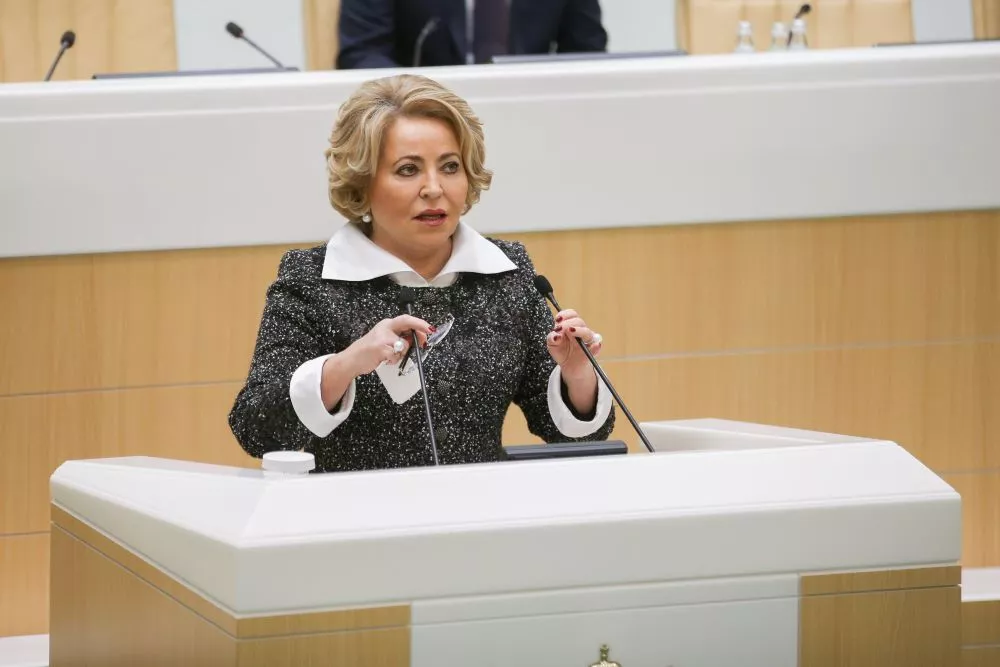
Federation Council Speaker Valentina Matviyenko has promised that the Soviet-era law criminalizing “social parasitism” would not be revived.
And yet, the politician argues that certain categories of unemployed people should at least make contributions to the compulsory medical insurance system. The Federation Council speaker spoke about this in an interview with Moskovsky Komsomolets:
I am talking about those unemployed people who drive Mercedes, have considerable hidden incomes, and yet do not pay taxes or make contributions to the compulsory medical insurance system. Or those, for example, who let their flats in downtown Moscow for 200,000 rubles a month [approx. 2,200 euros], but “on paper” claim that they rent it out for 10,000 rubles a month [approx. 110 euros]…. The tax service should identify such unscrupulous citizens and flush them out of the shadow economy and shadow incomes…. Workers, teachers, and doctors should not have to pay for young, healthy people who are under no obligation to society.
According to Matviyenko, forcing such citizens to be involved in the compulsory medical insurance system is fair because it is impossible to live in society and be free from it. She noted that teachers, doctors, workers, and others should not have to pay for healthy citizens without fixed employment.
This is not the first time Matviyenko has voiced the idea of collecting health insurance contributions from the unemployed: she has said that paying 45,000 rubles a year [approx. 500 euros] is quite affordable.
Surveys show that most Russians oppose a tax on social parasitism.
“Social parasitism” was a criminal offense in the USSR from 1961 to 1991. People who were unemployed without a valid reason could be sentenced to corrective labor, exile, or imprisonment. Citizens engaged in shadow private business were often prosecuted on this charge. The poet Joseph Brodsky was also convicted of “social parasitism.”
Source: Andrei Gorelikov, “Matviyenko: A law on social parasites will not be passed, but social parasites must pay,” Prosto Rabota, 25 November 2025. Translated by the Russian Reader
In 1964, when Joseph Brodsky was 24, he was brought to trial for “social parasitism.” In the view of the state, the young poet was a freeloader. His employment history was spotty at best: he was out of work for six months after losing his first factory job, and then for another four months after returning from a geological expedition. (Being a writer didn’t count as a job, and certainly not if you’d hardly published anything.) In response to the charge, Brodsky leveled a straightforward defense: he’d been thinking about stuff, and writing. But there was a new order to build, and if you weren’t actively contributing to society you were screwing it up.
Over the course of the trial he stated his case repeatedly, insistently, with a guilelessness that annoyed the officials:
BRODSKY: I did work during the intervals. I did just what I am doing now. I wrote poems.
JUDGE: That is, you wrote your so-called poems? What was the purpose of your changing your place of work so often?
BRODSKY: I began working when I was fifteen. I found it all interesting. I changed work because I wanted to learn as much as possible about life and about people.
JUDGE: How were you useful to the motherland?
BRODSKY: I wrote poems. That’s my work. I’m convinced … I believe that what I’ve written will be of use to people not only now, but also to future generations.
A VOICE FROM THE PUBLIC: Listen to that! What an imagination!
ANOTHER VOICE: He’s a poet. He has to think like that.
JUDGE: That is, you think that your so-called poems are of use to people?
BRODSKY: Why do you say my poems are “so-called” poems?
JUDGE: We refer to your poems as “so-called” because we have no other impression of them.
Brodsky and the judge were (to put it mildly) talking past one another: Brodsky felt his calling had a value beyond political expediency, while the judge was tasked with reminding him that the state needn’t subsidize his hobby if he wasn’t going to say anything useful. But the incommensurability of these points of view runs much deeper than this one case.
[…]
