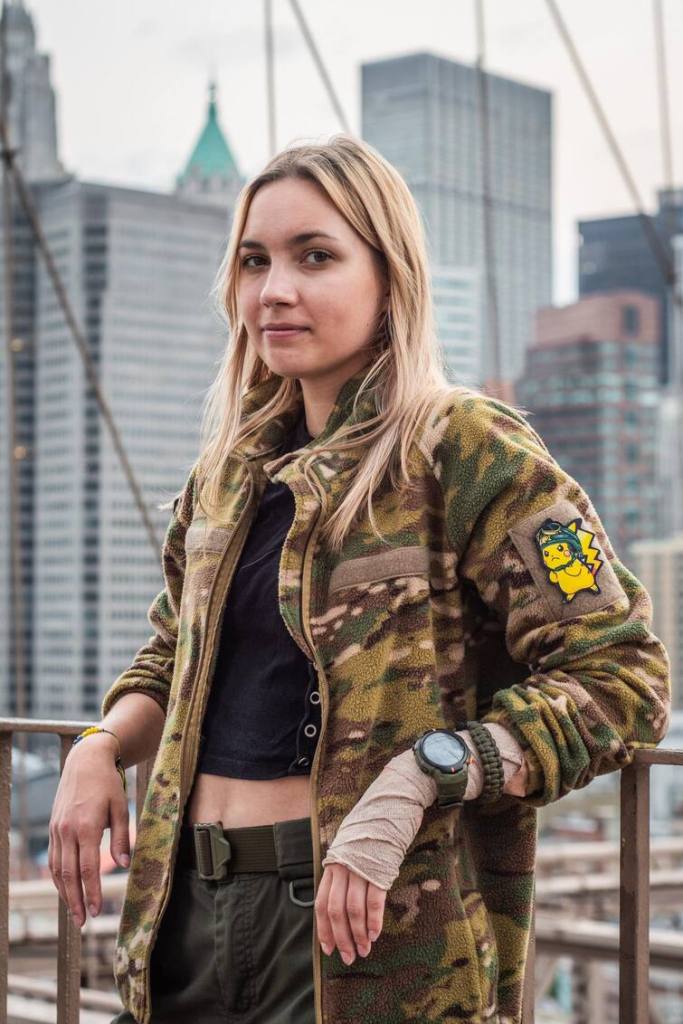
She had traveled the world, had ambitious plans in business and finance, and worked on Wall Street at a major US bank, but returned to defend Ukraine side by side with her family.
Ukrainian Victoria Honcharuk graduated from the innovative Minerva University in California. Nowadays, however, she is one hundreds of combat medics at the frontline, saving the lives of wounded soldiers as they try to save us.
Ukrainska Pravda: Life recounts how Victoria’s life, full of hope and plans, changed after the outbreak of the full-scale war and how she made her choice for her homeland.
Life before the full-scale war
Victoria grew up in the small town of Baranivka in the Zhytomyr Region in an ordinary family. Her parents never traveled outside of Ukraine, so at the age of twelve she started earning money on her own because she wanted to study abroad. She admits that she could count only on herself to fulfill this desire.
As a teenager, Victoria won a grant from the U.S. State Department’s FLEX cultural exchange program, on which she studied at a high school in the United States and, after graduation, at a university in Lithuania. However, she studied at that university for only a year. Victoria says she realized that she could not spend four years in one place.
That was when she found out about Ukraine Global Scholars, an organization that helps Ukrainian children get a free education at schools and universities abroad, including in the United States.
“I grew up in a small community, and after I learned English and went to America on the FLEX program, I realized that there were so many interesting things outside of Ukraine. I always thought, We are such a big and free country, why can’t we take our resources and use them to become a country we can be proud of?
“I realized that to do this, we needed to learn from the know-how of other countries. That’s why I had a plan to go study, work for a while, gain experience, return to Ukraine, and make it the best country in the world,” recalls Victoria.
At the age of fifteen, she went to study in Texas on the FLEX program, where she lived for a year, and after studying in Lithuania, she enrolled at Minerva University, which Vika calls her “dream university.”
“It’s a university based in California, but the most interesting thing about it is that you travel and live in different countries every semester,” she says.
During her first year of study, Victoria lived in San Francisco. Later, her geography expanded significantly, and she gained knowledge and experience in South Korea, India, the United Kingdom, Germany, Argentina, Taiwan, and elsewhere.
“I had two majors there: computer science and business and finance statistics. I was most interested in combining and using statistics and data science in business and finance.
“During my last two years, I wrote a research paper on M&A (mergers and acquisitions) at large companies. During my studies, I worked in startups as an investment analyst, data analyst, and financial manager. My two specialties have always been intertwined in my work,” says Honcharuk.
After graduating in 2022, Victoria worked with technology companies in Citigroup’s investment banking department, as well as in the investment banking department of Morgan Stanley, a major holding company.

From Wall Street to the frontline
When the full-scale war broke out, Victoria’s entire family—her sister, mother and father—decided to join the ranks of Ukraine’s defenders.
In the early months of the Russian invasion, Victoria was involved in volunteer work, throwing her energy into helping her family and the units in which they served.
“My goal was to provide my family and their units with everything they needed. It turned into small project of mine, then into an NGO registered in Britain. That’s what I was doing before I came back to Ukraine,” she says.
Victoria raised funds and was involved in delivering tactical medicine supplies. Thanks to her sister, who worked in medical evacuation, Vika always knew what to deliver and when and where to deliver. However, she could not stay in the United States for long, so in the winter of 2022, she decided that she had to return to Ukraine and “help with her hands.”
She admits that this decision was a “big leap” for her. Mentally, she readied herself for the worst—that she would live “in the open air in a puddle” and not eat anything. Nevertheless, she stresses that she “didn’t think twice” about leaving her warm New York office to help her family and her country.
“I worked on Wall Street at the largest bank in the country. The day before I went to Ukraine, we had a big gala event for clients, and then I got on a plane the next morning, went to Ukraine, put on my uniform and set off. It was winter, it was cold. A very big contrast.
“I had been preparing myself for this, and it was what I really wanted. As soon as I found the opportunity to be on the frontline, to work with my hands, to be part of the units, everything fell into place,” says Victoria after a year of service as a combat medic.
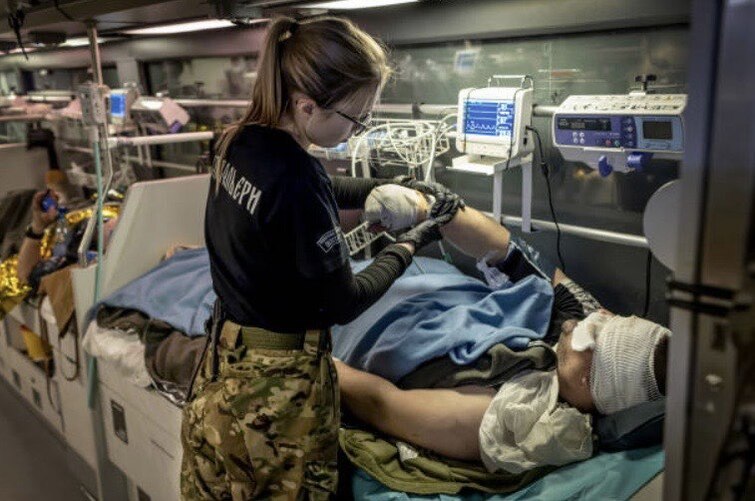
By the way, she acquired the skills for working as a paramedic by training with the Hospitallers. She learned some things from her sister and other combat medics, and the rest was gained on the frontline.
The most difficult choice
Victoria serves in one of the hottest areas of the frontline—Bakhmut. Before that, she worked in Avdiivka. Now she is the leader of her crew. For the last six months she has been working as a paramedic in the brigade where her sister serves as an assault rifleman.
As the combat medic explains, there are two stages of evacuating the wounded: “case evacuation” and “medical evacuation.” Case evacuation is the first stage of evacuation from the frontline, when an armored vehicle or pickup truck enters the most difficult areas and evacuates the wounded from the battlefield to a stabilization center.
A medevac unit is a medical crew that takes the wounded from a casevac unit and evacuates them to the stabilization center. Vika initially worked in casevac, before switching to medevac.
“This person often changes. At first, I had a doctor with too much experience, and he was transferred to a stabilization center, and we were given a third person by the battalions we worked with.
“Broadly, we work like a crew, just like mobilized military medics. We are just an additional team. We arrive on the battlefield, take the wounded, and hand them over to experienced medics,” says the paramedic.
According to Victoria, her team has changed several times during her year of service, as the people who make up the team work on a volunteer basis. Many of them have regular jobs, which they alternate with volunteering at the front.
“They are at work for a month, and with me for a month. Right now, the most stable members of my team are my driver and me. My driver’s cousin was my sister’s commander, who unfortunately was killed in August this year, just as we started working with them. The driver and I found common ground and continue to work together. The third person is a doctor,” says Victoria.

The paramedic also spoke about the most difficult moments she has had to face during her year at the front. According to her, the most difficult thing is to make decisions in circumstances in which other people’s lives depend on them.
“There were moments when we came under shelling and had to decide what we were going to do: move, find shelter, or not evacuate at all. It was a choice between evacuating the wounded or hiding from the shelling. We needed to weigh the chances that we would get injured or that the injured person would die if we didn’t evacuate them,” says Victoria.
There were situations in which they had to approach the battlefield in an unarmored vehicle. They then had to carefully weigh all the risks.
“We drove an ordinary ambulance to within 500 meters of the contact zone. We were on duty together with an armored car and realized that if something hit within twenty meters of us, we were finished.
“My vehicle still has a broken windshield after one of these collisions from ten meters away. After that, we would have to decide what we were going to do, so it can be stressful,” Victoria admits.
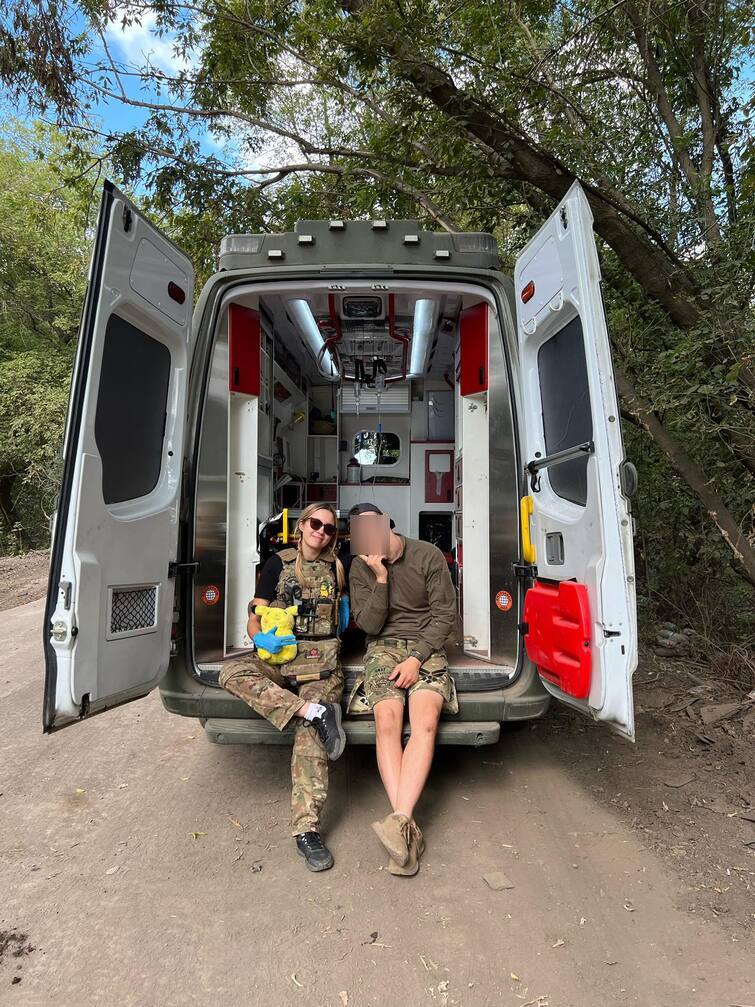
Amid the challenges she faces today, Vika recalls her studies and experience abroad with gratitude, saying that working on Wall Street toughened her up, because sometimes she had to work hard, to the point of exhaustion. She could not sleep for days or even weeks until she got the job done.
“It’s the same here. If the enemy mounts an assault, we don’t sleep—we work. Sometimes you just have to wait, just like waiting four hours on Wall Street for someone to send you a financial model. Here [on the frontline — ed.] you wait for a challenge. Very transferable skills [in English in the original — TRR],” she says with a smile.
Frequent traveling also played a significant role in her “toughening-up.” Thanks to this, Victoria has all the necessary vaccinations.
“It is a very good thing when you are a combat medic, because I come into contact with blood. When your gloves get torn, you can get infected with something. But I lived in India and Korea, so I have all the vaccinations. I can adapt quickly, and I don’t need much to feel comfortable, so I didn’t need to get used to the minimalist life,” she says.
In addition to her work as a paramedic, Victoria is also involved in military tech projects with Ukrainian developers.
“I consider the development, use, and integration of AI into military operations to be one of my main priorities,” she stresses.

“Everyone I want to spend my time with is at war”
According to Victoria, she has short leaves from work, but she lives with her crew. She admits that it is hard to see people in the rear who are “disconnected from the war and think that they will be spared.”
“I have literally two or three friends left. Unfortunately, I don’t even want to talk to them now—all the same, I live with my crew. I need one day to see my parents, another day to eat everything I want to eat, and that’s it, I can go back.
“There is no connection due to this. Everyone I want to spend my time with is at war. We have leave for a couple of days, but we come back to civilian life with the people we live with on the frontline, and we live in our own bubble,” says Victoria.
Given how her life and realities have changed, she underscore that she doesn’t regret any of her choices. When asked what advice she would give to her fifteen-year-old self if she could, Victoria said:
“Well done. I don’t have any regrets. I would have worked harder on my physical fitness. (Laughs.) I would have told her that no matter what your profession and lifestyle is, you need to be strong and in the best shape you can be, because it’s physically hard nowadays.”
Victoria’s experience as a woman in the military
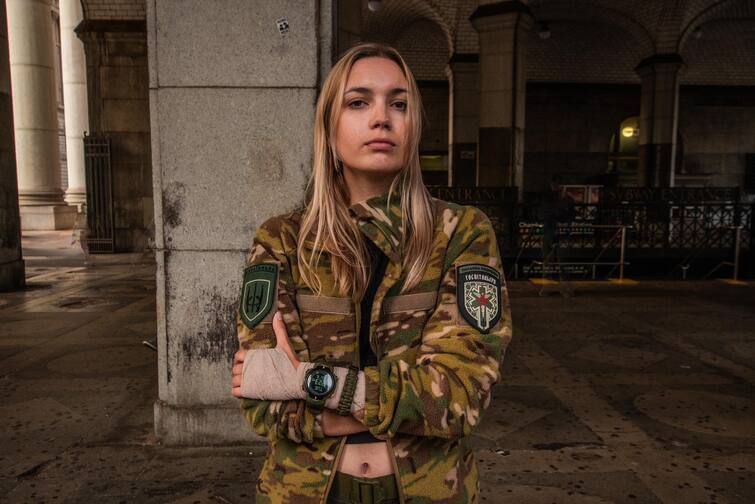
According to Honcharuk, women in the army need to work “a little harder” at their positions, as there are gender biases there, as well as in the broader society.
“Every newcomer has to work hard to gain attention, but women have a little more difficulty due to prejudice. But if you don’t give up and show that you are a good fighter, that you joined up for the right reason, that you will work hard, you will get respect from people.
“I think the problems in the army are the same as the problems in society. It’s just a smaller version [of society],” Vika adds.

And yet, she denies that men treat women in the army badly.
“I often hear that men treat women in the army badly, but this is not entirely true. Many women in Ukraine, unfortunately, position themselves as weak and needing protection. But we have to stand up for ourselves, stand up for Ukraine,” the paramedic argues.
She is convinced that the fight for Ukraine is not the duty of men, but of every citizen.
“Love for Ukraine is nurtured, and not necessarily from an early age. It’s not something you can kill. My sister and I are probably a very good example,” says Honcharuk.
The interview was recorded by Veronika Harmash, communications manager at Ukraine Global Scholars, and adapted by Diana Krechetova, journalist at Ukrainska Pravda: Life. All photos are from Victoria Honcharuk’s personal archive.
Source: Diana Krechetova, “From Wall Street to the front line: the story of a paramedic who left her job at a major US bank to defend Ukraine,” Ukrainska Pravda: Life, 19 December 2023. Translated by Alien Bio-Robot from the Future. Thanks to TV Rain for the suggestion. You can follow Victoria Honcharuk on Facebook and Instagram. \\\ TRR

One thought on “Victoria Honcharuk: Wall Street Investment Banker Turned Ukrainian Combat Medic”