You wanna fist, you wanna ride Go to school so you can hide Hop on the bus & be rewarded Get off fast & yer retarded Last off, last in line Chameleon, you’re doin’ fine
Second hand will tick Pancake batter’s gettin’ thick Cut my finger on a butter knife Watch the blood flow down just like The blood that I see on your hands
Bloody foot print swollen tongue Scaly skid mark better run Bitter swallow get you numb What is gold? Silver bullets
Beyond such basic political engagement, there’s the deeper public diplomacy that would initiate a conversation with ordinary Russians about how they see the country’s future place in the world. How many Russians just want to be part of a normal country, shorn of its cycles of oppression and lashing out? When Dicks analysed German POWs, he found that not all were all were beholden to the Nazi psychic see-saw of bullying and humiliation. He thought these other social groups would be the ones who could rebuild Germany after the war.
There are many Russians—artists, academics, film-makers—who already do a great job of excavating the Russian unconscious. They are often given minimal support by their own government, and some have had to leave the country. There should be a transatlantic fund, independent of any state, to support their work. Likewise we should be thinking of the future generation, and establish a Russian language university safe for critical inquiry.
Yes, what Russia needs is more opportunities for the creative intelligentsia to escape the country and perpetuate myths about the authoritarian tendencies of ordinary Russians to gullible, eager (and similarly snobbish and misguided) westerners. When in fact Putin and his regime would have not stayed in power so long without the fulsome and enthusiastic support of a good chunk of the country’s best and brightest. “The people” have had very little to do with it. ||| TRR
The new Russia doesn’t just deal in the petty disinformation, forgeries, lies, leaks, and cyber-sabotage usually associated with information warfare. It reinvents reality, creating mass hallucinations that then translate into political action. Take Novorossiya, the name Vladimir Putin has given to the huge wedge of southeastern Ukraine he might, or might not, consider annexing. The term is plucked from tsarist history, when it represented a different geographical space. Nobody who lives in that part of the world today ever thought of themselves as living in Novorossiya and bearing allegiance to it—at least until several months ago. Now, Novorossiya is being imagined into being: Russian media are showing maps of its ‘geography,’ while Kremlin-backed politicians are writing its ‘history’ into school textbooks. There’s a flag and even a news agency (in English and Russian). There are several Twitterfeeds. It’s like something out of a Borges story—except for the very real casualties of the war conducted in its name.
[…]
“If previous authoritarian regimes were three parts violence and one part propaganda,” argues Igor Yakovenko, a professor of journalism at the Moscow State Institute of International Relations, “this one is virtually all propaganda and relatively little violence. Putin only needs to make a few arrests—and then amplify the message through his total control of television.”
[…]
Ultimately, many people in Russia and around the world understand that Russian political parties are hollow and Russian news outlets are churning out fantasies. But insisting on the lie, the Kremlin intimidates others by showing that it is in control of defining ‘reality.’ This is why it’s so important for Moscow to do away with truth. If nothing is true, then anything is possible. We are left with the sense that we don’t know what Putin will do next—that he’s unpredictable and thus dangerous. We’re rendered stunned, spun, and flummoxed by the Kremlin’s weaponization of absurdity and unreality.
Here is a tiny illustration of how reality really is up for grabs in the Kremlin’s increasingly hot “cold civil war” against Russian society and, now, the rest of the world:
As I stand in the courtyard of a Moscow arts and craft center, a dark-haired, 20-something woman turns to me and asks: “Is this the venue for the ‘Is Vladimir Putin God?’ lecture?”
She smiles nervously, seemingly worried that I’ll think she’s crazy.
She’s not. The title of the lecture is actually “Will Putin Become God by Divine Grace?” but I decide not to correct her. Instead, I nod and show her the way to one of the oddest events in the Russian capital this year.
The lecture took place on Sunday and was first advertised by well-known radical Russian Orthodox activist Dmitry Enteo on VK, the Russian version of Facebook. In the post, Enteo promised to reveal the answers to the following questions:
“Is it possible to bow down to Vladimir Putin as God on earth?
“Will Vladimir Putin’s will fuse with the will of God?”
“Will Vladimir Putin receive endless pleasure through the completeness of the knowledge gifted to him by God?”
Not surprisingly, the lecture stirred up controversy online, as some Internet users accused Enteo of blasphemy, while others suggested he’d lost his mind.
“Let’s get this straight, Dmitry,” one VK user wrote. “Do you believe Putin will sit at the right-hand side of God’s throne when he dies?”
“Possibly,” replied Enteo.
The lecture kicks off with a hip-hop track by an African rap duo now based in Russia. The title: “I Go Hard Like Vladimir Putin.” When the song ends, Enteo fiddles with his laptop until Putin’s face appears on the screen behind him.
The Orthodox activist then addresses the audience of roughly 80 or so Muscovites, an apparent mixture of curious hipsters and true believers. (There’s also a middle-aged man in a suit that a fellow journalist immediately suspects of being an agent of the FSB, Russia’s principal security agency.)
“I’ll keep it brief, in the style of the subject of today’s lecture,” Enteo says.
At times his voice is barely audible, but when he quotes Putin, he makes sure to speak louder.
The hipsters behind me erupt in ironic applause. Enteo presses a button on his laptop, and the photo of Putin is replaced by swirling psychedelic images and low-volume break-beats. He proceeds to read a poem by Vladislav Surkov, the mysterious Kremlin ideologue. The overall effect is an atmosphere reminiscent of a secret cult meeting held at a nightclub.
Enteo then takes us through the history of Putin’s apparent transformation from hard-nosed KGB officer to Orthodox Christian believer. “Putin realized that his goal in life was God, and the Almighty entered into the body of Vladimir Putin,” Enteo says. “Then Vladimir Putin began to do good deeds, like break up opposition meetings.”
At one point, the activist curiously declares: “We disappoint Vladimir Putin. While he tearfully prays for us at night, we smoke hashish.”
The lecture lasts about an hour, before Enteo builds on a final riff in which he determines that, yes, Putin will transform into a godlike being, and like all good Orthodox believers, eventually grow a beard.
After a brief Q&A, the crowd files out. “That was creepy,” says one attendee.
Others seem puzzled by the whole affair.
“It’s a response, in many ways an ironic one, to Putin’s de facto domination of everything from the economy to the media,” says Anna Arutunyan, author of The Putin Mystique, who attended the lecture.
“Most of it, of course, is just Enteo publicizing himself, but some of it is also taking what we see around us to its grotesque logical conclusion.”
Russians have a long history of venerating their leaders, from the reverence of the czars to the terrifying cult of personality that developed around Soviet dictator Joseph Stalin. While Enteo didn’t directly say that Putin was God, he felt comfortable posing the question, which shows just how powerful the Russian president has become.
Not everyone, of course, sees the hand of God in Putin’s politics. In Ukraine, where a Kremlin-backed separatist movement is slowly tearing the ex-Soviet state apart, the country’s spiritual leader, Patriarch Filaret, recently suggested the Russian leader was possessed by the devil.
“Like Judas, Satan has entered into him,” Filaret declared, as he accused Putin of turning the two Slavic countries against each other. “Like the first brother-killer, Cain, he has fallen under a demonic influence.”
Regardless of which side you take in the “Putin: God or Satan?” debate, it’s a remarkable development in the life of this former, low-ranking KGB operative. From serving the officially atheist Soviet state in Cold War-era East Germany to being compared to God and the devil, it’s been a long, strange road for Vladimir Putin. And it’s not over yet.
Dmitry Enteo, a Russian Orthodox activist known for his controversial and sometimes violent public stunts, will hold a lecture and roundtable Sunday in Moscow about President Vladimir Putin and his connection to God.
“You will understand the secret of secrets, after which your life will never be the same. You will receive direct answers to questions that face Russia today,” reads an advertisement for the event posted on the VKontakte social networking website.
One of the questions due to be addressed in the lecture is whether Putin will become God “by grace.”
As of Tuesday evening, 1,429 people had signed up for the event, according to the website.
Enteo is head of the God’s Will movement, which has earned notoriety for its public campaigns targeting what it sees as blasphemy against the Russian Orthodox Church.
In November, Enteo and a female accomplice disrupted a performance of a contemporary play based on Oscar Wilde’s “An Ideal Husband” at the prestigious Chekhov Moscow Art Theater. In an outburst that many audience members believed was part of the performance, they shouted that the play “mocks our faith” and admonished the audience for not protesting.
Enteo’s group has also previously assaulted LGBT activists and Pussy Riot supporters. They have never been charged by law enforcement agencies.
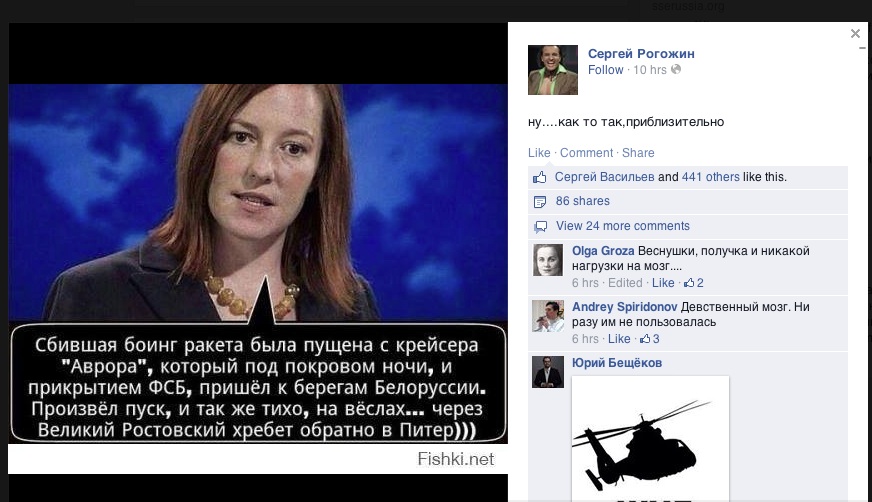
Here is an amazing bit of “folk art” I just captured on Facebook. What’s amazing about it is that it turns on their head all the impossible contortions that Russian state and mainstream media, and segments of Russian social media have been going through, over the past week, to befuddle the Russian public as to who might have shot down Flight MH17 (as described here, for example, by the indispensable Peter Pomerantsev), attributing them instead to US State Department spokesperson Jen Psaki. In the past couple months, Psaki has been elevated by the “pro-Russian” crowd (meaning the same state/”grassroots” media synergy behind the contortionist act) into a Great Satan figure, emblematic of American stupidity and ignorance.
The missile that shot down the Boeing was launched from the cruiser Aurora, which, under the cover of night, and escorted by the FSB, arrived on the shores of Belarus. It launched the missile and just as quietly rowed back, via the Great Rostov Ridge, to Petersburg.
Jen Psaki became one of the favorite targets of the Russian media. RG.ru published an article entitled “Jen Psaki found mountains in Rostov Oblast.” The article attributes direct quotes supposedly obtained by journalist Matt Lee about Ukrainian refugees to Russia, whom Psaki was said to have referred to as “tourists traveling to enjoy Rostov’ mountains.” Matt Lee promptly denied ever having such a conversation with Psaki, asserting that the claims in the article were false. In spite of Lee refuting claims in the article, the same allegations were regurgitated by Komsomolskaya Pravda and other news outlets, some of which attributed the fake quotes to Associated Press. Lenta.ru published an apology to Jen Psaki for re-printing the said false claims. None of the other outlets apologized, but instead went on to pontificate about Psaki’s prior commentary, continuing to attack her credibility.
__________
While society at large is complicit in this hysteria, to say the least, it cannot be stressed too many times how much of this “folk wisdom” about current affairs and “popular support” for whatever way the Putinist line is bending, has been generated either by state media outright or by covert paid commentators (i.e., Internet trolls), operating out of offices like this in the Petersburg suburb of Olgino:
Local reporters have infiltrated a covert organization that hired young people as “Internet operators” near St. Petersburg and discovered that the employees are being paid to write pro-Kremlin postings and comments on the Internet, smearing opposition leader Alexei Navalny and U.S. politics and culture.
Journalists from the MR7.ru website and the Novaya Gazeta newspaper have reacted to a posting by St. Petersburg local Natalya Lvova, who wrote on the Russian VKontakte social network about an interview she attended on Aug. 30 at what she described as a “posh cottage with glass walls” in Olgino, a village in St. Petersburg’s Kurortny District.
According to Lvova, the office occupying two rooms reminded her of an “internet club with lots of computers and people.” Employees in one room wrote blog posts for social networks, while those in the other room specialized in comments.
“To my question about a technical task — what exactly should be written in the comments — a young guy, a coordinator, told me, briefly and clearly, that they were having busy days at the moment and that yesterday they all wrote in support of [Moscow acting mayor Sergei] Sobyanin, while ‘today we shit on Navalny,’” she wrote on her VKontakte page.
According to Lvova, each commenter was to write no less than 100 comments a day, while people in the other room were to write four postings a day, which then went to the other employees whose job was to post them on social networks as widely as possible.
Employees at the company, located at 131 Lakhtinsky Prospekt, were paid 1,180 rubles ($36.50) for a full 8-hour day and received a free lunch, Lvova wrote.