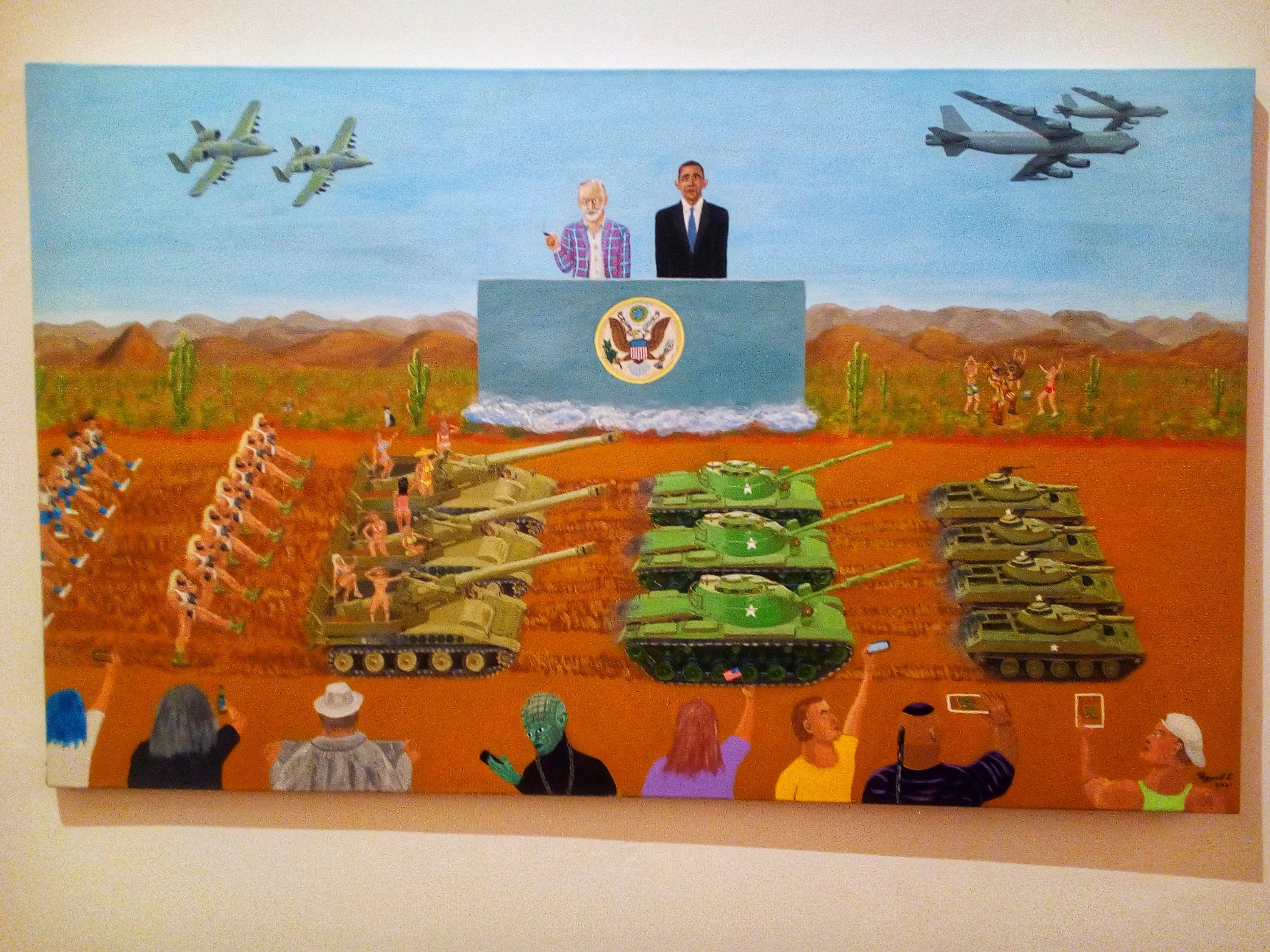
 Sergey Fedulov, Freud and Obama at the Parade, 2021. Gouache on paper. Courtesy of Studio 6 at St. Petersburg Municipal Psychiatric Hospital No. 6. Photo courtesy of Mikhail Ryzhov. The painting is currently on view at the exhibition Beyond the Establishment, at the Marble Palace of the Russian Museum in St. Petersburg.
Beyond the Establishment is an inclusive project of the Russian Museum and the first large-scale attempt to present the work of non-professional modern artists with mental disorders and/or psychiatric experience from an artistic point of view. Without diminishing the social significance of the exhibition, the aesthetic value of the artworks is in the foreground. The authors presented here express their personal attitude to the world through creativity, which fits well into the strategies of contemporary art, where the factor of professional artistic education has long ceased to prevail. First of all, these artists are distinguished by [their] lack of involvement in the art community, the art establishment and its marketing strategies, the current discourse on art, etc.
The process of including such art into common artistic practice was launched at the beginning of the twentieth century, but the terms that arose decades ago have acquired new shades of meaning over time and now no longer seem to be either correct or accurate enough to describe the phenomenon in its entirety. This also applies to the two most common terms: art brut and outsider art. The title of this exhibition, Beyond the Establishment, does not solve terminological problems, but indicates the intersection point for the six artists represented here.
Source: Beyond the Establishment
A rendering of the text below, about the artist Sergey Fedulov, in Russian Sign Language
Sergey Fedulov (born in 1981) started drawing at an early age. His grandfather was an artist and supported his grandson’s hobby, allowing him to make art any way he wanted and anywhere he wanted—even on the walls. After finishing school, Sergey studied to be a restorer at college. At first, he drew from life, as many artists do, but he always dreamed of finding his own special technique and original manner, and he was helped to do this at the Alternative Studio at Psychiatric Outpatient Clinic No. 7. After the Alternative Studio closed in 2018, the artist began working at Studio 6 at Psychiatric Hospital No. 6 and found support from the Outsiderville project.
Fedulov is fond of science fiction and is prone to supernatural interpretations of social and political conflicts. The artist’s style can be defined as a fantastic realism that is not averse to irony and sarcasm. In his world, communism has triumphed on a universal scale, but it is not aggressive or threatening: it is the ideal model of intergalactic order. The frightening potential of political myths is rendered harmless: they turn into anecdote, fairy tale, awkwardness. In the curators’ opinion, the inclusion of Masyanya as a recurring character helps Sergey openly fantasize and feel free on the paper. In every work there is a dialogue—not only between earthly authorities, but also with the inhabitants of other planets, who can also be heard. The frightening potential of political myths is neutralized—they are turned into anecdotes, fairy tales, embarrassments. Dream and reality are intertwined: Comrade Stalin meets Napoleon, the psychiatrist Pyotr Kashchenko treats aliens, Sigmund Freud and Barack Obama review a military parade, and these events are calmly observed by the cat Masyanya, the artist’s pet. According to the curators, the inclusion of Masyanya as a recurring character has enanbled Sergey to fantasize freely on the paper.
Fedulov’s works have been shown at the Russian Museum (St. Petersburg, 2019, 2020), the Museum of Russian Lubok and Naive Art (Moscow, 2019), the Ariadne’s Thread Festival (Moscow, 2018), the 2nd Triennial of Self-Taught Artists (Yagodina, Serbia, 2019) and Art Brut Global. Phase II (a virtual project of the Outsider Art Fair, 2020). His work was also in competition at the Paralym Art World Cup in Tokyo in 2020.
Source: Beyond the Establishment. Translated by the Russian Reader. Thanks to Mikhail Ryzhov and Victoria Andreyeva for bringing this marvelous artist and this show to my attention.