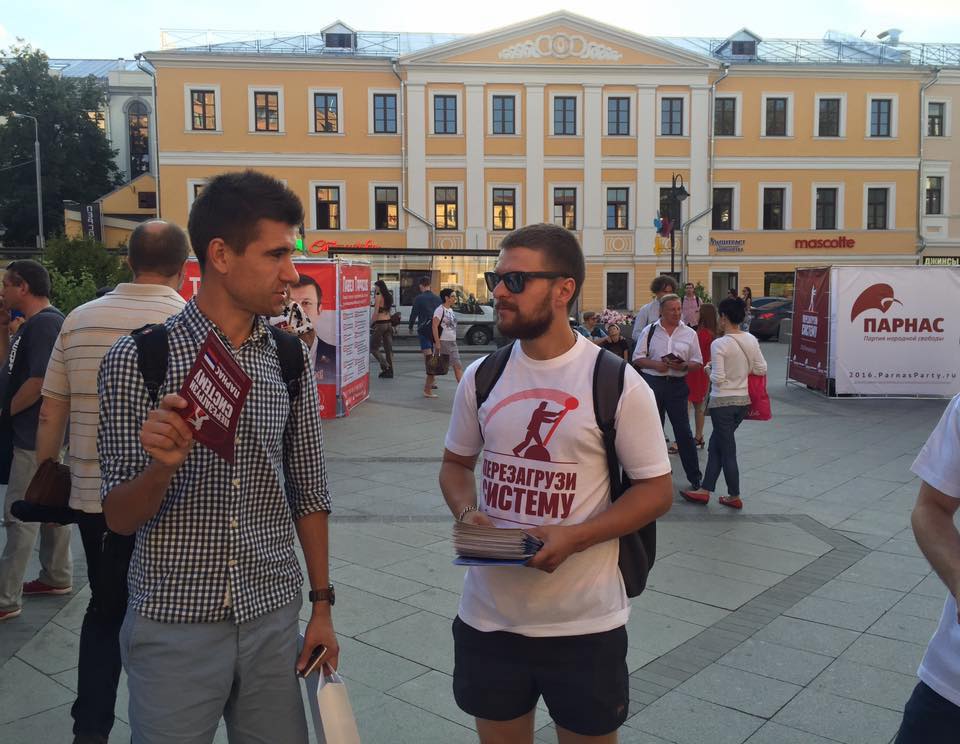
Igor Stomakhin’s photo reportage of yesterday’s youth protest outside the Russian Supreme Court

Following a nine-hour hearing, the Russian Supreme Court sided with the suit brought by the Motherland (Rodina) party and disqualified the Yabloko party’s federal list of candidates in the upcoming State Duma elections. Most of the plaintiffs’ claims concerned alleged copyright infringements in Yabloko’s campaign materials. In addition to these allegations against Yabloko, suspicions of “extremist” activity and foreign funding were also raised.
The case was heard by Judge Vyacheslav Kirillov, who has previously been involved in high-profile political trials. In particular, he ruled that the human rights organization Memorial was “extremist” and dismissed Alexei Navalny’s suit against the Federal Penitentiary Service and the wardens at the penal colony where he was imprisoned.
At least five hundred people gathered outside the Supreme Court building. They handed out apples [because yabloko means “apple” in Russian] and sang songs in support of the party. After the hearing concluded, security forces threatened the protesters with arrest and told the young people amongst them that they would be sent to a military enlistment office. Yabloko’s chair, Nikolai Rybakov, stated that the party had not broken the law and would appeal against the court’s decision within the five-day period stipulated by law.
“Moscow, 10 August 2026. Hundreds of people came to support the Yabloko party. Party chair Nikolai Rybakov had called on supporters to come to the Russian Supreme Court’s hearing of a lawsuit to disqualify the party from the elections. The suit was filed by the pro-Kremlin Motherland party. Alexei Zhuravlyov, Motherland party chair: ‘Freedom of speech is a word that would be good to shut up.’ The Yabloko party supports ending the war. Nikolai Rybakov: ‘We support the signing of a ceasefire agreement so that people stop getting killed.'”
Yabloko’s co-founder Grigory Yavlinsky wrote on Telegram that the authorities were afraid of the party’s campaign platform, which urged voters “to vote for peace, life, and liberty without fear,” because it is supported by an ever-growing number of people from across the political spectrum.
“Disqualifying a party with precisely this manifesto from the elections without any real grounds is a clear demonstration of the political system’s true nature,” he said.
DW has rounded up reactions to the court’s decision and asked experts what Yabloko’s disqualification means for the elections to the State Duma, which are slated for 18–20 September 2026.
Navalnaya: The Kremlin got scared and switched to ‘Plan B’
Motherland filed suit against Yabloko in the Supreme Court just as exiled Russian opposition politicians and cultural figures had publicly called on Russians to support Yabloko in the State Duma elections. Amongst those who had joined this appeal were Yulia Navalnaya, Lyubov Sobol, Ilya Yashin, writer Dmitry Bykov, and human rights activist Oleg Orlov.
After the court’s ruling was made public, Yulia Navalnaya, the widow of Anti-Corruption Foundation founder Alexei Navalny and the organization’s current leader, said that the Russian authorities had originally planned to let Yabloko run in the elections but not let it garner more than two percent of the vote. [Parties need to clear a five-percent threshold to be seated in the Duma.] Later, however, “the Kremlin got scared” and “switched to Plan B,” disqualifying the party, she opined.
“They saw something happening that they didn’t want to see: people are beginning to unite. It wasn’t even a matter of support for Yabloko. The fact of the matter is that millions of Russians have a chance to say what they really think about Putin and about the war,” Navalnaya wrote on Telegram, adding that the Anti-Corruption Foundation had its own “Plan B.”
Exiled politician Andrei Pivovarov, coordinator of the Russian Antiwar Committee’s Consuls project, told DW that the opposition did not regard their support of Yabloko as a way of achieving instant political change or ending the war. Rather, they wanted to demonstrate the scope of antiwar sentiments in Russian society.
“There are a dozen parties on the ballot who support the war and one that supports peace. Even if Yabloko was seated in the Duma, the war wouldn’t end. But it would show that there are many antiwar Russians,” Pivovarov said. He argued that Yabloko had become the symbol of protest voting and the public’s antiwar sentiments wouldn’t vanish with the party’s disqualification from the elections.
Why did the authorities want to let Yabloko stand in the elections?
Political analyst Ivan Preobrazhensky, speaking to DW, suggested that Yabloko’s removal from the race could have been the result of “Kremlin bungling” or a power struggle amongst various influential factions. One of his theories is that a security forces bloc linked to the FSB may have backed Yabloko as a counterweight to New People, which is seen as the pet project of Sergei Kiriyenko, the first deputy head of the presidential administration. According to another theory, Kiriyenko himself was attempting once again to generate the appearance of political competition, but underestimated the strength of antiwar sentiment.
According to Preobrazhensky, the authorities have underestimated the number of antiwar Russians who are willing to rally behind any political force advocating an end to the war. He noted that even official opinion polls point to significant support for this. He believes that Yabloko’s eligibility to stand in the elections had been agreed in advance, but the rise in support for the party alarmed the authorities.
Political analyst Ilya Grashchenkov wrote on his Telegram channel that the Supreme Court’s ruling could lead to a rise in the poll ratings of the mainstream opposition parties. According to him, Yabloko was initially allowed to stand in the election to act as a spoiler for New People: the assumption was that the votes of antiwar voters would be split between the two parties and thus would not go to a single political force calling for an end to the war.
“We’re expecting VTsIOM’s poll results in a week’s time. I reckon part of the opposition will see a bump again,” he wrote.
Political analyst Mikhail Vinogradov also expressed surprise at Yabloko’s removal from the ballots. In his view, the party’s presence would have enabled the authorities to announce a modest outcome at the polls for it, present this as evidence of public support for the war, and provoke fresh disillusionment amongst antiwar Russians. Furthermore, the campaign would have helped to single out new politically engaged citizens. Even if Yabloko had secured a mandate in the State Duma, Vinogradov believes, this could have been used to demonstrate to voters the futility of the party’s presence in parliament.
“There are certainly advantages to Yabloko’s not being registered. But the authorities are keeping this under wraps for the time being,” he concluded.
What does Yabloko’s ouster from the elections mean?
Yabloko’s ouster will complicate matters for independent election observers since the party loses the right to dispatch its own representatives to polling places, Roman Udot, an expert on elections in Russia, argues. In the past, Yabloko eagerly provided passes to independent observers, although they can still get accreditation from other parties, including the Communists, New People, and even United Russia, Udot adds.
“Besides, it’s not a certainty that a schoolteacher who back in the day would help to rig elections because she was told that this was how her school would get moneys for repairs will behave the same way when her husband or son could be called up for combat. People’s interests are at stake here: it’s every man for himself, especially with all the talk about a mobilization,” says Udot.
Udot argues that the involvement in the campaign of New People, with its proposal to end the war in Ukraine, is significant, even if the party is controlled by the Kremlin: politicians are forced to respond to public sentiment.
“We may see a shift from hawks to lesser hawks, and then to doves,” says Udot.
Furthermore, in rigged elections, it is not only the official result that matters but also the public’s impression of the election campaign, he says.
“It all depends on the mood of the populace. If the people show that the wind is changing and that there is a certain desire, and people start casting their votes for a particular stance, then some politician will catch the wind and capitalize on it.”
Do the authorities have a grip on the situation?
Elections to the Duma are taking place amidst growing anxiety in Russian society, Margarita Zavadskaya, a senior researcher fellow at the Finnish Institute of Foreign Affairs, reminded DW in an interview. She pointed out that FOM (Public Opinion Foundation) reported that 57% of the Russians it polled in late July were anxious about the state of affairs in their country, the highest percentage recorded by the pollsters since the military mobilization of autumn 2022. Although FOM’s polls should be treated skeptically, an uptick like this at the height of summer testifies to the fact that “something is out of whack,” Zavadskaya argues.
Zavadskaya sees a connection between the public’s dour moods and the increasingly frequent Ukrainian drone attacks, the deaths of civilians and warehouse fires caused by these attacks, and rumors of a new military mobilization. According to her, the summer of 2026 has been the most anxious since Russia’s full-scale invasion of Ukraine in February 2022. At the same time, the numbers of the most bellicose pro-war Russians have likely been dropping.
Anxiety is mounting in the Kremlin as well, since it is the authorities who have the most at stake in the election results, the political analyst argues.
“The ideal scenario for the Kremlin is boring elections with a sparse turnout in which nothing happens. But we can see that this scenario is now unlikely to materialize, because what’s happening on the eve of the elections doesn’t look normal, nor does it suggest that the authorities have a grip on the situation,” Zavadskaya told DW.
Source: Yevgeny Dyuk, “Yabloko’s ouster from the elections: reactions from politicians and experts,” Deutsche Welle Russian Service, 10 August 2026. Translated by the Russian Reader
Statement of (partial) interest: Ages ago, in another life, I took part in a protest rally led by Ilya Yashin, then head of Yabloko’s youth wing, on Nevsky Prospekt in Petersburg. Also, my boon companion is personallly well acquainted with current Yabloko party chair Nikolai Rybakov who, they fear, will soon be arrested and imprisoned for his temerity. ||||| trr