Yabloko Is Not the Apple of the Kremlin’s Eye

Igor Stomakhin’s photo reportage of yesterday’s youth protest outside the Russian Supreme Court


Yabloko supporters outside the Russian Supreme Court, which decided whether the party should be barred from upcoming parliamentary elections (10 August 2026). Photo: Yevgeny Messman/TASS/Picture Alliance via DW

Following a nine-hour hearing, the Russian Supreme Court sided with the suit brought by the Motherland (Rodina) party and disqualified the Yabloko party’s federal list of candidates in the upcoming State Duma elections. Most of the plaintiffs’ claims concerned alleged copyright infringements in Yabloko’s campaign materials. In addition to these allegations against Yabloko, suspicions of “extremist” activity and foreign funding were also raised.

The case was heard by Judge Vyacheslav Kirillov, who has previously been involved in high-profile political trials. In particular, he ruled that the human rights organization Memorial was “extremist” and dismissed Alexei Navalny’s suit against the Federal Penitentiary Service and the wardens at the penal colony where he was imprisoned.

At least five hundred people gathered outside the Supreme Court building. They handed out apples [because yabloko means “apple” in Russian] and sang songs in support of the party. After the hearing concluded, security forces threatened the protesters with arrest and told the young people amongst them that they would be sent to a military enlistment office. Yabloko’s chair, Nikolai Rybakov, stated that the party had not broken the law and would appeal against the court’s decision within the five-day period stipulated by law.

“Moscow, 10 August 2026. Hundreds of people came to support the Yabloko party. Party chair Nikolai Rybakov had called on supporters to come to the Russian Supreme Court’s hearing of a lawsuit to disqualify the party from the elections. The suit was filed by the pro-Kremlin Motherland party. Alexei Zhuravlyov, Motherland party chair: ‘Freedom of speech is a word that would be good to shut up.’ The Yabloko party supports ending the war. Nikolai Rybakov: ‘We support the signing of a ceasefire agreement so that people stop getting killed.'”

Yabloko’s co-founder Grigory Yavlinsky wrote on Telegram that the authorities were afraid of the party’s campaign platform, which urged voters “to vote for peace, life, and liberty without fear,” because it is supported by an ever-growing number of people from across the political spectrum.

“Disqualifying a party with precisely this manifesto from the elections without any real grounds is a clear demonstration of the political system’s true nature,” he said.

DW has rounded up reactions to the court’s decision and asked experts what Yabloko’s disqualification means for the elections to the State Duma, which are slated for 18–20 September 2026.

Navalnaya: The Kremlin got scared and switched to ‘Plan B’

Motherland filed suit against Yabloko in the Supreme Court just as exiled Russian opposition politicians and cultural figures had publicly called on Russians to support Yabloko in the State Duma elections. Amongst those who had joined this appeal were Yulia Navalnaya, Lyubov Sobol, Ilya Yashin, writer Dmitry Bykov, and human rights activist Oleg Orlov.

After the court’s ruling was made public, Yulia Navalnaya, the widow of Anti-Corruption Foundation founder Alexei Navalny and the organization’s current leader, said that the Russian authorities had originally planned to let Yabloko run in the elections but not let it garner more than two percent of the vote. [Parties need to clear a five-percent threshold to be seated in the Duma.] Later, however, “the Kremlin got scared” and “switched to Plan B,” disqualifying the party, she opined.

“They saw something happening that they didn’t want to see: people are beginning to unite. It wasn’t even a matter of support for Yabloko. The fact of the matter is that millions of Russians have a chance to say what they really think about Putin and about the war,” Navalnaya wrote on Telegram, adding that the Anti-Corruption Foundation had its own “Plan B.”

Exiled politician Andrei Pivovarov, coordinator of the Russian Antiwar Committee’s Consuls project, told DW that the opposition did not regard their support of Yabloko as a way of achieving instant political change or ending the war. Rather, they wanted to demonstrate the scope of antiwar sentiments in Russian society.

“There are a dozen parties on the ballot who support the war and one that supports peace. Even if Yabloko was seated in the Duma, the war wouldn’t end. But it would show that there are many antiwar Russians,” Pivovarov said. He argued that Yabloko had become the symbol of protest voting and the public’s antiwar sentiments wouldn’t vanish with the party’s disqualification from the elections.

Why did the authorities want to let Yabloko stand in the elections?

Political analyst Ivan Preobrazhensky, speaking to DW, suggested that Yabloko’s removal from the race could have been the result of “Kremlin bungling” or a power struggle amongst various influential factions. One of his theories is that a security forces bloc linked to the FSB may have backed Yabloko as a counterweight to New People, which is seen as the pet project of Sergei Kiriyenko, the first deputy head of the presidential administration. According to another theory, Kiriyenko himself was attempting once again to generate the appearance of political competition, but underestimated the strength of antiwar sentiment.

According to Preobrazhensky, the authorities have underestimated the number of antiwar Russians who are willing to rally behind any political force advocating an end to the war. He noted that even official opinion polls point to significant support for this. He believes that Yabloko’s eligibility to stand in the elections had been agreed in advance, but the rise in support for the party alarmed the authorities.

Political analyst Ilya Grashchenkov wrote on his Telegram channel that the Supreme Court’s ruling could lead to a rise in the poll ratings of the mainstream opposition parties. According to him, Yabloko was initially allowed to stand in the election to act as a spoiler for New People: the assumption was that the votes of antiwar voters would be split between the two parties and thus would not go to a single political force calling for an end to the war.

“We’re expecting VTsIOM’s poll results in a week’s time. I reckon part of the opposition will see a bump again,” he wrote.

Political analyst Mikhail Vinogradov also expressed surprise at Yabloko’s removal from the ballots. In his view, the party’s presence would have enabled the authorities to announce a modest outcome at the polls for it, present this as evidence of public support for the war, and provoke fresh disillusionment amongst antiwar Russians. Furthermore, the campaign would have helped to single out new politically engaged citizens. Even if Yabloko had secured a mandate in the State Duma, Vinogradov believes, this could have been used to demonstrate to voters the futility of the party’s presence in parliament.

“There are certainly advantages to Yabloko’s not being registered. But the authorities are keeping this under wraps for the time being,” he concluded.

What does Yabloko’s ouster from the elections mean?

Yabloko’s ouster will complicate matters for independent election observers since the party loses the right to dispatch its own representatives to polling places, Roman Udot, an expert on elections in Russia, argues. In the past, Yabloko eagerly provided passes to independent observers, although they can still get accreditation from other parties, including the Communists, New People, and even United Russia, Udot adds.

“Besides, it’s not a certainty that a schoolteacher who back in the day would help to rig elections because she was told that this was how her school would get moneys for repairs will behave the same way when her husband or son could be called up for combat. People’s interests are at stake here: it’s every man for himself, especially with all the talk about a mobilization,” says Udot.

Udot argues that the involvement in the campaign of New People, with its proposal to end the war in Ukraine, is significant, even if the party is controlled by the Kremlin: politicians are forced to respond to public sentiment.

“We may see a shift from hawks to lesser hawks, and then to doves,” says Udot.

Furthermore, in rigged elections, it is not only the official result that matters but also the public’s impression of the election campaign, he says.

“It all depends on the mood of the populace. If the people show that the wind is changing and that there is a certain desire, and people start casting their votes for a particular stance, then some politician will catch the wind and capitalize on it.”

Do the authorities have a grip on the situation?

Elections to the Duma are taking place amidst growing anxiety in Russian society, Margarita Zavadskaya, a senior researcher fellow at the Finnish Institute of Foreign Affairs, reminded DW in an interview. She pointed out that FOM (Public Opinion Foundation) reported that 57% of the Russians it polled in late July were anxious about the state of affairs in their country, the highest percentage recorded by the pollsters since the military mobilization of autumn 2022. Although FOM’s polls should be treated skeptically, an uptick like this at the height of summer testifies to the fact that “something is out of whack,” Zavadskaya argues.

Zavadskaya sees a connection between the public’s dour moods and the increasingly frequent Ukrainian drone attacks, the deaths of civilians and warehouse fires caused by these attacks, and rumors of a new military mobilization. According to her, the summer of 2026 has been the most anxious since Russia’s full-scale invasion of Ukraine in February 2022. At the same time, the numbers of the most bellicose pro-war Russians have likely been dropping.

Anxiety is mounting in the Kremlin as well, since it is the authorities who have the most at stake in the election results, the political analyst argues.

“The ideal scenario for the Kremlin is boring elections with a sparse turnout in which nothing happens. But we can see that this scenario is now unlikely to materialize, because what’s happening on the eve of the elections doesn’t look normal, nor does it suggest that the authorities have a grip on the situation,” Zavadskaya told DW.

Source: Yevgeny Dyuk, “Yabloko’s ouster from the elections: reactions from politicians and experts,” Deutsche Welle Russian Service, 10 August 2026. Translated by the Russian Reader


Statement of (partial) interest: Ages ago, in another life, I took part in a protest rally led by Ilya Yashin, then head of Yabloko’s youth wing, on Nevsky Prospekt in Petersburg. Also, my boon companion is personallly well acquainted with current Yabloko party chair Nikolai Rybakov who, they fear, will soon be arrested and imprisoned for his temerity. ||||| trr
Valery Dymshits: After the Fight

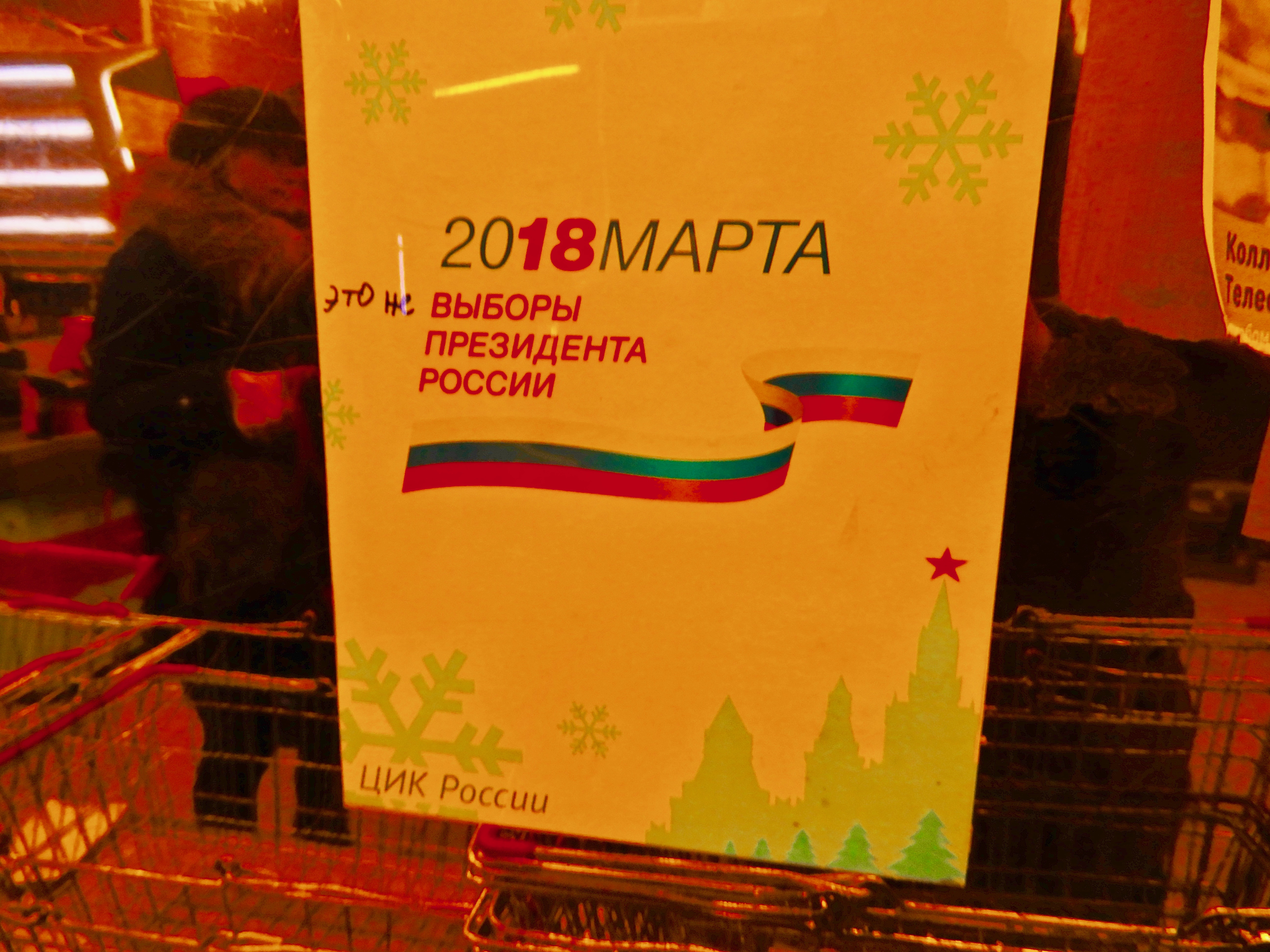
DSCN4942Poster: “March 18, 2018. Russian Presidential Election. Russian Central Election Commission.” || Graffiti: “This is not an election.” Dixie grocery store, Central District, Petersburg. Photo by the Russian Reader
Valery Dymshits
Facebook
March 20, 2018

After the Fight

I wrote so often about the election or, rather, the non-election, that it is time to sum up.

I admit I had hoped for a qualitative decrease in turnout, but it is true we did not manage to achieve this.

Of course, the feverish ideas (I heard them voiced more than once, alas) that if it were not for the boycott, the “forces of good” either would have returned a mystical 10% of the vote tally (whatever for?) or made it into the second round (yes, yes, I read such claims with my own eyes) have nothing to do with reality. The fact the turnout was a few percentage points less, and Putin got a few percentage points more, makes no difference at all to anyone.

Nevertheless, I continue to regard the boycott as the right choice. Here is the reason for my stubbornness.

It is self-evident the election—not the day of March 18, but the process—was god knows what, only it was not an election.

Accordingly, the feeling of disgust kept many people from voting. Disgust is a worthy emotion. But that is not my point here.

In so-called normal countries, candidates and parties fight over half a percentage point, and a threepercent difference is deemed a crushing victory or crushing defeat. In our archaic autocracy, the regime and the populace communicate with each other in a language of symbols. As soon as it transpired the Kremlin was planning to fight for a 70% turnout and 70% of the total vote tally, I immediately realized the Kremlin wanted fifty percent of all possible voters, plus or minus one percent, to come out and vote for Putin and—voilà!—a 65% turnout and a 75% share of votes cast is exactly 50% of all potential voters. Meaning the Kremlin’s statement was purely symbolic and qualitative. Qualitative, symbolic collective action was, likewise, the only possible counterargument. It largely did not come off, but there were no other gestures of resistance except the boycott. The attempt to talk back to the regime quantitatively—for example, Yabloko’s responding to the argument “we have half of all voters” with the rejoinder “but we have 10% of everyone who voted” (i.e., “you have 50%, but we have a whole 5%”)—was ridiculous. Now, if it had been possible to counter the claim “we are robustly supported by half of the populace” with the countargument “ha-ha, you have the support of no more than a third of the populace,” but, alas, it proved impossible.

It is clear the numerous violations, committed here and there by zealots who were not thinking straight, generated a certain stench on election day, but I don’t imagine they had a serious impact on the outcome. It was the outcome that sincerely floored me.

The issue of voter turnout, so hysterically raised by the regime, had nothing to do with a fear of Navalny and the boycott, but with the fact that in the absence of real suspense and real rivals, Russians would be reluctant to go out and vote for Putin, who would be elected anyway. After Navalny was not allowed to run, it was impossible to generate any suspense, so the regime combined the carrot and the stick. Russians were driven and dragged to polling stations by the gazillions.

I would like to make a slight digression. First of all, you can make people who are subordinate and dependent—state employees and employees of state corporations—vote by forcing them or threatening them. The state’s share in the economy has been growing continuously: in 2005, the state controlled 35% of the Russian economy, while it now controls around 70%. That means the numbers of dependent Russians have also been growing.

The Kremlin felt it was vital to drag lazy Russians to the polls whatever the cost. As for voting as they should, they would do that all on their lonesome. The Kremlin knew they would do it, but I didn’t. I thought more or less that people would feel their weekend had been ruined. They had been forced to go somewhere and then forced to report back to their superiors. How swinish! So these people would do something spiteful: vote for Grudinin, vote for Sobchak, vote for Yavlinsky, vote for a four-letter word.

No, since they were dragged all the way to the polling stations anyway, enticed with carrots and prodded with sticks, they voted for Putin.

This is an important albeit gloomy outcome. It means the regime relies on a not terribly active but quite considerable majority. It means the regime can do whatever it likes with whomever it likes, and will be able to do so for a long time to come.  Previously, it could do a lot of things, but not everything. Now, however, it can do anything. Strictly speaking, things have been this way for several years, but now it has been proven in a large-scale, expensive experiment. It is like in the Arabian tales: destroy a city, build a palace, jail a director, close a university, etc., just for the heck of it, just for the fun of it. This does not mean the regime will immediately start throwing its bulks around in all directions, but it can. A clear awareness of this circumstance should make us feel bleak.

Translated by the Russian Reader

Igor Averkiev: Elections That Kill Democracy

photoIgor Averkiev

There Are Elections That Build Democracy, and Elections That Kill It: The Tricks Is Not to Confuse Them
Igor Averkiev
igor-averkiev.com
March 13, 2018

1. If you relate to elections solely as a value, you will never grasp their essence. You will never tame them.

2. In the modern world, the presence of elections per se in a particular country is neither an achievement nor a value, except for liberal democratic fundamentalists. In the modern world, it is the political outcome of elections that is an achievement and value. In some countries, elections build democracy, while in other countries they kill democracy. In Russia, they kill democracy.

3. There are about two hundred countries in the modern world. The vast majority of them (around one hundred and eighty) hold elections more or less regularly. Around fifty countries in this vast majority are more or less classic democracies. There are another forty countries that hold elections and are more or less classic authoritarian regimes. The other hundredsome countries that hold elections are ruled by a variety of transitional, semi-authoritarian, and hybrid regimes. Meaning that elections per se do not vouchsafe democracy at all. Morever, in most of the world’s countries, people voting in elections does not produce democracy.

4. Elections are merely a social know-how that can be used by anyone for any purpose.  Know-how is a simple thing: if you wield it, you can profit from it in keeping with your interests. An axe is similar in this respect. It matters who wields it: a carpenter or a killer. In the hands of some people, elections produce a democratic regime, while in the hands of others they produce an authoritarian regime. Democracy is not programmed into electoral know-how itself. Democratic elections thus coexist on our planet with authoritarian elections: everything is decided by the person who presides over the elections. If you want elections in Russia to produce democracy, first you have to gain control of them. Elections serve democracy only when they are monitored at all phases by political forces with a stake in democracy. Nor is it only a matter of monitoring the tallying of votes.

5. Elections serve democracy only when the question of power has already been resolved to the benefit of pro-democratic forces or during an unstable transition period in which an authoritarian regime is still in power, but can longer dismiss pro-democratic forces out of hand. Therefore, in order to use elections to advance democratic interests, they must first be taken away from the old authoritarian boss. Or he must be so scared he has to take the interests of pro-democratic forces into account when elections are held. There is no other way. This is how things are done the world over, but millions of freedom-loving Russians for some reason still believe that regularly going to vote in elections presided over by someone else will in itself hasten democracy’s victory in Russia.

6. What is democracy? I won’t go into high-flown arguments, but the democracy that freedom-loving Russians like so much gels only when the country is run by politicians who have no desire to restrict political competition. They are willing, if push comes to shove, to lose elections; moreover, they are willing to accept defeat until the next elections. That’s all there is to it. That is why there is no democracy in Russia: because the people in power restrict political competition and have no intention of losing elections under any circumstances, much less accepting defeat. They are assisted in their restriction of political competition by the selfsame democratic know-how and institutions. It is just that without democratic politicians inhabiting them, this know-how and these institutions are only formally democratic, not democratic in fact.

7. The pro-democratic forces include not only the liberal democratic parties but also all political and civic organizations—leftist, nationalist, imperialist, religious, environmentalist, alternative leftist, alternative rightist, etc.—whose political interests are not bound up with Vladimir Putin’s personalist regime, who have no plans to limit political competition in Russia, and are willing, depending on the outcomes of elections, not only to come to power but also to cede power. Putin’s authoritarian regime can be opposed only by a broad pro-democracy coalition, without necessarily becoming a formal coalition. The trial version of this broad pro-democracy coalition presented itself to the country during the nationwide protest movement that kicked off in December 2011. We should not expect extremely well-coordinated joint actions from a broad pro-democracy coalition. (The “Decembrists” overplayed their hand in this respect.) It is enough to head in the same direction along more or less parallel routes, coordinating actions at certain critical points.

8. An electoral authoritarian regime, such as Russia’s, is organized quite simply. All the democratic know-how a modern country is supposed to have—elections, representation, separation of powers—functions smoothly, but not all comers have access to it. It is even simpler than that. An authoritarian regime simply does not allow potential competitors, that is, leaders and organizations, to get on their feet politically and grow organizationally to the extent they would be able to surpass the two- or three-percent minimumthreshold of votes needed for admission to the political arena. It does this by refusing to register parties, intimidating leaders, limiting freedom of speech and freedom of assembly in a pinpoint fashion, etc. If, despite everything, they nevertheless grow and thrive, they are simply not admitted to elections, as I have mentioned. In Russia, therefore, democratic procedures do not serve democracy. The soul of democracy is not know-how, procedures, and institutions, but people willing to use them in a particular way. In Russia, politicians interested in democracy simply do not make it into formal democratic politics. Thanks to the political regime built by Vladimir Putin, year after year only pro-authoritarian political forces make it into Russia’s formally democratic politics, and year after year they limit the involvement of pro-democratic forces in democratic procedures. It is a vicious circle. There is democracy, and there is no democracy at the same. Putin’s authoritarian regime is even elegant after a fashion.

9. Elections in authoritarian countries do not increase the supply of democracy, nor do they prepare the way for it, since they do not facilitate competition, do not put the opposition through its paces, and do not put rank-and-file voters in circumstances where the country’s fortunes depend on the choices they make. In authoritarian countries, elections function as a full-fledged authoritarian institution for legitimizing the regime. In authoritarian countries, elections are required only as a source of power, nothing more. Everyone involved in these elections is involved solely in legitimizing the regime. They are doing nothing else.

10. In authoritarian and hybrid countries, including modern Russia, elections have another vital political function. Elections are also an outlet for the liberal public, a valve, installed by the regime, for releasing oppositional steam and keeping opposition politicians busy somehow. The Putin regime has used elections to satisfy the need many freedom-loving Russians have to “fight for democracy” in a safe, comfortable way, a way that lets them feel like decent dissidents honestly doing their duty. Everyone comes out on top. The liberal public engages in self-actualization, and the regime does not find it frightening.

11. If the liberal democratic opposition’s sole aim is symbolic involvement in election campaigns within the authoritarian regime, but year after year the regime does not permit it to grow politically and organizationally, and does not allow it to run in elections, the opposition will gradually wither and become marginalized. This, in fact, is the kind of opposition we have nowadays. If we realize, however, that elections serve democracy only after the question of power has been decided to the benefit of pro-democratic forces, it means we need a different opposition altogether, one radically different from the opposition that has filled the niche the past fifteen years. We need a liberal democratic opposition that is not hung up on being involved in meaningless elections governed by someone else’s hostile rules. We need an opposition focused on vigorous, direct political action and a propaganda duel (a fight over values) with the regime in order to command the attention and respect of the so-called Putinist majority, those very same “ordinary people” who, when a window of opportunity opens, would at least not oppose the new, free-minded political alternative. There is a big problem with the word “new,” however.

12. The creation of a new, free-minded opposition is encumbered by the liberal democratic fundamentalism that holds sway in the minds of Russia’s freedom-loving public. One manifestation of this fundamentalism is, in fact, the irrational cult of elections: all elections are good, regardless of their political essence and their consequences. Two other burdens are the extreme political impracticality and even archaicism of today’s liberal democratic platform. Currently, we have nothing to offer people from the standpoint of a future regime. Here is a simple question. What can we offer the average Russian family, something they would really need and value, that the Putin regime either cannot give them or promise them? The keywords in this case are “really need and value.” Moreover, in the obviously adverse conditions of a post-Putin Russia, the current liberal democratic prescriptions would necessarily lead the country into new crises the very first year they were implemented and, consequently, to new outbursts of the conservative revolution. It is ridiculous to discuss this with educated people, but thinking outside the box is now more important than doing things. At very least, it is more important than running off to vote in Putin’s elections.

13. For free-minded Russians and Russian politicians, the issue today is not how to win Putin’s authoritarian elections, but how to behave and build a reputation in society today in order to win future democratic elections in which the former so-called Putinist majority would be among the voters. If you want to facilitate the collapse of the Putin regime, you need to work less with the Putinist state and more with the Putinist majority.

14. The main problem freedom-loving Russians face in the impending presidential election is not what choice to make, whether to vote or not, and certainly not who they should vote for. The main problem is that whatever choice each of us makes—to vote or not vote, to vote for Yavlinsky or Sobchak—it will have no impact whatsoever on the fortunes of Vladimir Putin and his political regime. Any electoral action we take will change nothing about the election or the regime. Judging by various opinion polls [sic], there are between ten and fifteen million of us in Russia. Even if we assume the incredible—that all of us would act in concert in this election, and thanks to our monitoring the elections themselves would be extraordinarily fair—we cannot have a significant impact on the outcome of the election, even if each of us to the last man boycotted it or we all voted for Ksenia Sobchak or Grigory Yavlinsky.

15. Everything is seemingly quite simple. In Putin’s Russia, elections have nothing to do with building democracy and vanquishing the Putin regime. Why, however, does something so evident not get through to many advocates of liberty and diversity in Russia? How did the perverted cult of mandatory involvement in all elections take hold among such a considerable segment of the Russian liberal public? There are explanations. First, many opposition politicians, speakers, opinion leader, and experts have a professional stake in Putin’s elections. Some of them try and run in these elections (the simplest way of being an opposition politician in an authoritarian regimes), while others assist the elections professionally, serve as polling station monitors, analyze the whole megillah or write about it. This entire mob would simply be out of a job, in the broad sense of the word, if the opposition-minded public did not vote in authoritarian elections. Thus, in the opposition milieu, they are the principal propagandists and agitators for the idea of voting in these demonstrative non-elections. Since, as a rule, they are the most intelligent, energetic, and authoritative people in opposition-minded communities, their opinion is quite important. Second, as I have mentioned, above, involvement in authoritarian elections (“but they are elections all the same”) has served a considerable segment of the liberal public as a safe, comfortable way to “fight for democracy,” a way that lets them feel like decent dissidents honestly doing their duty. The notion that it is foolish and nasty for an advocate of democracy to vote in authoritarian elections immediately nullifies the opposition’s semantic space, the space of election enthusiasts, plunging them into the “desert of the real.” Everything is so painful and disturbing in that desert. You have to acquire a new civic faithfulness to yourself, redefine yourself in terms of the meanings and tools of your opposition, what normal risks are, who your supporters and opponents are within the opposition, and so on. “No, it’s better to vote in Putin’s elections.”

16. On the other hand, if nothing really depends on us in Putin’s elections, is it worth persuading our allies not to vote in them? Why hassle people? Why prevent them from doing what they deem important? Because things won’t get any worse for us if they do vote in the election anyway, right? I think it is still worth pestering them. Politics, after all, depends on political sentiments and emotions, and thoughts are tangible things even when they are not true. If millions of people who hunger so much for freedom and diversity in Russia think, “How can I vote in authoritarian elections the right way, so that it benefits the opposition’s cause?” that is one kind of opposition. But if millions of people who hunger so much for freedom and diversity in Russia think, “What else, besides voting in authoritarian elections, can I do to dismantle the Putin regime and bring about the victory of freedom and democracy in Russia?” that is a completely different opposition.

Igor Averkiev is the chair of the Perm Civic Chamber. Photo courtesy of Igor Averkiev. Thanks to Comrade Koganzon for the heads-up. Translated by the Russian Reader