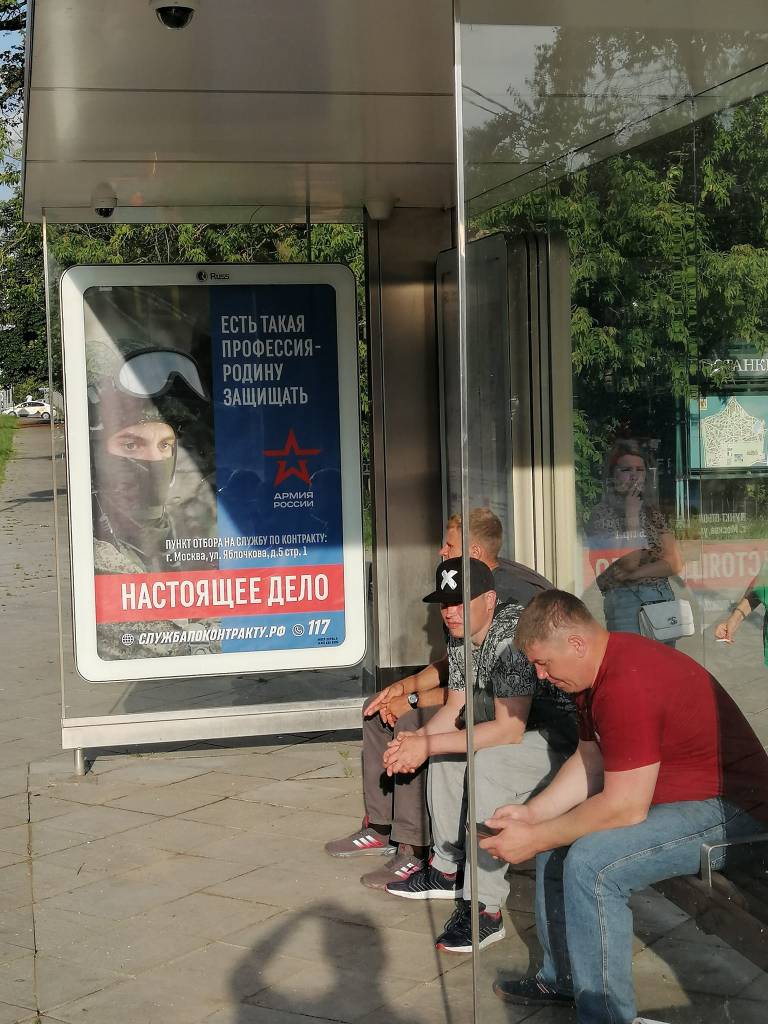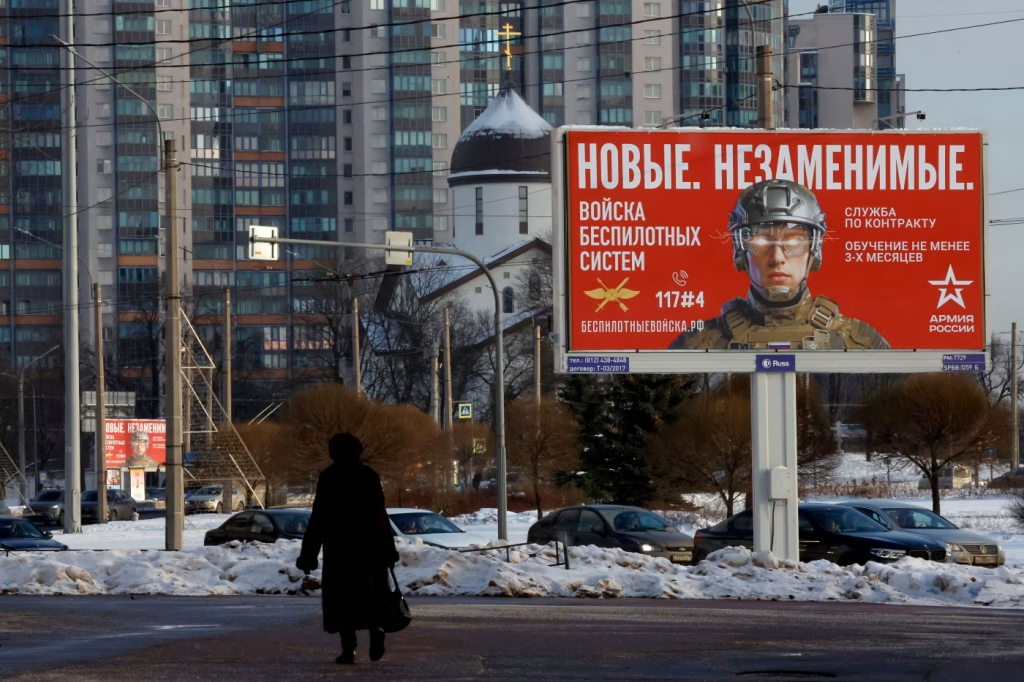
Raids aimed at forcing men to fight in the war against Ukraine have become widespread throughout Russia’s regions. In the Penza Region, where law enforcement, in concert with officials from military registration and enlistment offices, have been carrying out such raids in a particularly aggressive manner, local residents have banded together to “take back their men,” as they put it.
“They took him away, but we caught up with them halfway and got him back”
On 23 July, unknown men in plain clothes drove up to the home of Sergei Teplyakov, an employee of a local security firm in Bashmakovo, a district council town in the Penza Region with a population of around nine thousand).
“One of them introduced himself as the new neighborhood beat cop and demanded to see [Sergei’s] passport. Sergei then started phoning the real neighborhood beat cop. [The intruders] flew into a rage, grabbed him, and dragged him into their car. It was a straight-up abduction: no grounds for his arrest, no names, no paperwork whatsoever were provided,” says Oksana, a resident of the town. (We have changed the names of those whom we interviewed for their own safety.) “Sergei’s son, who had been telephoned by the neighbors, arrived, started filming it on his phone, and shouting at them. They let [Sergei] go. But the next day, [Alexei] Denisenko was caught in a raid.”
According to the locals, two unknown men grabbed Denisenko in a park where he was cutting grass to work off court-ordered community service hours for drunk driving.
“They threatened [Denisenko]. They said he would suffer the consequences if he didn’t go with them to the district council offices. A female council staffer was in the car with the ‘trappers,’ and so [Alexei] believed them. Plus, the license plates on the car were local, and it was a council vehicle,” says local resident Artyom. “He was told they were taking him to the council to ‘verify his details.’ But witnesses noticed they drove him off towards Penza and they called his family. His sister was able to chase them down halfway there, less than a hundred kilometers from Penza. She forced them to stop their car and she wrested Alexei from their clutches. These ‘recruiters’ are local officials working for the Defense Ministry by supplying them with unsuspecting folk. It’s utter lawlessness: these recruiters barge straight into people’s homes. If a man is walking down the street a bit tipsy, he’s definitely at risk. But basically, they’ll grab anyone.”
According to Mediazona, which has been compiling a name-by-name list of fallen Russian servicemen since 2022, more than two thousand residents of the Penza Region are known to have been killed in combat. The list of those killed from Bashmakovo includes twenty-five people.
Bashmakovo residents say that they had never met any of the “recruiters” before.
“We looked up the drivers of these vehicles—it turned out that one of them works as a bailiff!” says Artyom. “The plates of the second vehicle (O217XR) are registered to the Bashmakovo District Council. The families of Denisenko and Teplyakov reported the attempted abduction and coercion into signing military contracts to the police. Recently, two more men were also abducted. They managed to get a lawyer sent to them, but it wasn’t possible to get them out of the recruitment center on Skladskaya Street in Penza: they’d already been pressured into signing up there. According to the lawyer, one of them was threatened with ‘criminal charges’ over debts, even though the amount he owed didn’t warrant criminal prosecution. In other words, they were basically hoodwinked.”
Following these incidents, the locals decided to form a neighborhood watch group to defend the men.
“I joined the patrols almost straight away. It all happened spontaneously,” says Galina, a resident of Bashmakovo. “The guys set up [an online chat] group and started posting there about what was happening in the town and how they were rounding up the men. Gradually, people simply got together on VKontakte. That’s where we coordinate our efforts: we’ve split into shifts and we patrol the town around the clock. Around 250 people have joined the vigilante group. It’s much more effective to take back people on the spot, before they’re sent to the police station or the military recruitment office, because there’s simply no legal basis for detaining them.”
She says that almost everyone in the vigilante group has personal motives.
“There’s fear for our loved ones, of course. God forbid that my husband goes off to work and then disappears: you already know what might have happened to him. In June, they took my cousin away. He has two children. I recently found out that he had some sort of unpaid loan. I don’t know where he is now and what’s become of him.”
Galina says the members of the neighborhood watch patrol Bashmakovo every day and even at night: those who have cars drive around the town to check for suspicious vehicles or strangers. The volunteers chip in for petrol. They also use a community fund to cover unexpected expenses. Recently, during a patrol, there was a minor road accident in which two cars were damaged. They were repaired free of charge by acquaintances at a garage, and the only cost was for the spare parts.
Galina herself has been called out in response to a report of an attempted abduction.
“I was with my mom at the hospital when a message came through the group chat saying that two police officers were trying to force their way into Pavel Berdechenkov’s house. My mom and I drove over there, and the rest of the crew joined us. In the end, the police had nothing to say: they got into their car and drove off. There was another incident when we were patrolling a neighboring village and spotted a GAZelle van we didn’t recognize. All such reports go straight to our private group.”
She estimates that the vigilante group’s members have managed to prevent at least five or six people from being abducted in this way. But their methods doesn’t always work.
“Today we weren’t able to rescue a man because the alert came in too late. Within forty-five minutes, they’d already taken him far away. That’s why what matters most is that we’re notified straight away. Then we can get to the scene.”
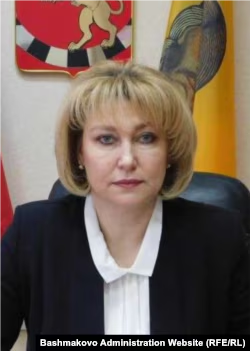
A member of the volunteer group claims that at least two vehicles belonging to district authorities have been used in the raids. According to her, a Lada Granta, which residents have dubbed “401,” belongs to the Bashmakovo District education department, while a Lada Largus 217 belongs to the district council. Locals blame the council’s chair, Tamara Pavlutkina, for what is happening and feel that reporting incidents to the local police is pointless.
“There’s no point in complaining to the police. We believe the district council chair gives the orders and the rest just carry them out. She gets everything done by proxy,” says Galina.
As an example, she cites the story of fifty-eight-year-old Sergei Milkin from the village of Podgornoye, sixteen kilometers from Bashmakovo. According to her, the local beat cop, Sinyov, invited Milkin to the village council “for a chat,” after which he disappeared. Milkin, says Galina, had serious heart problems: he’d had a bypass operation. The day after his chat with the police officer, he rang his family from the Rostov recruitment center and told them he was being sent to the war. Ten days later, he died, basically on the front line.
“We wrote to every relevant authority: the military prosecutor’s office and Bastrykin at the Investigative Committee, and we appealed to the television. Our complaint was registered, and then there was silence.
Another member of the vigilante group, Alexei, joined it after his relative was nearly sent off to war.
“He was summoned by letter to the military registration and enlistment office to ‘verify his details.’ We happened to be visiting him at the time and witnessed the whole thing. The round-ups had begun in Penza by then, but not here yet. What’s more, he didn’t go alone but with a friend, so we felt a bit more reassured. He’d left his phone at home,” says Alexei. “Two hours went by, but he wasn’t back yet. Three hours passed, and still nothing. His friend returned alone and said, ‘Your relative’s gone to Penza for a medical board.’ We were in a panic. I rang the infamous Penza military registration and enlistment office at 19 Skladskaya Street. They replied, ‘We’ve got no one by that name here.’”
Alexei says that at that moment the village chair came to the house and asked for the missing man’s military service card.
“I started filming her straight away. ‘What grounds do you have for asking to see his papers?!’ I ask her. She replies, ‘The council sent me.’ I ask her to give me names and job titles, but she refuses. We take a taxi to Penza. At 19 Skladskaya Street, we race up and down all the floors. We come across a drunk man whom someone had brought in, while the bloke accompanying him boasts that he’s already brought in and ‘handed over’ two people that day. Then we meet a tearful mother: her son had been snatched straight from their home, and she’d rushed there hot on their heels. Her [other] two sons were already at [the front]. She said she won’t hand over the third one.”
Alexei spotted his relative right on the steps of the military registration and enlistment office.
“He had been brought there in a private car by an ‘acquaintance’ of the village council chair. When we shouted at this man, he claimed that he had nothing to do with it: he had just ‘kindly’ given [my relative] a lift to Penza. Then he scrammed. We immediately took our relative by the arms, but by that point he had already been ‘psyched out’: they’d explained to him that after the medical examination he would have to sign some papers, supposedly to verify his details. What sort of people are they? They’re a disgrace. They’re prepared to take people’s lives for these payments.”
Meanwhile, Oksana, who has also joined the group, told [Radio Svoboda] that the local authorities had begun putting pressure on them.
“The security forces have already threatened us. Do you know what they threatened to do us? To send us off to the war! What’s more, they’ve been openly persecuting those who have criticized the raids or written about them on social media. Police officers went straight to the home of Vera Makavtsova and, in front of her four children, threatened her with criminal charges. They are threatening to charge her under Article 319 (“insulting a public official”). All because, in a post of hers, she called the district council accomplices to the abductions, and its chair, Tamara Pavlutkina, a co-organizer of press-ganging people into combat.”
In an audio recording made during Makavtsova’s arrest, police officers can be heard bursting into the house and demanding that the woman “come with them.” This is because she allegedly “poses a threat to Russia’s national security,” posts all manner of “extremist” content on social media, and takes part in meetups of residents.
“You don’t have a warrant,” Makavtsova says.
“Do you have a fucking warrant to gather in the city center on Saturdays?!” the police officer replies.
“In the end, they busted down the door and detained her. Of course, it’s not domestic violence, her husband beating her [that brought the police to Makavtsova’s home]. It was a post attacking an official and the Defense Ministry. That was grounds for the police to ‘intervene.’ They never responded to the complaints from Denisenko and the Teplyakovs. I’m sure Pavlutkina herself filed the complaint [against them],” Oksana says indignantly.
“The chair of the council has two sons,” adds Galina. ‘When I asked her why she wasn’t sending her own sons [to the front], she said, ‘I didn’t give birth to them for that.'”
Meanwhile, on 25 June, a ceremony was held at the Bashmakovo District Council to present state awards to the local families of men killed during the invasion of Ukraine. Relatives and loved ones of the soldiers, who had returned home as “Cargo 200,” received honors and medals. The ceremony was attended by the local military enlistment officer, Alexei Valygin, and Pavlutkina, a member of the ruling United Russia party, who assured those present that “should any questions arise, citizens can always contact the district council.”
[Radio Svoboda] reached out to Pavlutkina, asking her to comment on reports that the district council had been involved in detaining residents and forcing them to volunteer for the army. As this article went to press, she had not responded.
In early August, Penza-based blogger Stanislav Morozov set up a support chat group for men who have been detained and pressured into enlisting in the army. He called on residents to unite to resist such detentions.
“We are doing this out of desperation, because we simply have no other choice. We are people who are standing up for our fundamental rights and freedoms—the right not to be treated as a commodity and not to have our free will taken away under the threat of a truncheon. When lawful means of self-defense cease to work, the only shield left is a neighbor’s shoulder. Our strength now lies in this compulsory yet consciously chosen consolidation,” Morozov explained in the chat’s overview.
Within the first twenty-four hours, 300 people had joined the chat, and within a week the number of participants had exceeded 1,200. Morozov calls on eyewitnesses to report arrests promptly and promises to help find lawyers for those detained. He warns that security forces and provocateurs may have joined the chat and asks everyone to be careful with what they say.
Amid the raids, other ways of warning people about them have emerged. In early August, an online service launched featuring a map on which users could mark the locations of arrests. A few days later, its developers reported that the service and its associated Telegram channel had been hacked, and the website had started redirecting users to a porn site, according to the Telegram channel Mobilization. The project’s creators speculated that the law enforcement agencies might have taken an interest in them, but it is not yet possible to independently ascertain who was behind the hack.
“They’ve taken a blind man away!“
All across Russia, men are being deceitfully lured into the war against Ukraine.
On 8 August, an incident involving abduction and the forced signing of a military service contract took place in Omsk.
According to Valentina, on Saturday morning three unknown men grabbed her 31-year-old brother, Danil, straight from the courtyard of their home in Omsk’s Kirovsk District.
“He has a wife and children. This morning, he took a can of beer and went to sit on a bench by the entrance to his block. That’s where they picked him up. It was a private vehicle, but luckily, the neighbors managed to write down the license plate number. While we were looking for him, he came back on his own. He told us they’d taken him to a ‘volunteer’ recruitment center at 8 Maryanovskaya Street. He had barely managed to break free and escape, and he hadn’t signed anything. Well, we calmed down a bit,” says Valentina.
But that same evening, she says, they came for him again.
“Danil was out in the courtyard with his wife and children. Some men arrived in a Niva [off-road vehicle]. They twisted his arms behind his back and took him away to parts unknown. The children were screaming, and his wife tried to fight them off, but to no avail. We were terrified: what should we do? We started dashing off statements to the military prosecutor’s office, the military Investigative Committee, and the police. We found out he was back on Maryanovskaya Street. We’re demanding his release, but they won’t even let us speak to him on the phone. It’s a proper kidnapping.”
Her brother was released after some time, but, according to Valentina, he had been beaten up beforehand and forced to sign a “voluntary” military enlistment contract.
“They’ve finally let him go, but they intimidated him so much and beat him up so badly, that he signed the contract. We’re in shock at the moment, trying to raise money for lawyers. What else can we do? He’s at home for now, but they’ve got that contract they forced him to sign. They could turn up and break down the door, after all. What’s going on is just horrific.”
In August in Russia’s Maritime Territory, according to Ivan, a former soldier, the military stopped his brother Mikhail, who has a category 1 visual impairment.
“On 3 August, Misha went to the shop. He was stopped by two soldiers who initially asked him to sign a contract with the Defense Ministry,” says Ivan. “My brother refused. He told them straight away that he was a person with a category 1 visual impairment. They kept pressuring him: ‘Then you’ll be building barracks in Sibirtsevo’ (a village in the Maritime Territory’s Chernigovsky District, where military unit 16871 is stationed). He explained to them at length that he could hardly see anything at all. He’d been making his way to the shop by memory and by touch, after all. Then they grabbed him and took him away by force.”
The following day, Ivan (who had himself been discharged due to an injury sustained in combat in Ukraine) brought all his brother’s medical records to the recruitment center in Ussuriysk.
“They were holding him at the recruitment center on Lermontov Street. I showed them his medical records and his Category 1 disability certificate. I was certain they’d sort it out and let him go. But early the next morning, Misha rang and said they were putting him on a bus to the airport,” says Ivan. “That was it! He was off to Ukraine to fight. How on earth will he manage there?! He can only cope here on his own because he knows the streets like the back of his hand. But over there, he won’t even be able to get around. What do they want with him?!”
Mikhail’s family filed a complaint with the military prosecutor’s office claiming that he had been coerced into signing a contract.
“They said they had thirty days to respond. But how can we wait when a blind man has been whisked off to a war zone? He’s in danger there every single minute!” exclaims Ivan indignantly.
Human rights defenders note that after someone signs a contract volunteering for the army, it is extremely difficult to get the agreement annulled, even if he alleges that he was coerced into signing it.
“Coercion is illegal in theory, but if the contract has already been signed, annulling it at one’s own request is nearly impossible. In this case, one also has to file a written request with the military commissar to withdraw from the contract,” says Yaroslav Mukhin (whose name has been changed for his own safety), a lawyer specializing in cases involving conscientious objectors. “But experience shows that even medical certifications of disability are no longer of any help. The case may well go to court, but by the time the proceedings are over, a conscript in such poor health will already have been killed [in combat].”
Raids on men in Russia have been taking place amid growing challenges with recruiting volunteers. The Financial Times reports that the Kremlin and the Defense Ministry tasked the regions with recruiting 409,000 men in 2026, and it is up to local officials to fulfill the recruitment quotas. Meanwhile, the costs of recruiting itself have increased. Important Stories calculated that in the first quarter of 2026 alone the regions paid recruiters 3.2 billion rubles [approx. 33 million euros], which is more than twice the monthly average a year earlier.
In early August, the Wall Street Journal reported on complaints of men being detained and forced to volunteer for the army in Penza, Ulyanovsk, Rostov, Amur, and Yaroslavl regions, as well as Udmurtia, Tatarstan, Voronezh, and Arkhangelsk. According to the newspaper, American officials believe that the Kremlin is considering a larger-scale option: a new round of mobilizations. If such a decision is made, the newspaper’s sources expect it to be implemented after national parliamentary elections on 18–20 September. Russian authorities deny plans for another mobilization.
Source: “‘People have put together a militia’: How Russians are fighting back against recruiters to protect their men,” Radio Svoboda, 14 August 2026. Translated by the Russian Reader. Thanks to Comrade Koganzon for the heads-up.