The 45-year-old resident of the Tatarstan capital with the exotic first name and surname and the patronymic Petrovich has four prior criminal convictions
Holy Week has kicked off for a Kazan defendant with a quite uncommon name: Jesus Christ. The 45-year-old Kazan resident has been charged with falsely registering forty-five migrant workers at his address. Jesus Petrovich has prior repeat convictions for burglary and robbery, and in 2014 he underwent preventive care for substance abuse. Business Online reports on Christ’s failure to appear at his court hearing, and the “way of the cross” he has blazed through Kazan’s district courts.
Jesus Petrovich’s “Good Friday”
The biography of Kazan’s latest criminal defendant would not be too different from the average person’s — the divorced and unemployed high school graduate will turn forty-six on the tenth of May — were it not for one catch. His name is Jesus Christ: that is the name listed in his [internal] passport.
The story of how he got the name remains a mystery: neither the court staff nor the state prosecutor know what Christ’s name at birth was. All that the people involved in the criminal proceedings know is that the defendant was “obsessed” with numerology, and this led, allegedly, to his decision to change his name and surname several years ago. He kept only his real patronymic: Petrovich.
Christ was scheduled to appear before the Moscow District Court (the Kizichevsky Vvedensky Monastery is situated right next door to the court building on Justice Street ). The current case against Jesus Petrovich is an anniversary of sorts: he has four prior criminal convictions, having blazed a trail through the city’s district courts on his own “way of the cross.”
Jesus was first convicted in 1994 by the Lenin District Court (now the Aviastroitelny District Court) of robbery, per Article 145.2 of the RSFSR Criminal Code. He was given a two-year suspended sentence. Since his next conviction, for theft, per Article 144.2 of the RSFSR Criminal Code, was handed down by the Novo-Savinovsky District Court, he was given the standard sentence: two and a half years in a medium-security correctional labor colony and confiscation of his property.
After serving his sentence, Christ did not enjoy his freedom for long. In 1999, he appeared before the Volga Regional Court, where he was sentenced to nine years in prison per Article 162.3.g of the Russian Federal Criminal Code, for “robbery committed by a person previously convicted two or more times of theft or extortion.” The convict was sent to a maximum security penal colony and was released in 2007. A little more than a year passed before Christ again came before the Lenin District Court, which by then had been redubbed the Aviastroitelny District Court. He was sentenced to another three years in prison per Article 158.3.a of the Russian Federal Criminal Code, for “theft involving home invasion.”
In addition to his criminal record, Christ had a penchant for illegal substances. From 2014, he was registered with a substance abuse therapist, but not for long, according to his personal file, as submitted to the court. In 2015, a forensic psychiatric expert commission found that Jesus had an organic personality disorder, and he was removed from the substance abuse registry. His mental illness had been triggered by a severe head trauma received in 2010. At the time, Christ did not complete his treatment, leaving the hospital on his own. He was also diagnosed with brain malfunction due to multiple organ dysfunction syndrome and was thus registered as a class III disabled person.
During his last clinical examination, psychiatrists noted the patient’s irritability, brashness, inflated self-esteem, pretentiousness, egotism, and mood swings. Although Jesus’ truculent personality was palpable, it was not significant enough to warrant hospitalization, so his diagnosis was not a factor in the criminal investigation.
The charges
What is Christ accused of this time round? According to police, whose account has been corroborated by the prosecutor’s office, between April and December 2024, Christ registered forty-five foreign nationals as residing in his 31.9-square-meter flat. With the consent of the foreigners, Jesus filled out foreign national residential arrival notices in which he identified himself as their host and provided the address of his flat. He then submitted arrival notices to the Moscow District office of the Tatarstan Multifunctional Public Services Center.
The prosecution is certain that the foreigners did not reside at their registered address. The false information about the arrival of forty-five individuals, as received by the migration department of the Russian Interior Ministry’s Kazan office, was registered and entered into the federal migration registration database. Christ faces up to five years in prison.
“The case is quite ordinary. [Police officers] examine the Multifunctional Public Services Center’s identification numbers and files and identify violators,” said assistant prosecutor Nadezhda Moshkova in a conversation with Business Online before the court hearing.
Common practice in such cases
Such cases are not uncommon. There were several such cases in a row in February alone. Six Tatarstan residents and a foreigner were charged with organizing the illegal immigration and falsified registration of more than three thousand foreigners. Later in the month, three more cases of unlawful employment agreements, involving two thousand migrant workers, were uncovered, and on February 26 it transpired that another resident of Kazan had aided almost three thousand immigrants in registering illegally. So the list of Christ’s “apostles” is not that long compared to those of others.
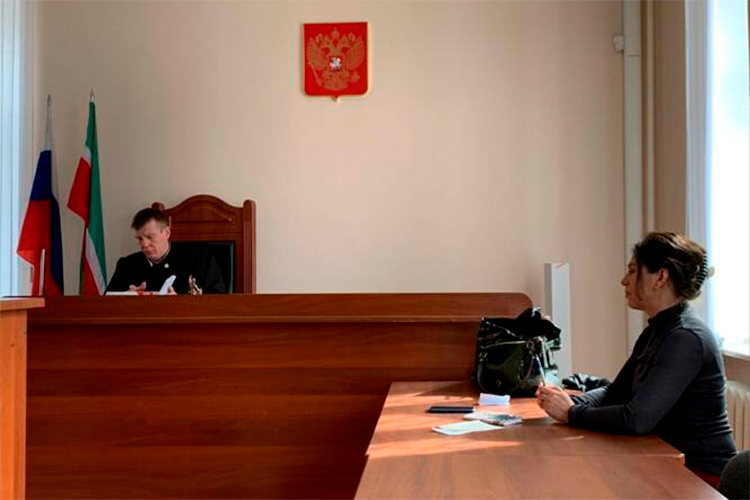
“Has Jesus Christ stopped by?” the assistant judge asked hopefully over the phone exactly one minute before the start of the trial.
“No, he hasn’t,” the bailiff replied with a grin.
The mood of the people in the courtroom was upbeat, despite the fact that the “appearance” of Christ before the Moscow District Court did not take place. Moshkova assured the court that the defendant had been notified in every possible way, but she herself, even before the hearing, had not actually believed that he would show up. “He’s a curious chap,” the assistant prosecutor said, adding that defendants themselves do not like to appear at such hearings, and jokingly condoned Christ by saying that Easter had not yet arrived.
The accused himself, as it turned out, had no clue about the hearing.“What case? And wait, if a court hearing has been scheduled, why the fuck was a notification and a summons not sent?!” said a perplexed Christ, whom Business Online was able to reach by telephone. After voicing his indignation, our source asked us to leave him alone. “I have done twenty years in prison. You’ve got the wrong number, good luck,” concluded Jesus.
Nevertheless, court-appointed defense lawyer Ksenia Matveeva told us that the defendant fully admits his guilt. He had even requested expedited consideration of the case, but because of his failure to appear, the process had to be postponed to the end of May.
“I order that the defendant be forcibly delivered to the next court hearing,” the presiding judge, Nikolai Zakharov said as he concluded the proceedings. “No one has ever walked away from the court yet,” he said, shrugging.
Source: Eva Malinovskaya, “‘He’s a curious chap’: how Kazan tried to put Jesus Christ on trial,” Business Online, 19 April 2025. Translated by the Russian Reader. Thanks to Sergey Abashin for the heads-up.
A 45-year-old Russian national named Jesus Petrovich Christ has gone on trial in Kazan for fictitiously registering foreigners in his apartment. Information on the upcoming court hearing was posted on the website of the city’s Moscow District Court.
The defendant fictitiously registered forty-four illegal immigrants in his one-room apartment, in violation of Article 322.3 of the Russian Federal Criminal Code. In fact, [none of the immigrants] lived in the apartment. Christ did not appear in court, so the hearing of his case did not take place.
According to law enforcers, Jesus Petrovich Christ has four previous convictions — for robbery, armed robbery, and theft.
According to local media, the defendant was given a different name at birth, but he changed his first name and surname after becoming interested in numerology. The man’s patronymic is real.
Source: “Jesus Christ accused of aiding illegal immigrants in Kazan,” Vesti.Ru, 19 April 2025. Translated by the Russian Reader. Thanks to Sergey Abashin for the link.
A Russian citizen named Jesus Petrovich Christ is being tried in Kazan on charges of fictitiously registering immigrants. A notice of the upcoming court hearing appeared on the website of Kazan’s Moscow District Court.

courtesy of Sergey Abashin
Jesus Christ is suspected of fictitiously registering forty-five illegal immigrants in his one-room apartment, in violation of Russian Federal Criminal Code Article 322.3. Despite receiving a summons to appear in court, the 45-year-old Russian national did not show up for the proceedings, and therefore the hearing of the case did not take place.
It is also known that the man was previously convicted several times — in 1994 and 1996, for robbery; in 1999, for armed robbery; and in 2007, for theft.
[…]
Source: Danila Titorenko, “Kazan court to hear case of Jesus Petrovich Christ, charged with aiding illegal immigrants,” Gazeta.Ru, 18 April 2025. Translated by the Russian Reader. Thanks to Sergey Abashin for the link.