
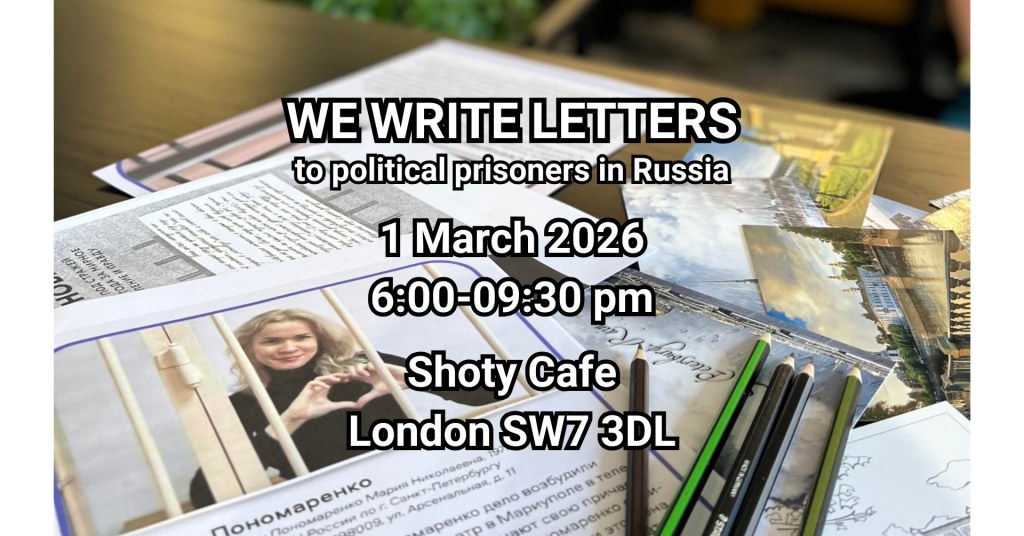
Hundreds have been unlawfully imprisoned by the Russian authorities for opposing the war and dictatorship.
Join us to write letters to Russia’s political prisoners and support them!
1 March 2026 (Sun), 6:00-09:30 pm • Shoty Georgian Cafe & Restaurant (upper ground), 30 Old Brompton Road, London SW7 3DL
No knowledge of Russian is required.
All materials and guidance will be provided.
Why do we write letters? In the words of Maria Ponomarenko, sentenced to six years in prison for anti-war posts:
I’ve already explained it multiple times that the letters are highly valuable to all of us who are unjustly imprisoned. But I’m ready to repeat it again and again, even 1000 times!
Your letters inspire us, give us strength and confidence that there will be a dawn and the changes are inevitable.
Your letters serve as a support — solid ground beneath our feet.
Your letters are uplifting and help distract us from the unpleasant realities of the Russian penitentiary system.
Write letters to political prisoners! Write, even in the absence of feedback!
The letters are also very important because they demonstrate to the authorities and other inmates that the political prisoner has support outside the prison and is not alone. That we have not been abandoned and have not been forgotten!
#RussiansAgainstWar #RussiansAgainstPutin
Source: Facebook. Thanks to News from Ukraine Bulletin for the heads-up.
Why it’s crucial
Political prisoners find themselves in physical, social and informational isolation. Thanks to the letters, prisoners feel supported and that they are not alone. In pre-trial detention centres, prisons and colonies, it is not often possible to find like-minded people, but letters give prisoners a chance to be heard and a much-needed connection with one another.
In addition, in prison a person quickly ceases to understand what is happening on the outside, so letters are also a way to stay informed about external events: they can be about big news or something less significant, but important for the political prisoner himself (for example, about changes in countries or what is happening in his work\interest spheres, and so on).
Finally, when prisoners receive regular letters, it is an indicator to prison and colony staff that the world outside is paying attention to them, so the risks of pressure are reduced.
This is safe
It is legal and safe to send letters to political prisoners. It is important to remember that all letters go through a censor, but if you follow certain rules you will be safe.
However, there is a list of topics to avoid.
– Do not write about war and combat, such letters will almost certainly not pass the censor.
– Do not write about the details of their criminal case: this may be a painful topic for discussion, but on the other hand, such correspondence may harm them legally.
– Do not write anything about LGBTQ+ people, as based on the history of cases this may harm the political prisoner in the eyes of homophobic prisoners and prison staff.
– Do not write direct insults to the authorities and their representatives or calls to overthrow the government.
– Avoid any topics related to what law enforcement agencies may consider extremism and terrorism.
– In addition, do not use obscure abbreviations, ciphers, foreign words – anything that the censor may not understand or find suspicious. Finally, do not use foul language in your letters.
Where to start
First, you need to decide who you want to write to. You can write to political prisoners whose stories you already know from the news, but it is important that not only media figures receive letters: there are many lesser-known prisoners who need support just as much. You can find their names and stories on our website (general list and religious list of political prisoners), and you can also find addresses where you can write to them. A great reason to start a correspondence would be, for example, a birthday greeting.
What to write about in the first letter
Introduce yourself and tell about your experiences, so that the political prisoner understands who he is communicating with. If you do not want to use your real name, you can sign with a pseudonym – the main thing is that your addressee can later recognize you among other interlocutors.
In an interview with Novaya Gazeta, Elena Efros – founder of the letter-writing project “Tales for Political Prisoners” says: “It’s just the way to write it, a standard text like: Hi, I learned about your case from the media or the Internet, do you want to correspond with me, if yes, what topics are interesting to you. And don’t worry – if you don’t get a reply, just write to someone else.”
How to send letters
The fastest way would be to send one online. Our colleagues from ‘Memorial France’ have launched a service for sending letters to political prisoners in Russia and Belarus.
The website itself is still only available in French, but you can write to political prisoners in different languages: French, English, Belarusian, Russian, and any other are also accepted for translation.
- Go to the Mémorial France website
- Choose any political prisoner from the lists of Mémorial or Viasna.
- Write a letter and paste it into the online form
- Our colleagues will translate the text and send it to the addressee
- When and if the inmate responds, they will send you their letter
The service has more detailed instructions for each step, as well as recommendations on what to talk about and what to avoid in letters.
You can also use one of the following services available in English:
- Letters Across Borders is an OVD-Info project to collect letters to Russian political prisoners in English (or other languages) and translate them for free. You can support the project with a donation.
- PrisonMail (payment with international bank cards)
In Russian:
- F-letter – payment by Russian bank cards only;
- ZT – payment by Russian card only, but the service works in more colonies;
- RosUznik – a volunteer project that sends letters in Russian for free or for a donation (you can write from abroad if you translate your letter yourself).
You can also send a paper letter and put something that will please the prisoner: photos, printed pictures, extracts from a magazine, herbarium and so on. You can put unsigned postcards so that the prisoner can send them to their loved ones. Please note that the weight of the letter mustn’t exceed 99 grams and letters in languages other than Russian are highly unlikely to reach the recipient.
Write legibly so that your handwriting can be understood by both the addressee and the censor. When sending a letter, put not only the address but also the full name of the institution on the envelope and write the year of birth after the addressee’s name. If you want a reply, put a blank sheet of paper, another envelope and stamps in the envelope with the letter.
To receive a reply letter, a reply form must be paid for. Usually, the censor sends a scan of the letter to the email address you specify, but it is worth bearing in mind that Prisonmail does not cooperate online with all colonies – then the website when you send the letter will say that you can only receive a reply in paper form.
Source: “How to write letters,” Memorial Human Rights Center Support Program for Political Prisoners
